
 By Yuvrajsinh Vaghela
Contents
Your users expect software that opens instantly in a browser, runs on any device, and never asks them to download anything. When an application fails that test, they abandon it and rarely come back.
For businesses, that expectation now drives real spending. The global web development services market is projected to grow from USD 80.6 billion in 2025 to USD 125.4 billion by 2030, according to Mordor Intelligence. Web apps are where customers, revenue, and daily work increasingly live.
The hard part is knowing what to build. Most business owners planning a web application cannot picture what a strong one looks like, which type fits their goals, or which features genuinely matter.
This guide solves that. We break down 10 popular web application examples, the features that make each one work, and the main types of web applications, so you can decide what to build with confidence. As an AI web development company serving clients across the USA and Canada, Monocubed has built feature-rich web applications for a wide range of industries. If you are planning an interactive web application, the examples below are the clearest place to start.
What Is a Web Application?
Before exploring the examples, it helps to be clear on what a web application actually is.
A web application is software that runs on a remote server and is delivered to users over the internet through a web browser, instead of being installed on a device. Unlike a static website that mainly displays information, a web application lets users actively interact with data: they can log in, create, edit, save, and share content in real time.
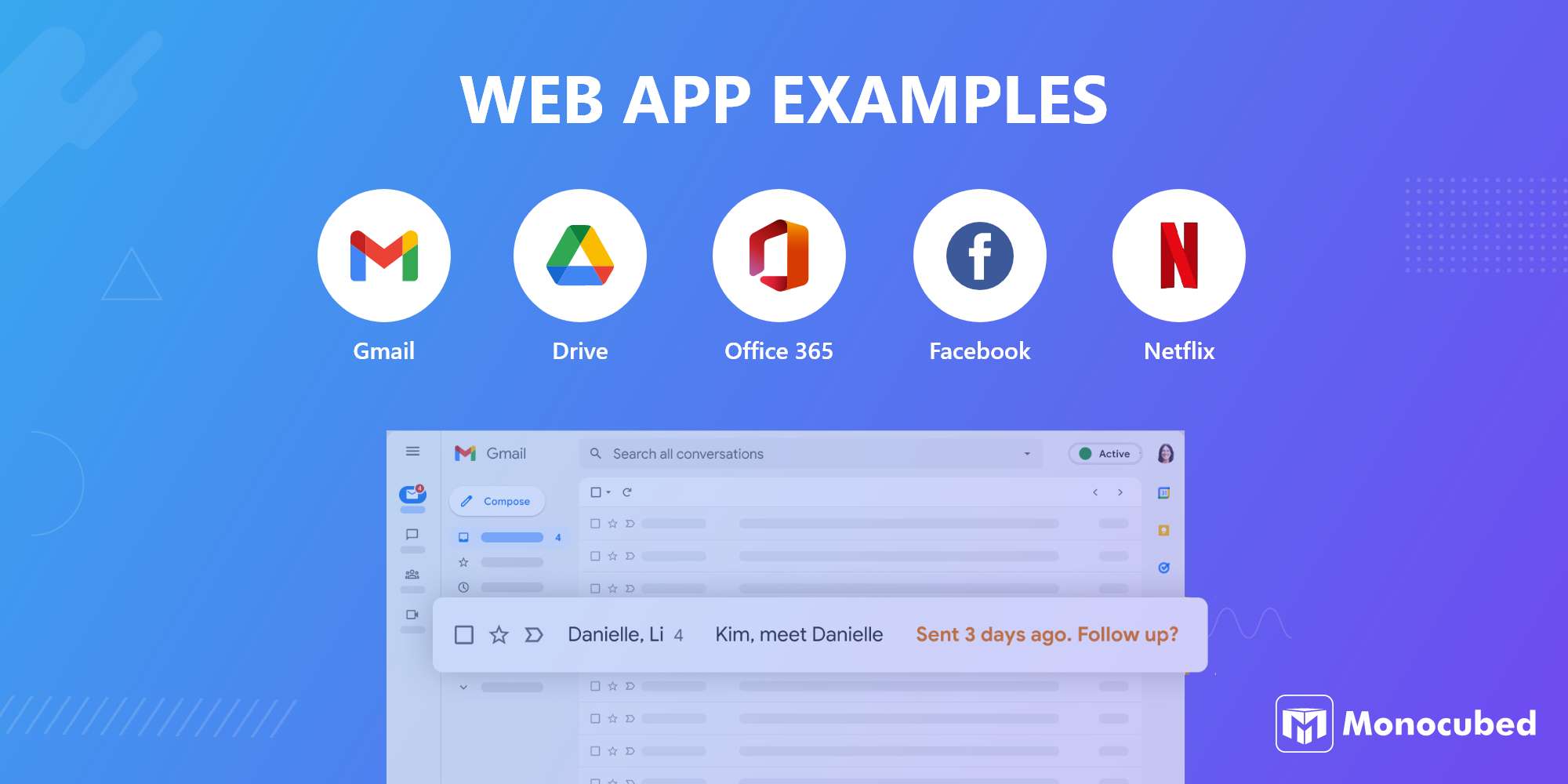
In short, a web app combines the reach of a website with the interactivity of installed software. Gmail, Microsoft Office 365, and Netflix are all examples of web applications you likely use every day. Businesses choose web application development when they need software that works on any device with a browser, with no app store and no installation required.
Types of Web Applications
With the definition clear, the next step is knowing how web applications are grouped, since each type suits a different goal. Most modern web apps fall into one of these categories:
- Static web apps deliver fixed content with little server-side processing, suited to simple, rarely changing pages.
- Dynamic web apps generate content in real time based on user requests and databases, like most dashboards and social platforms.
- Single-page applications (SPAs) load a single shell and update content without full page reloads for a fast, app-like feel. Gmail and Facebook work this way.
- Multi-page applications (MPAs) load a new page from the server for each action, common in large content and commerce sites.
- Progressive web apps (PWAs) behave like installed apps, with offline support and push notifications. If you need one, see our progressive web app development services.
- eCommerce web apps handle catalogues, carts, and payments for online stores.
- CMS web apps let non-technical teams publish and manage content without touching code.
- Portal web apps give defined user groups a secure login to personalised dashboards, built with web portal development.
Knowing these types of web applications makes it easier to decide which web app example below is closest to what your business needs.
Not Sure Which Type of Web App You Need?
Our architects help you match the right type of web application to your goals, then design and build it around your workflows, users, and budget.
Best Web Application Examples: Top Web Apps at a Glance
Now that you know the types, here are the web apps that bring them to life.
Below is a quick list of popular web application examples you already use, grouped by what they do. Each one is explained in detail, with its key features, in the next section.
| Web App | Category | What It Does |
|---|---|---|
| Gmail | Send, organise, and search email entirely in the browser | |
| Google Drive | Cloud storage | Store, sync, and share files across all your devices |
| Microsoft Office 365 | Enterprise productivity | Online Word, Excel, and PowerPoint with team collaboration |
| Social networking | Connect, post, and message people in real time | |
| Netflix | Video streaming | Stream on-demand movies and TV shows |
| Slack | Team communication | Organise team conversations into searchable channels |
| Trello | Project management | Track work visually with boards, lists, and cards |
| Canva | Graphic design | Create designs from templates without any installation |
| GitHub | Developer tools | Host code and collaborate on software development |
| Airbnb | Marketplace | Search, book, and manage stays in one platform |
10 Web App Examples: In-depth Explanations
Here is a closer look at each of the web app examples above, with the key features that make them work.
1. Gmail: Secured, Effective, and Easy-to-use Application
Gmail is one of the most sought-after email services across the globe. It has evolved extensively over the years. Gmail is a great example of a web application because its functionalities extend beyond just displaying the contents of the email.
Users can compose new mail and chat with other Gmail users through the application. The application also allows you to customise your inbox by labelling, filtering, deleting emails, and much more.
With one of the largest user bases of any email service worldwide, Gmail offers a way for its customers to access their email messages via IMAP or POP protocols securely.
Gmail has a modern Material interface that integrates well with other Google services. It is very effective at blocking spam. Gmail also has clever features like snoozing emails, sending emails with expiration dates, sending emails you can read with special codes, and requesting and sending money via Google Pay.
So, it might not be easy to imagine an online world without Gmail.
8 Features of Gmail Web Application
| Features | Description |
|---|---|
| Writes emails faster | The smart compose feature in Gmail assists users in writing faster emails. |
| Use email without internet | Gmail offers offline access to your emails. |
| Schedule an email | You can write an email and schedule delivery at a later time. |
| Increase the recall time from 5s to 30s | You can use the “undo send” email feature between 5 seconds and 30 seconds. |
| Gmail nudges | This feature helps you to remember to send replies to important emails. |
| Search | Since Gmail is an application, it provides a comprehensive search option with advanced search features. |
| Send attachments via Google Drive | This feature allows you to send emails up to 25MB in file size. |
| Create labels and organise the mailbox | Instead of creating folders, Gmail allows you to label your inbox and organise it in a better way. |
2. Google Drive: Cloud Storage and File Sharing Platform
Next in line with the best web app examples is Google Drive. It is a free cloud-based storage service. The service syncs stored documents, photos, and more across all users’ devices, including mobile devices, desktop computers, and tablets.
Google Drive is also a Progressive Web App. It integrates with the company’s other services, including Google Docs, Google Slides, Google Sheets, Google Workspace, Gmail, Android on mobile, Chrome, Google Analytics, and YouTube. Google Drive has its competitors in Apple iCloud, Dropbox, and Microsoft OneDrive.
The majority of users access Google Drive via its web app. Its mobile apps for Android and iOS allow users to store, share, and view files. Google Drive offers free storage to every user, with paid plans for extra space. The enterprise version offers more storage, management controls for IT administrators, APIs to connect with existing business applications, and extra technical support from Google.
Google Drive is encrypted with the TLS standard before it leaves a user’s device and uploads to Google Cloud, then encrypted again at rest. It supports two-factor authentication. To develop Google Drive-type web apps, you need to know the best web app frameworks for web development.
8 Features of Google Drive Web Application
| Features | Description |
|---|---|
| Team collaboration | Collaborate with others on spreadsheets, documents, slides, and drawings. Up to 50 people can work on the same file simultaneously, using any device, from any location. |
| Share with people outside your organisation | Files and folders can be shared with up to 200 email addresses for viewing, suggesting, or editing, including addresses outside your organisation. |
| Advanced search | Google Drive allows advanced search options with useful search strings. |
| Drag and drop uploads | You can drag and drop files for automatic upload. |
| Mobile app to scan directly to your drive | Scan an image with your mobile camera and upload it straight to your drive. |
| Starred folders and files | Star-mark your files to access them quickly from the starred folder. |
| Automatically convert uploaded files to Google Docs editor format | Convert your uploaded files into an editable format. |
| View any type of file | View multiple file types, including videos, Microsoft files, PDFs, and several image file types. |
3. Microsoft Office 365: Provides the Best Productivity Experience
Microsoft Office 365 is a web application that allows enterprise solutions to be adopted by any organisation. The most popular Microsoft Office applications are Excel, Word, PowerPoint, OneNote, Access, Publisher, and Outlook.
There are more than 30 web applications under the Microsoft Office 365 umbrella, including SharePoint, Exchange Server, OneDrive, Power BI, Yammer, and Microsoft Teams.
Microsoft Office for the web is an online version of the Microsoft Office Suite. It provides global access to Microsoft Office solutions. You do not have to install Office on your desktop computer. The Office web apps are hosted and executed at Microsoft data centres.
The application can be used entirely over the internet with a supported web browser. Documents created using these applications can be saved in OneDrive or downloaded for offline viewing and stay compatible with current Microsoft Office file formats.
To use Microsoft Office 365, users need a valid Microsoft account, such as an Outlook.com address, to access these applications.
8 Features of Microsoft Office 365
| Features | Description |
|---|---|
| Secure data storage | You can securely store up to 1TB of data on OneDrive. |
| Company-wide licensing | With Microsoft 365, a single licence fee covers the software solutions. This is particularly useful for small business owners. |
| Market-leading word processor | You can use Microsoft Word, one of the most widely used word processing tools. |
| Ideal for dispersed teams | You can work on complex tasks collaboratively since all the Microsoft apps are in one place. |
| Excellent email facilities | Includes Microsoft Outlook, a popular email client that comes as part of Microsoft 365. |
| Strong cyber security | Microsoft provides security through Microsoft Defender, and you can add password protection on files and folders. |
| Mobile and web accessibility | There are mobile apps and web applications for all core products. Each user can connect several Android or iOS mobile devices. |
| Presentation tools | Create professional business presentations and use interactive tools in Microsoft PowerPoint. |
4. Facebook: Connect With Friends & Family Easily
As a social networking service and online social media, Facebook is one of the best examples of a web application. You can access it from anywhere with an internet connection, such as mobile web, mobile apps, and web browsers.
Facebook allows people from different places, ethnicities, backgrounds, and classes to connect with one another worldwide. Users can create an online profile and keep in touch with others through messages or by sending virtual gifts or invitations.
Social media is a good example of a highly interactive web application. Facebook is a remarkable tool for giving engaging experiences to its users.
Facebook’s web interface, accessed at facebook.com, is a genuine web application that runs entirely in the browser. Its mobile apps are separate, fully native applications: Facebook publicly moved away from an earlier hybrid HTML5 approach to native mobile development for better performance. To develop a web app like Facebook, it is necessary to know the best backend frameworks for easier web development.
So, is Facebook a web app? Yes. The Facebook.com interface is a web application you use in any browser, while its phone apps are native, which is why it is one of the most cited web application examples.
8 Features of Facebook Web Application
| Features | Description |
|---|---|
| Organise your list | This feature allows you to organise your friends list and see posts from the selected category. You can also send posts to selected groups. |
| Groups | This feature helps you to grow a community interested in your products and services. It is a great marketing tool for growing a business. |
| Messages | The Messenger bot feature helps you talk to your subscribers and can support direct customer conversations at scale. |
| Royalty-free music | This feature allows you to use music for videos or posts without worrying about copyright infringement. |
| Live streaming to multiple pages | Considered a useful feature, it allows you to live stream to multiple pages, called cross-promoting. It allows collaboration with other pages and boosts your branding. |
| Legacy contact | Similar to a will, this feature allows a Facebook user to permit one person to operate the account when the user is gone. |
| Scrapbooking | This feature allows parents to create scrapbook albums for their children. |
| Notification to members | Group admins can directly notify a user about various situations through this feature. |
5. Netflix: On-Demand Video Streaming Platform
Netflix, one of the top video streaming platforms, is also a subscription-based web application. It serves hundreds of millions of paid members across more than 190 countries. The platform provides internet entertainment services for watching movies and television shows.
It is accessible across various devices and operating systems, as with other web apps. Netflix is also available as a mobile app. The company illustrates how a web app can be a great example of an ideal content platform.
Over the years, Netflix has become the one-stop shop for much of our entertainment, and you can say that Netflix brought about a “streaming revolution.”
5 Features of the Netflix Web Application
| Features | Description |
|---|---|
| Discover more | This feature allows viewers to watch shows or series similar to the ones they were watching. |
| Surprise me | This feature helps you when you are unsure about what to watch. |
| Kids mystery box | With this feature, you can discover age-appropriate movies to watch. |
| Top 10 | This feature allows you to watch the top 10 trending films. |
| Global top 10 list | Through this feature, you can watch the top 10 content globally. |
Want to Build a Web App People Rely On?
From streaming platforms to dashboards, we build custom, scalable web applications for your industry, handling design, development, and launch with a team that fits your roadmap.
6. Slack: Team Communication and Collaboration
Slack is one of the best-known web applications for workplace communication. It replaced scattered email threads with organised, searchable conversations that run entirely in the browser, with no installation.
Work is organised into channels for each team, project, or topic, alongside direct messages and threaded replies. Slack also connects with tools such as Google Drive and GitHub, so their updates arrive automatically in the relevant channel.
For larger organisations, Slack adds single sign-on, data retention, and compliance controls. It works as a web, desktop, and mobile experience, and the browser version is fully featured.
8 Features of the Slack Web Application
| Feature | Description |
|---|---|
| Channels | Organise conversations by team, project, or topic so the right people see the right messages. |
| Direct messages | Hold private one-to-one or small-group conversations outside public channels. |
| Huddles | Start an instant audio or video call inside any channel or direct message. |
| Threaded replies | Keep a focused discussion attached to a specific message without disrupting the channel. |
| Search | Find past messages, files, and decisions across the entire workspace. |
| App integrations | Connect tools such as Google Drive, GitHub, and Jira so updates post automatically. |
| Workflow Builder | Automate routine requests and notifications without writing code. |
| Enterprise controls | Apply single sign-on, data retention, and compliance settings for larger teams. |
7. Trello: Visual Project Management
Trello is a web application that manages work visually using boards, lists, and cards. It is a clear example of a single-page web app, where actions update instantly without reloading the page.
Teams use a board for a project, lists for stages, and cards for tasks. Cards move across lists as work progresses, and each card holds checklists, due dates, labels, attachments, and comments, so files and discussions stay with the work.
Trello extends through Power-Ups and Butler automation, which trigger rules without code and connect them with tools such as Slack and Google Drive. It runs in any browser and syncs in real time across devices.
8 Features of Trello Web Application
| Feature | Description |
|---|---|
| Boards | A dedicated workspace for a project or team. |
| Lists and cards | Represent stages and individual tasks that move as work progresses. |
| Checklists | Break a card into trackable subtasks. |
| Due dates | Keep deadlines visible with reminders. |
| Labels and filters | Categorise cards and find them quickly. |
| Attachments and comments | Keep files and discussion on the relevant card. |
| Butler automation | Trigger rules and scheduled actions without code. |
| Power-Ups | Add integrations with tools such as Slack, Google Drive, and calendars. |
8. Canva: Browser-Based Graphic Design
Canva is a design web application that brought professional design within reach of people who are not designers. Everything runs in the browser with no software to install, which makes it a popular example of what a modern web app can replace on the desktop.
Users start from a large template library and customise designs with a drag-and-drop editor, using built-in photos and icons without leaving the page. Teams can edit and comment on the same design in real time, while a Brand Kit keeps logos, colours, and fonts consistent.
Beyond static graphics, Canva creates presentations, documents, and short videos, and exports to formats such as PNG, JPG, PDF, and video so the output is ready for any channel.
8 Features of the Canva Web Application
| Feature | Description |
|---|---|
| Template library | Start from professionally designed layouts for almost any use. |
| Drag-and-drop editor | Build designs visually with no design background required. |
| Brand Kit | Store logos, colours, and fonts for consistent output. |
| Stock content | Use photos, icons, and illustrations from inside the editor. |
| Presentations and video | Create more than static graphics within the same tool. |
| Real-time collaboration | Edit and comment on the same design with teammates. |
| Folders and sharing | Organise assets and control team access. |
| Multi-format export | Download as PNG, JPG, PDF, or video for any channel. |
9. GitHub: Code Hosting and Collaboration
GitHub is a web application that software teams use to host code and collaborate on it. It is a frequently cited web app example because it runs developer workflows that were once desktop-only, such as version control and code review, entirely in the browser.
Code lives in repositories that track every change. Developers propose updates through pull requests, where teammates review specific lines and approve changes before they merge. Issues track bugs and tasks, and project boards show what is in progress.
GitHub Actions automates testing and deployment, and an API connects external tools. It scales from individuals to large organisations with granular permissions and two-factor authentication, and works on web, desktop, and mobile.
8 Features of GitHub Web Application
| Feature | Description |
|---|---|
| Repositories | Store and version code and project files. |
| Pull requests | Propose, discuss, and merge changes with review. |
| Code review | Comment on specific lines before code ships. |
| Issues | Track bugs, tasks, and feature requests. |
| Project boards | Plan work in a Kanban-style view. |
| GitHub Actions | Automate testing and deployment pipelines. |
| API and integrations | Connect external tools and build custom workflows. |
| Access controls | Use organisations, granular permissions, and two-factor authentication. |
10. Airbnb: Online Marketplace Web App
Airbnb is a marketplace web application that connects hosts who list accommodation with travellers who book it. It is a strong example of a transactional, data-driven web app, because one platform handles discovery, payment, and trust for users worldwide.
Guests search and filter listings by location, dates, price, and amenities, browse them on a map, and reserve instantly or request the host first, with all coordination in built-in messaging. Payments and host payouts run through a protected system, and a two-way review model keeps quality visible.
Hosts get a dashboard to manage listings, calendars, and pricing, while guests see personalised recommendations based on activity. Airbnb runs as a responsive web app alongside native mobile apps.
8 Features of the Airbnb Web Application
| Feature | Description |
|---|---|
| Search and filters | Find stays by location, dates, price, and amenities. |
| Map view | Browse available listings geographically. |
| Instant and request booking | Reserve a stay directly or ask the host first. |
| In-app messaging | Communicate with hosts before and during a trip. |
| Secure payments | Pay and receive payouts through a protected system. |
| Reviews and ratings | Build trust with a two-way review model. |
| Host dashboard | Manage listings, calendars, and pricing. |
| Personalised recommendations | Surface relevant stays based on user activity. |
Advantages and Disadvantages of Web Apps
Now that you have seen the examples, it is worth weighing what web apps do well and where they fall short. Knowing both sides upfront helps you decide whether a web app is the right fit for your business before you invest in development.
| Advantages | Disadvantages |
|---|---|
| Cost-effective solution, accessible through a uniform web browser environment. | Dependent on an internet connection. |
| 24/7/365 accessibility from anywhere and via any computer system. | Web apps are completely dependent on websites. |
| Provides high-level security since they are deployed on dedicated servers. | Often operate at a relatively low speed compared to mobile apps. |
| Scalable, since increasing processor capacity is far simpler in web-based applications. | Generally lack quality control features. |
| Designed to support multiple operating systems. | As non-native software, they sometimes fail to work with all hardware and operating systems of a specific device. |
| Increases efficiency and simplifies work. | |
| Easily integrated with third-party software. | |
| Capable of handling sudden increases in traffic. | |
| Always updated in the background, with no manual updates. |
Want to know other advantages of web apps? Here is a complete guide on the pros of web apps.
Need a Skilled Team to Build Your Web App?
Our experienced developers pick the right frameworks and tools for your project and build a web application that fits your goals, timeline, and budget.
When Should You Develop a Web Application?
With the pros and cons in mind, the next step is deciding whether a web app is the right fit for your project.
This is an important question to answer, but you would know what to provide for your business. Depending on your business format and online presence, you can choose to have a web app, a mobile app, or both.
You can choose web apps when:
- You want to run your business application on multiple platforms regardless of the operating system or the device, as long as the web browser is compatible.
- All your users access the same version, eradicating any compatibility issues.
- Your web app is not installed on the hard drive, thus removing space limitations.
- You want to bring down software piracy in subscription-based web applications.
- You want to reduce costs for both the business and your users. Web apps require less support and maintenance by the business and even fewer resources for the end-user device.
Build Your Next Web Application with Monocubed
Web applications power the tools that businesses and customers use every day, from email to commerce. The examples above show what a strong one looks like and the choices, type, features, and technology that decide whether people rely on it.
Web applications are core to what Monocubed does. Over 6+ years, our team of 50+ developers has shipped 200+ custom projects, so we have met most of the decisions you will face long before your app goes live.
We build web applications with React, Angular, Node.js, Django, and Laravel, from single-page apps to PWAs, portals, SaaS platforms, and AI-driven web solutions. That work spans 100+ clients, delivered through ISO 9001 processes with 98% client satisfaction and 99.9% uptime.
Ready to develop a web application that fits your business? Tell us about your project, and we will put together a clear plan with a transparent cost breakdown. Schedule a free consultation with our experts to get started today.
Frequently Asked Questions About Web Applications
-
What is the difference between a web app and a website?
A website mainly displays information and looks the same for every visitor. A web app is interactive: users log in and act on their own data, so each person sees a different experience. This is why Facebook and Gmail are web applications, not just websites. Most web based applications combine the reach of a website with the function of installed software. -
What are the main types of web applications?
The main types of web applications are static, dynamic, single-page applications, multi-page applications, and progressive web apps. Beyond these, eCommerce, CMS, and portal apps cover common business needs. Most popular web apps fall into one of these groups, so knowing the types of web applications helps you choose the right type and budget before development begins. -
What are some examples of web applications?
Common web application examples include Gmail, Google Drive, Microsoft Office 365, Facebook, and Netflix, plus Slack, Trello, Canva, GitHub, and Airbnb. Each runs in a browser and handles real tasks like email, storage, design, or booking. These examples of web applications span email, collaboration, streaming, and marketplaces, which shows how broad modern web apps have become. -
How much does it cost to develop a web app?
The cost to develop a web app typically varies from about $20K to $70K, depending on features, integrations, and complexity. A simple web application costs less, while a feature-rich platform costs more. Web application development pricing also depends on the team and timeline, so it is best to request a tailored estimate after a discovery call. -
How do web apps work?
A web app works by splitting tasks between your browser and a remote server. The browser sends your request, the server processes it, queries a database, and returns the result, which the web application renders on screen. This client-server model lets web apps update data in real time without any installation, which is why most modern web applications run this way. -
What are the benefits of using a web application for business?
A web application reaches users on any device with a browser, with no app store or installation, so it is faster to launch and update. It lowers support costs, scales with demand, and keeps everyone on the same version. These benefits are why many businesses choose a web app over desktop software, and why popular web apps dominate daily work. -
How long does it take to develop a web app?
The time to develop a web app usually ranges from a few weeks for a simple tool to several months for a feature-rich platform. Timelines depend on the number of features, integrations, and the type of web application you need. Web application development moves faster with a clear scope, so a discovery phase helps set a realistic schedule. -
What programming languages are used to build web apps?
Web apps are usually built with JavaScript and frameworks such as React, Angular, or Vue on the front end. On the back end, web application development commonly uses Node.js, Python, PHP, or Ruby, with databases like PostgreSQL or MongoDB. The exact stack depends on the type of web application, its scale, and the features you need.

 All our projects are secured by NDA