
 By Yuvrajsinh Vaghela
Contents
Choosing the wrong patient portal development partner can result in HIPAA violations, security breaches, poor patient adoption, and wasted investment. With healthcare regulations becoming stricter and patient expectations rising, the stakes have never been higher.
Security and compliance risks remain a major concern. Healthcare continues to be one of the most targeted industries for cyberattacks. The report from IBM found he report from IBM found that the global average cost of a data breach reached $4.4 million, highlighting the growing financial risk and the need for secure architecture and compliance-driven development
To help healthcare organizations make informed decisions, we analyzed 40+ patient portal development companies based on their technical capabilities, regulatory compliance expertise, client portfolios, scalability of solutions, and proven track record in delivering secure patient engagement platforms.
In this article, you’ll discover:
- A quick comparison table of leading patient portal developers
- Detailed company profiles with pricing, tech stack, and specializations
- Key selection criteria to evaluate potential partners
- Essential features every patient portal must include
- The complete development process from discovery to launch
Let’s dive into the leading web portal development companies that help you build a scalable and secure patient portal for your healthcare organization.
Quick Glance at Top Patient Portal Development Companies
Before we explore each patient portal development agency in detail, here’s a snapshot comparison to help you quickly identify potential matches for your project.
| Company | Hourly Rate | Location | Specialization |
|---|---|---|---|
 Monocubed Monocubed | $25 – $49/hr | Mesa, AZ, USA | Custom HIPAA-Compliant Portals |
 ScienceSoft ScienceSoft | $50 – $99/hr | USA, Europe | EHR Integration Specialists |
 eClinicalWorks eClinicalWorks | Custom Pricing | USA | Cloud-Based Patient Engagement |
 Bitcot Bitcot | $50 – $99/hr | USA | Healthcare Analytics Portals |
 Itransition Itransition | $50 – $99/hr | USA, Europe | Enterprise Healthcare Systems |
 BairesDev BairesDev | $50 – $99/hr | Latin America | HL7/FHIR Compliant Solutions |
 Intellectsoft Intellectsoft | $50 – $99/hr | USA, Europe | AI & Blockchain Healthcare |
The Patient Portal Your Clinic Needs Is Just One Click Away
From scheduling to telehealth, Monocubed builds fully integrated portals that streamline operations and improve care.
This table gives you a high-level view, but choosing the right patient portal development partner requires deeper evaluation. Let’s look at how we assessed these companies.
How We Evaluated These Patient Portal Development Companies
Not all web development companies are created equal. To ensure our recommendations are trustworthy, we developed a rigorous evaluation framework for assessing capabilities of the agency while outsourcing patient portal development services.
Our assessment methodology focused on these critical factors:
1. HIPAA compliance expertise
We evaluated each company’s depth of knowledge in healthcare regulations, including HIPAA, HITECH, and applicable state-level compliance requirements.
Companies demonstrating structured compliance frameworks, documented security protocols, and proven experience working under Business Associate Agreements (BAAs) received higher rankings. This ensures they can safely manage Protected Health Information (PHI) while minimizing regulatory risk.
2. Technical capabilities and interoperability expertise
We assessed each provider’s proficiency in implementing healthcare interoperability standards such as HL7, FHIR, and CCD/C-CDA. Special attention was given to their experience integrating with major EHR/EMR platforms, building scalable architectures, and leveraging modern technology stacks capable of supporting secure and high-performance patient engagement platforms.
3. Portfolio and product quality assessment
We analyzed completed patient portal development projects to evaluate functional depth, usability, scalability, and security implementation. Our review focused on real-world performance indicators such as patient usability, provider workflow alignment, and the ability to support complex healthcare ecosystem integrations.
4. Client testimonials and reviews
We examined authentic client feedback from trusted review platforms such as Clutch, GoodFirms, and G2. This helped us evaluate delivery reliability, communication transparency, technical expertise, and overall client satisfaction across healthcare organizations of varying sizes.
5. Post-Launch maintenance and support
Patient portals require continuous monitoring, feature enhancements, and regulatory updates. We assessed each company’s maintenance models, SLA commitments, response times, and ability to support ongoing compliance, performance optimization, and security upgrades.
With this evaluation framework in place, let’s examine each patient portal development company in detail to help you find your ideal firm that turns your patient needs into a centralized platform.
Detailed Overview of Top 7 Patient Portal Development Companies
Now that you understand our evaluation criteria, let’s take a closer look at each company. We’ve compiled comprehensive profiles covering their strengths, services, pricing, and what makes them stand out in the patient portal development space.
1. Monocubed
| Aspects | Details |
|---|---|
| Hourly Rate | $50–$99/hr |
| Location | Mesa, AZ, USA |
| Team Size | 50–249 |
| Founded | 2019 |
| Min. Project Size | $25,000+ |
| Industries Served | Healthcare, Fintech, eCommerce, Education, Real Estate |
| Tech Stack | React, Node.js, Python, Flutter, AWS, Azure |
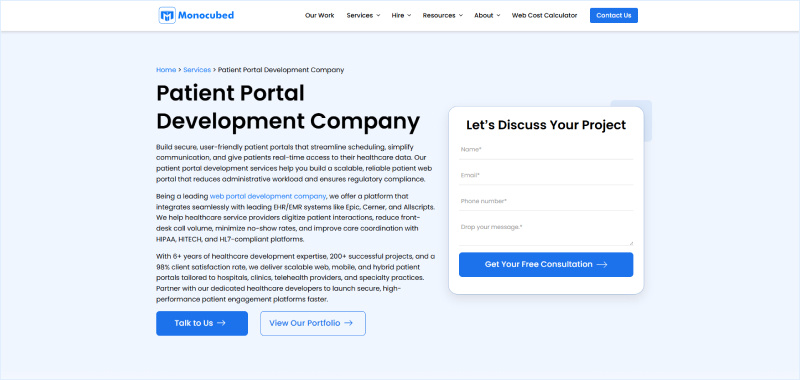
Monocubed is a trusted web portal development agency that creates secure, scalable, and user-centric digital solutions for businesses across industries such as healthcare, fintech, education, and logistics. They specialize in building high-performance web platforms, portals, and applications that streamline workflows, enhance user engagement, and support long-term growth.
This patient portal development company specializes in building HIPAA-compliant patient engagement platforms with seamless EHR integration. Their team has hands-on experience integrating with Epic, Cerner, Allscripts, and Meditech using HL7 FHIR standards, ensuring bi-directional data flow between patient-facing applications and clinical systems.
What sets Monocubed apart
Monocubed combines deep technical expertise with a patient-centric approach to deliver healthcare solutions that truly make a difference. Their UX specialists perform patient journey mapping and usability testing to design intuitive interfaces that encourage adoption—even among less tech-savvy users. With dedicated project managers ensuring transparent communication throughout the project, Monocubed has consistently achieved a 98% client satisfaction rate.
Explore Monocubed’s client success story:
Monocubed developed a fully functional custom telehealth platform called MedCall Advisors to simplify access to emergency medical care and telemedicine services across the United States.
Designed for workers’ compensation programs, brokers, third‑party administrators, and employers, the platform enables users to connect with emergency medicine physicians via live audio and video consultations, helping patients access timely care without the need for in‑person visits.
MedCall’s web portal and mobile access allow insured employees to receive prompt consultations, while administrators can manage physicians, patient records, and worker’s compensation data from a centralized dashboard.
This was one of Monocubed’s client success stories, where the agency developed a custom patient portal to streamline healthcare workflows and enhance patient engagement. Let’s see what other healthcare organizations say about Monocubed’s patient portal development services.
What clients say about Monocubed
“Monocubed understood our clinical workflows from day one. They didn’t just build software — they transformed how our patients interact with us.”
— Operations Director, Regional Healthcare Network
Save Hours — Partner with an Experience Web Portal Development Team
Monocubed helps you build custom portals for your healthcare organization, including patient portals based on your patient needs and organization expectations.
2. ScienceSoft
| Aspects | Details |
|---|---|
| Hourly Rate | $50 – $99/hr |
| Location | McKinney, Texas, USA |
| Team Size | 250-999 |
| Founded | 1989 |
| Min. Project Size | $5,000+ |
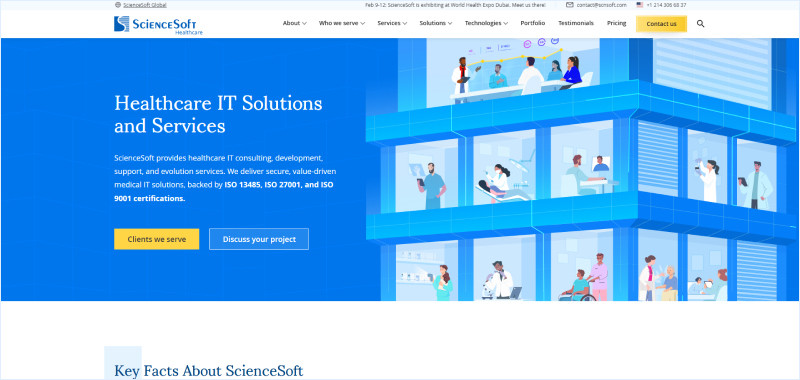
ScienceSoft is an ISO 9001, ISO 27001, and ISO 13485 certified healthcare IT consulting and software development company with more than 35 years of industry experience. Founded in 1989, the company has grown into a global technology partner with a team of 750+ IT professionals delivering enterprise-grade digital health solutions.
ScienceSoft is recognized for its strong capabilities in patient portal integration and interoperability. The company helps healthcare organizations develop and modernize patient portals that seamlessly connect with leading EHR platforms such as Epic, Cerner, Meditech, and athenahealth.
Their web portal development solutions enable secure, bi-directional data exchange that improves care coordination, enhances patient engagement, and supports regulatory compliance.
3. eClinicalWorks
| Aspects | Details |
|---|---|
| Hourly Rate | Custom Pricing |
| Location | Westborough, Massachusetts, USA |
| Team Size | 5000+ Employees |
| Founded | 1999 |
| Min. Project Size | Custom |
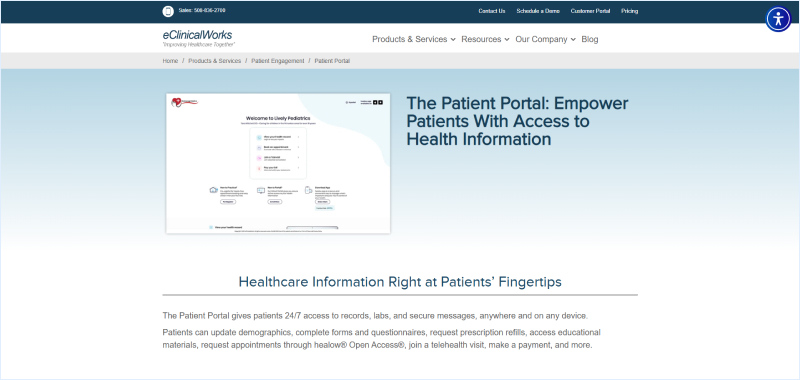
eClinicalWorks is a major healthcare IT company with over 25 years of experience serving 850,000+ medical professionals across the United States. Since 1999, their Healow patient engagement platform has become one of the most widely adopted cloud-based patient portal solutions, fully integrated with their comprehensive EHR system.
This healthcare technology company offers a turnkey patient portal development solution through their Healow platform. Features include appointment scheduling, secure messaging, telehealth, lab results viewing, and population health management—all available out-of-the-box without custom development.
4. Bitcot
| Aspects | Details |
|---|---|
| Hourly Rate | $25 – $49/hr |
| Location | San Diego |
| Team Size | 50 – 249 |
| Founded | 2011 |
| Min. Project Size | $25,000+ |
Bitcot is a web and mobile app development company with over 13 years of experience delivering custom digital solutions across multiple industries, including healthcare. Founded in 2011, the company specializes in building secure, scalable, and compliance-ready applications tailored to modern business needs.
Within the healthcare sector, Bitcot develops HIPAA and GDPR-compliant patient engagement solutions, including patient portals designed to improve communication, care coordination, and service accessibility.
Their healthcare applications often incorporate analytics dashboards, reporting tools, and cloud-based infrastructure that enable providers to track patient engagement trends and optimize operational workflows.
5. Itransition
| Aspects | Details |
|---|---|
| Hourly Rate | $25 – $49/hr |
| Location | London England |
| Team Size | 1000-9999 |
| Founded | 1998 |
| Min. Project Size | $25,000+ |
Itransition is a Clutch-awarded enterprise software development company with over 26 years of experience and a global team of 3,000+ professionals. Since 1998, they have been recognized as “Best Software Development Company 2024” by Clutch, delivering mission-critical healthcare solutions for enterprises including Expedia, Toyota, and major hospital networks.
This patient portal development company specializes in enterprise-scale implementations requiring sophisticated architecture and extensive multi-system integrations. Their expertise includes legacy modernization, healthcare data migration, and complex EHR connectivity for large health systems.
6. BairesDev
| Aspects | Details |
|---|---|
| Hourly Rate | $50 – $99/hr |
| Location | San Francisco |
| Team Size | 1000-9999 |
| Founded | 2009 |
| Min. Project Size | $50,000+ |
BairesDev is a top-tier software development company with over 15 years of experience and a rigorously screened team representing the top 1% of tech talent. Since 2009, over 500+ companies including Google, Pinterest, and Rolls-Royce have relied on their nearshore development expertise to accelerate digital health initiatives with HL7/FHIR-compliant patient engagement platforms.
As a patient portal development service provider, they offer flexible engagement models that allow healthcare organizations to augment their in-house teams or create dedicated development squads. As a nearshore partner specializing in healthcare interoperability standards, they ensure agile project management and responsive communication.
7. Intellectsoft
| Aspects | Details |
|---|---|
| Hourly Rate | $50 – $99/hr |
| Location | Miami, FL |
| Team Size | 50-249 |
| Founded | 2007 |
| Min. Project Size | $50,000+ |
Intellectsoft is an innovation-focused digital transformation company with over 17 years of experience delivering cutting-edge solutions for industry leaders. Since 2007, they have served enterprises including Universal, Harley-Davidson, and major healthcare organizations seeking competitive differentiation through AI, blockchain, and predictive analytics.
They are a leading web portal development firm, specializing in incorporating machine learning algorithms, blockchain-secured health records, and AR/VR capabilities for patient education. Their innovation-first approach helps healthcare organizations leverage emerging technologies to improve outcomes.
Now that you’ve seen the best patient portal development companies, how do you decide which one is right for your project? The next section outlines the key criteria you should evaluate.
Key Selection Criteria to Choose the Right Patient Portal Development Company
Identifying the top patient portal development agencies is just the first step. Selecting the right patient portal development partner requires evaluating them against criteria specific to your organization’s needs. Here are the five most critical factors to consider.
1. Does the company understand healthcare compliance?
HIPAA compliance is mandatory for building a web portal for patient care and needs. A single data breach can result in fines up to $1.5 million per violation category and irreparable reputation damage.
What to examine:
- Ask for their HIPAA compliance documentation
- Verify experience with Business Associate Agreements (BAA)
- Check if they conduct regular security audits
- Review their data encryption standards
- Understand their incident response procedures
Red flags:
- No dedicated compliance officer or team
- Vague answers about HIPAA requirements
- No documented security protocols
- Unwillingness to sign a BAA
Monocubed’s commitment: We maintain comprehensive HIPAA compliance protocols, sign BAAs with all healthcare clients, and conduct quarterly security audits on all patient portal development deployments.
2. Can they integrate with your existing EHR system?
Seamless EHR integration is crucial for patient portal development success. Without it, staff must manually duplicate data entry, creating inefficiencies and potential errors.
What to examine:
- Experience with your specific EHR (Epic, Cerner, Allscripts, etc.)
- Knowledge of HL7 FHIR and other interoperability standards
- Past integration projects and their complexity
- Approach to handling API limitations
- Data synchronization strategies
Red flags:
- No experience with healthcare interoperability standards
- Inability to provide integration case studies
- Over-promising on timeline for complex integrations
Monocubed’s Commitment: Our specialists have hands-on experience on patient portal integration with Epic, Cerner, Allscripts, Meditech, and NextGen. We use HL7 FHIR standards and provide detailed integration documentation for every patient portal development project.
3. Do they prioritize user experience and adoption?
A technically perfect portal means nothing if patients don’t use it. Industry data shows average patient portal adoption rates between 30-50%—poor UX is often the culprit.
What to examine:
- UX design portfolio specific to healthcare
- Accessibility compliance (WCAG 2.1)
- Mobile responsiveness and native app capabilities
- User testing methodologies
- Patient onboarding strategies
Red flags:
- No dedicated UX/UI design team
- Healthcare interfaces that look like enterprise software
- No mobile-first approach
- Inability to show patient-facing design work
Monocubed’s Commitment: Our healthcare design services conduct patient journey mapping, usability testing with real users, and design interfaces that meet WCAG 2.1 accessibility standards for every patient portal development engagement.
4. What’s their pricing model ?
Budget overruns are a common challenge in healthcare software projects. By understanding the full cost picture, including development, post-launch maintenance, and ongoing enhancements, you can avoid financial surprises and ensure a smoother patient portal development journey.
What to examine:
- Transparent pricing breakdown
- Licensing vs. custom development costs
- Hosting and infrastructure expenses
- Ongoing maintenance and support fees
- Compliance audit costs
Red flags:
- Significantly lower pricing than competitors
- Hidden fees revealed later in the process
- No clear maintenance pricing
5. What post-launch support do they provide?
Patient portals require ongoing maintenance for security patches, compliance updates, and feature enhancements. A patient portal development partner who disappears after launch leaves you vulnerable.
What to examine:
- SLA (Service Level Agreement) terms
- Response times for critical issues
- Security patch deployment process
- Compliance update handling
- Feature enhancement roadmap
Red flags:
- No formal support agreement
- Vague SLA terms
- No dedicated support team
- Outsourced support to third parties
Monocubed’s commitment: We provide tiered support packages with guaranteed response times, proactive security monitoring, and quarterly compliance reviews for all patient portal development clients.
With selection criteria covered, let’s look at what features your patient portal must include to meet both patient and provider needs.
Monocubed – Your Trusted Patient Portal Development Partner
Choosing the right patient portal development company is crucial for patient satisfaction, operational efficiency, and regulatory compliance. Partnering with a team that understands healthcare workflows and delivers secure, scalable solutions makes all the difference.
At Monocubed, we specialize in custom patient portal development that combines technical expertise with deep healthcare domain knowledge. Our solutions ensure HIPAA compliance, seamless EHR integration, and patient-centric designs that drive engagement and streamline care delivery.
We have successfully delivered numerous portals for healthcare organizations, helping improve workflows and enhance patient experiences.
Whether you’re building a portal from scratch, upgrading an existing system, or adding new features, Monocubed guides you through every stage with transparency, agile practices, and long-term support.
Schedule a free consultation with us to develop and deliver a compliant, patient-friendly portal that drives engagement.
Reduce Administrative Burden With a Smarter Patient Portal
Monocubed helps healthcare organizations implement high-performance, fully compliant patient portals designed to simplify communication, automate workflows, and improve care accessibility.
Frequently Asked Questions
-
What is a patient portal and why does my healthcare organization need one?
A patient portal is a secure online platform that gives patients 24/7 access to their health information, including medical records, lab results, appointment scheduling, and secure messaging with providers. Healthcare organizations need patient portals to meet patient expectations for digital access, reduce administrative burden on staff, improve patient engagement and health outcomes, and comply with regulatory requirements like Meaningful Use.
-
How much does patient portal development cost?
Patient portal development costs range from $50,000 to $500,000+ depending on complexity. Basic portals with core features typically cost $50,000-$100,000. Mid-range solutions with EHR integration and telehealth run $100,000-$250,000. Enterprise-grade portals with advanced features and multiple integrations cost $250,000-$500,000+. Ongoing costs include hosting ($1,000-$10,000/month), maintenance (15-20% of development cost annually), and compliance audits.
-
How long does it take to develop a patient portal?
Development timelines vary based on scope and complexity. A basic patient portal typically requires 4-6 months from discovery to launch. Mid-range solutions with EHR integration take 6-9 months. Enterprise-grade portals with complex integrations and custom features may require 9-12 months or longer. Factors affecting timeline include integration requirements, customization level, regulatory compliance needs, and client review cycles.
-
Is HIPAA compliance mandatory for patient portals?
Yes, HIPAA compliance is mandatory for any patient portal development project handling Protected Health Information (PHI) in the United States. This includes implementing administrative safeguards (policies, training), physical safeguards (facility access, device security), and technical safeguards (encryption, access controls, audit logs). Non-compliance can result in fines ranging from $100 to $50,000 per violation, with annual maximums of $1.5 million per violation category.
-
Can a patient portal integrate with multiple EHR systems?
Yes, patient portals can integrate with multiple EHR systems using healthcare interoperability standards like HL7 FHIR, HL7 v2, and CCD/CCDA documents. This is essential for healthcare organizations using different EHR systems across facilities or departments. However, multi-EHR integration increases complexity and cost, requiring experienced patient portal development partners familiar with various EHR APIs and data formats.
-
What are typical patient portal adoption rates?
Patient portal adoption rates typically range from 30% to 70% depending on the healthcare organization, patient demographics, and portal usability. Factors improving adoption include user-friendly design, mobile accessibility, active promotion by providers during visits, patient education and training, and features of patient value (like online scheduling and test results access). Organizations with dedicated patient engagement strategies see higher adoption rates.
-
Should I build a custom patient portal or use a ready-made solution?
The choice depends on your specific needs. Ready-made solutions offer faster deployment and lower upfront costs but may lack customization and create vendor lock-in. Custom patient portal development provides tailored functionality, competitive differentiation, and full control but requires higher investment and longer timelines. Many organizations choose a hybrid approach—starting with a configurable platform and adding custom modules for unique requirements.
 All our projects are secured by NDA