
 By Yuvrajsinh Vaghela
Contents
This guide is for healthcare CTOs, IT directors, and product managers at hospitals, clinics, and health networks who need to build secure, HIPAA-compliant web portals — whether that’s a patient-facing portal, a provider dashboard, a telehealth platform, or an enterprise multi-location system.
Hospitals, clinics, and health networks lose thousands of hours every year to disconnected workflows. Patients call to schedule appointments, wait days for lab results, and fill out the same paper forms at every visit. These inefficiencies persist until the organization invests in a centralized digital portal.
According to Grand View Research, the patient portal market stood at $6.56 billion in 2025 and is projected to reach $15.52 billion by 2030, growing at an 18.8% CAGR.
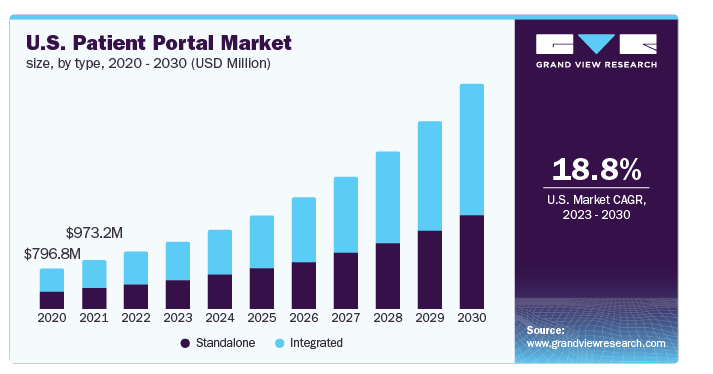
This growth signals a clear shift: healthcare organizations that do not invest in digital portal infrastructure risk falling behind competitors who already offer patients seamless, self-service access to their care.
Monocubed is a healthcare web development company based in Tempe, Arizona, specializing in HIPAA-compliant portal development since 2020. With 200+ web solutions delivered (based on completed projects from, our team has built patient portals, provider dashboards, and enterprise healthcare platforms for hospitals, clinics, and health-tech startups. Based on this hands-on experience, we’ve created this guide to walk you through every stage of healthcare web portal development.
This guide walks you through every stage of healthcare web portal development, from understanding the types of portals you can build to selecting the right features, technology stack, development process, and development partner.
What Is a Healthcare Web Portal and How Is It Different from a Healthcare Website?
A healthcare web portal is a secure, browser-based platform that connects patients, providers, administrators, and other stakeholders through a unified digital interface.
Unlike a standard healthcare website that simply displays information, a web portal provides authenticated, role-based access to interactive features like appointment scheduling, medical records, secure messaging, billing, and clinical workflows.
The distinction between a website and a web portal matters in healthcare because portals handle protected health information (PHI) and must comply with HIPAA, HITECH, and other regulatory frameworks. Every interaction within the portal, from a patient viewing their lab results to a provider updating a care plan, must be encrypted, logged, and access-controlled.
Healthcare web portals serve as the operational backbone of modern healthcare delivery. They replace phone calls with online scheduling, paper forms with digital intake, and fragmented communication with secure messaging. For healthcare organizations, they reduce administrative overhead, improve patient engagement, and create measurable improvements in care coordination.
The scope of a healthcare web portal varies based on organizational needs.
- A solo practice might need a simple patient-facing portal with scheduling and secure messaging.
- A hospital network might require a multi-location enterprise platform with EHR interoperability, role-based dashboards for different departments, and AI-powered clinical decision support.
What remains constant is the core purpose: bringing every stakeholder in the care journey onto one secure, connected platform. Achieving this requires understanding the different types of web portal models available for healthcare and how each can serve your patients, providers, and administrative staff.
What Are the Different Types of Healthcare Web Portals You Can Build?
Not all healthcare web portals serve the same purpose or audience. The types of web portal you build should align with your organization’s clinical workflows, patient population, and strategic goals. Understanding the options helps you invest in the right platform from the start.
1. Patient portals
Patient portals are the most widely adopted type of healthcare web portal. They give patients direct access to their health information, appointment scheduling, prescription refill requests, lab results, and secure communication with their care team.
A well-designed patient portal reduces call volume, decreases no-show rates, and improves patient satisfaction scores.
Patient portals range from basic platforms with scheduling and messaging to comprehensive systems with telehealth integration, wearable device connectivity, and personalized health content.
Best for: Hospitals and clinics that want to reduce call volume, decrease no-show rates, and give patients 24/7 self-service access to scheduling, records, and messaging.
2. Provider portals
Provider portals serve physicians, nurses, and clinical staff by centralizing access to patient records, clinical workflows, care coordination tools, and administrative functions. These portals integrate with EHR/EMR systems and provide real-time access to patient histories, test results, medication lists, and treatment plans.
The primary value of a provider portal lies in workflow efficiency. Instead of switching between multiple systems, clinicians access everything through a single interface that surfaces relevant information based on their role and current context.
Best for: Multi-provider organizations where clinicians need a single interface to access patient data across encounters and care settings without switching between systems.
3. Administrative and operations portals
Administrative portals support the non-clinical side of healthcare operations. These platforms handle staff scheduling, resource allocation, inventory management, compliance tracking, revenue cycle management, and operational reporting. They are particularly valuable for multi-location healthcare organizations that need centralized visibility into operations across facilities.
Best for: Multi-location healthcare organizations that need centralized visibility into staffing, resources, compliance, and revenue across facilities.
4. B2B healthcare portals
B2B portals connect healthcare organizations with their vendors, suppliers, insurance providers, and business partners. These platforms streamline procurement, contract management, claims processing, and supply chain coordination. They reduce manual paperwork and accelerate transaction cycles between organizations.
Best for: Healthcare organizations managing complex vendor, supplier, or payer relationships with high transaction volumes.
Choosing the right B2B portal development partner helps you to build a secure and scalable platform.
5. Telehealth portals
Telehealth portals enable virtual consultations between patients and providers through integrated video conferencing, secure messaging, digital prescribing, and remote patient monitoring. The demand for telehealth platforms accelerated dramatically and continues to grow as patients and providers recognize the convenience and accessibility benefits of virtual care delivery.
Best for: Organizations expanding virtual care delivery — especially primary care, behavioral health, and chronic disease management practices.
6. Insurance and claims portals
Insurance portals serve payers, brokers, and healthcare providers involved in claims processing, benefits verification, and coverage management. These platforms automate eligibility checks, claims submissions, prior authorization workflows, and payment reconciliation. For healthcare organizations, insurance portal integration reduces billing delays and improves revenue cycle performance.
Best for: Healthcare providers and payers looking to reduce billing delays, automate eligibility checks, and improve revenue cycle performance.
Each portal type addresses a specific set of workflows and stakeholders. Many healthcare organizations build platforms that combine multiple portal types into a single ecosystem. A hospital, for example, might deploy patient-facing, provider-facing, and administrative portals that share a common data layer and authentication system.
Not Sure Which Portal Type Fits Your Organization?
Every healthcare setup has different workflows, patient volumes, and integration needs. Our team can help you identify the right portal type and feature set based on your specific clinical environment.
10 Essential Features of a Secure and Scalable Healthcare Web Portal
The features you include in your healthcare web portal determine its adoption rate, clinical value, and return on investment. Building too few features creates a platform that does not justify the switch from existing workflows.
Building too many at launch increases cost, complexity, and time to market without proportional value. The right approach is selecting features of a web portal that address your most pressing operational gaps and scaling from there.
1. Patient registration and onboarding
Digital patient registration moves the intake process online, eliminating long paper forms and reducing the workload for front-desk staff. Patients can complete their personal details, medical history, insurance information, and consent forms before their visit.
Tools like digital signatures, document uploads, and insurance card scanning make the process faster, more accurate, and error-free. By incorporating these features through patient portal development, healthcare organizations can streamline operations, save time, and provide a smoother, more convenient experience for patients.
2. Appointment scheduling and managementReal-time appointment scheduling with provider availability, multi-location support, automated reminders, and waitlist management is the single most impactful feature for patient-facing portals. Automated SMS and email reminders reduce no-show rates by 20% to 35%, directly improving revenue and provider utilization.
3. Electronic health records access
Patients expect secure access to their medical records, lab results, visit summaries, immunization histories, and medication lists. Providers need real-time access to patient data across encounters and care settings. EHR integration through HL7 FHIR and SMART on FHIR APIs connects your portal with clinical systems like Epic, Cerner, and athenahealth.
4. Secure messaging and communication
HIPAA-compliant messaging replaces phone calls and unsecured email with encrypted, auditable communication between patients and providers. Asynchronous messaging allows providers to respond at their convenience while giving patients a documented communication channel for non-urgent questions, prescription requests, and follow-up care coordination.
5. Telehealth and video consultations
Integrated video consultation capabilities with virtual waiting rooms, session recording, e-prescribing, and screen sharing extend care delivery beyond the physical clinic. Telehealth modules must include end-to-end encryption, consent capture, and seamless transition between virtual and in-person care workflows.
6. Billing and payment processing
Online billing with itemized statements, insurance claim tracking, payment plan options, and multiple payment methods improves revenue cycle performance. Integrating with payment gateways like Stripe allows patients to pay balances directly through the portal, reducing collection delays and administrative costs.
7. Prescription management
E-prescribing, prescription refill requests, medication history tracking, and pharmacy integration streamline medication management for both patients and providers. These features reduce prescription errors and improve medication adherence by making the process convenient and transparent.
8. Role-based access control
Healthcare portals serve multiple user types, including patients, physicians, nurses, administrative staff, billing teams, and system administrators. Role-based access control ensures each user only sees and interacts with data relevant to their role, which is both a usability requirement and a HIPAA compliance mandate.
9. Analytics and reporting dashboards
Real-time dashboards provide visibility into patient engagement metrics, appointment volumes, revenue cycle performance, clinical outcomes, and operational KPIs. For decision-makers, analytics capabilities transform raw portal data into actionable insights that drive operational improvements.
10. Advanced features for enterprise portals
Enterprise portals often incorporate advanced capabilities including AI-powered symptom triage, predictive analytics for patient risk stratification, remote patient monitoring integration with wearable devices, multi-language support, and clinical decision support systems.
Integrating these features during enterprise portal development adds significant value but requires careful planning and specialized development expertise.
The features you prioritize should be guided by your patient population needs, provider workflows, and organizational goals. Starting with core features and expanding through phased development ensures you deliver value quickly while building toward a comprehensive platform.
Ready to turn your patient portal vision into reality? Let’s walk through how to develop a healthcare web portal step by step, from planning and feature selection to design, development, and deployment.
How Do You Build a Healthcare Web Portal from Scratch? 7 Steps
Building a healthcare web portal requires a structured approach that accounts for clinical workflows, regulatory compliance, and stakeholder alignment at every stage. Skipping or rushing steps leads to scope creep, compliance gaps, and platforms that do not meet user needs.
The web portal development process below reflects how experienced teams deliver healthcare portals that work in real clinical environments.
Step 1: Discovery and requirements gathering
Every successful healthcare portal begins with a thorough discovery phase. This foundational step ensures that the portal aligns with your organization’s workflows, user needs, and compliance requirements. Key activities include:
- Mapping workflows and identifying pain points: Analyze existing clinical and administrative processes to uncover inefficiencies and areas for improvement.
- Defining user personas: Understand the needs of patients, providers, and administrators to ensure the portal delivers a seamless experience for all stakeholders.
- Documenting integration requirements: Determine how the portal will connect with your existing EHR, scheduling systems, billing software, and other technology.
- Establishing compliance obligations: Identify HIPAA, HITECH, and state-specific regulations to guide development and maintain security standards.
- Conducting stakeholder interviews: Gather insights from clinical staff, administrators, and patient representatives to capture real-world requirements.
- Producing a detailed requirements document: Summarize portal functionality, user roles, integration points, and compliance considerations in a blueprint for development.
A strong discovery phase lays the foundation for a portal that not only meets technical and regulatory standards but also improves operational efficiency and patient satisfaction.
Step 2: Portal architecture and design
The architecture phase transforms requirements into a detailed technical blueprint for the healthcare portal. Key components include:
- System architecture design: Define how all portal components—front-end, back-end, and integrations—will work together.
- Database schema planning: Organize data structures for secure, efficient storage and retrieval of patient information.
- API integration mapping: Plan seamless connections with EHRs, billing systems, and other healthcare software.
- Security architecture: Ensure HIPAA-compliant data flows, encryption, and role-based access controls.
- Infrastructure planning: Design for scalability to handle growth in users, locations, and patient data.
UI/UX design runs alongside architecture to ensure the portal is user-friendly for all stakeholders. Healthcare portals must accommodate diverse users, including elderly patients, busy clinicians, and non-technical administrative staff. Creating wireframes, prototypes, and conducting usability testing guarantees an intuitive interface before development begins.
Step 3: Development and integration
Development follows an agile methodology, with two-week sprints, regular stakeholder reviews, and continuous integration to ensure steady progress and early feedback. Front-end and backend development happen in parallel, guided by API contracts defined during the architecture phase, so both teams work cohesively.
Healthcare-specific development tasks include:
- FHIR-based EHR integrations: Connect seamlessly with electronic health record systems for real-time data exchange.
- HIPAA-compliant authentication and authorization: Ensure secure access for all users.
- Encrypted messaging systems: Enable secure communication between patients, providers, and staff.
- Audit logging for PHI access: Track all activity involving sensitive patient data for compliance and accountability.
- Role-based access controls: Ensure each user sees only the information relevant to their role.
Integration with EHR systems like Epic, Cerner, or athenahealth is often the most complex part of development and should be treated as a dedicated sprint to carefully manage dependencies and ensure reliability.
Step 4: Security implementation and compliance
Security is embedded into every sprint of healthcare portal development. Dedicated security hardening, however, ensures that nothing is overlooked before launch.
Key security and compliance tasks include:
- AES-256 encryption for data at rest and in transit to protect patient information.
- Multi-factor authentication to secure user access.
- Comprehensive audit logging to track all access and actions involving PHI.
- Vulnerability scanning and penetration testing to identify and fix potential risks.
- Compliance documentation to meet regulatory requirements and facilitate audits.
The updated HIPAA Security Rule makes all implementation specifications mandatory, removing the previous distinction between “required” and “addressable” safeguards. Embedding these practices ensures the portal is secure, compliant, and ready for safe patient use.
Step 5: Testing and quality assurance
Healthcare portals demand rigorous testing across multiple dimensions:
- Functional testing: Verifying every feature works as specified across all user roles
- Integration testing: Confirming data flows correctly between the portal, EHR systems, payment gateways, and third-party services
- Security testing: Penetration testing, vulnerability scanning, and compliance validation
- Performance testing: Load testing to ensure the portal performs under peak concurrent user loads
- Accessibility testing: Validating WCAG 2.1 compliance across devices and assistive technologies
- User acceptance testing (UAT): Clinical staff and patient representatives validate the portal in realistic scenarios
QA in healthcare is not just about catching bugs. It is about ensuring every data interaction is secure, accurate, and compliant.
Step 6: Deployment and launch
Deployment to a HIPAA-eligible cloud environment includes staging environment validation, data migration from legacy systems, staff training and onboarding programs, phased rollout strategies (starting with a pilot group before full launch), and monitoring setup for performance, security, and user adoption metrics.
A phased launch reduces risk by allowing the team to identify and resolve issues with a smaller user group before expanding access.
Step 7: Post-launch optimization and maintenance
Launching the portal is not the end of development. Post-launch involves monitoring user adoption metrics, gathering feedback from patients and providers, fixing issues that emerge in production, optimizing performance based on real usage patterns, and implementing regulatory updates as compliance requirements evolve.
Annual maintenance typically costs 15% to 25% of the original development investment and covers security patches, compliance updates, performance optimization, and feature refinements.
Each step in this process builds on the previous one. Teams that follow this structured approach deliver portals that work in real clinical environments, earn user adoption, and meet compliance requirements without expensive post-launch remediation.
With a strong foundation in place, healthcare portals can now leverage emerging technologies to further enhance patient engagement, streamline workflows, and deliver smarter, more personalized care.
5 Emerging Technologies Transforming Healthcare Web Portals
Healthcare web portal development is evolving beyond core clinical features. Organizations that build with emerging technologies in mind position their platforms for long-term relevance and competitive advantage.
1. Artificial intelligence and machine learning
AI is reshaping healthcare portals in practical, measurable ways. AI-powered symptom checkers and triage tools help patients assess their conditions before scheduling appointments, reducing unnecessary visits and directing urgent cases to appropriate care. Natural language processing (NLP) enables intelligent search within medical records, allowing patients and providers to find relevant information without navigating complex menu structures.
For providers, ML-based predictive analytics identify patients at risk for readmission, medication non-adherence, or chronic disease progression. These capabilities transform portals from passive record viewers into proactive care management tools.
2. Internet of Things and remote patient monitoring
Integration with IoT devices and wearables extends the portal’s reach beyond the clinical setting. Patients with chronic conditions transmit blood pressure, glucose levels, heart rate, and other vitals directly to their provider dashboard through the portal. This continuous data stream supports remote patient monitoring programs, early intervention, and reduced hospital readmissions.
FHIR-based APIs enable standardized data exchange between wearable devices and portal platforms, making IoT integration increasingly practical for healthcare organizations.
3. Blockchain for health data security
Blockchain technology offers a decentralized, tamper-proof approach to managing health data access and consent. While still emerging in healthcare, blockchain-based systems can provide patients with granular control over who accesses their records, create immutable audit trails for compliance, and enable secure data sharing across organizations without centralized intermediaries.
4. Voice-enabled interfaces
Voice-activated features powered by AI make healthcare portals more accessible for elderly patients, visually impaired users, and anyone who finds typing inconvenient. Voice interfaces can handle appointment scheduling, medication reminders, symptom reporting, and navigation within the portal.
5. Modular UI systems
In healthcare web app development, modular UI systems allow organizations to scale content and functionality without compromising design consistency. This is especially valuable for medical platforms that require frequent updates, approval workflows, and version control across departments. Modular architecture also enables faster feature deployment because new components can be developed and tested independently.
Building your healthcare portal on a modular, API-first architecture ensures you can integrate emerging technologies as they mature without rebuilding your core platform. This forward-looking approach protects your investment and keeps your portal competitive as patient expectations and clinical capabilities evolve.
What are the Biggest Challenges in Healthcare Web Portal Development?
Healthcare web portal projects carry unique risks that generic web development does not encounter. Acknowledging these challenges upfront and planning for them prevents costly delays, compliance failures, and adoption problems.
Challenge 1: Regulatory compliance complexity
Healthcare portals must meet HIPAA, HITECH, WCAG accessibility standards, state privacy laws, and evolving federal mandates. The 2026 HIPAA updates add mandatory encryption, multi-factor authentication, and new attestation requirements, raising the compliance bar.
Solution: Monocubed’s team has deep healthcare compliance expertise, ensuring portals are built with secure data flows, proper authentication, and audit-ready documentation from day one, avoiding costly post-launch remediation.
Challenge 2: EHR and legacy system integration
Integrating with EHR systems like Epic, Cerner, or athenahealth is complex due to diverse APIs, HL7/FHIR standards, and legacy system constraints. Poor integration can limit clinical value.
Solution: Monocubed specializes in FHIR-based integrations and custom middleware, ensuring smooth, reliable connections with EHRs and legacy systems while maintaining data integrity and interoperability.
Challenge 3: Data security and breach prevention
Healthcare data breaches are expensive and common, yet many organizations underinvest in cybersecurity. A single breach can affect millions of patients and cost millions in damages. According to IBM’s Cost of a Data Breach Report, the average healthcare data breach costs $10.93 million.
Solution: Monocubed embeds security into every sprint, implementing AES-256 encryption, multi-factor authentication, audit logging, and continuous monitoring to protect sensitive patient data and maintain compliance.
Challenge 4: User adoption and change management
Portals fail if clinicians resist new workflows or patients are unfamiliar with digital tools. Lack of training and engagement leads to low adoption.
Solution: Monocubed designs portals with intuitive UX for all user types, provides staff training, patient onboarding support, and feedback loops to drive adoption and embed the portal into everyday clinical workflows.
Challenge 5: Scalability and performance
Portals face spikes in usage (e.g., appointment scheduling, lab result checks, seasonal vaccinations). Poor architecture can cause slowdowns and failures under load.
Solution: Monocubed plans scalable architecture, cloud infrastructure, and optimized database strategies from the start, ensuring portals perform reliably under high traffic while maintaining security and audit standards.
Challenge 6: Balancing customization with time to market
Excessive customization can delay launch and increase costs, while off-the-shelf solutions may not fit unique workflows.
Solution: Monocubed helps prioritize features, plan phased development, and balance custom and standard components, delivering a tailored portal without unnecessary delays or overspending.
Addressing these challenges requires a development partner with direct healthcare experience, a structured development methodology, and an honest assessment of complexity upfront.
Successfully navigating these challenges starts with choosing the one of the best web portal development partners—one with hands-on healthcare experience, a structured methodology, and a clear understanding of project complexity.
How Much Does It Cost to Build a Healthcare Web Portal?
Healthcare web portal development costs range from $30,000 to $500,000 or more, depending on the portal type, feature complexity, integration requirements, and compliance scope. Understanding cost drivers helps you budget accurately and make informed decisions about where to invest.
For a detailed breakdown of costs by project type, feature pricing, hidden costs, and cost reduction strategies, read our comprehensive healthcare web app development cost guide. Below is a high-level overview.
Cost ranges by web portal type
| Portal Type | Cost Range | Timeline |
|---|---|---|
| Basic Patient Portal | $30,000 – $80,000 | 2 – 4 months |
| Mid-Range Clinical Portal | $80,000 – $200,000 | 4 – 7 months |
| Telehealth Platform | $120,000 – $300,000 | 5 – 9 months |
| Enterprise Multi-Location Portal | $200,000 – $500,000+ | 6 – 14 months |
All costs listed in USD. For organizations outside the US, costs vary based on regional compliance requirements (GDPR for EU, PIPEDA for Canada) and local development team rates. Contact us for region-specific estimates.
Key cost factors that influence the web portal development
Several factors directly influence your healthcare web portal development cost:
- Scope and complexity: A basic scheduling portal costs fundamentally less than an enterprise platform with AI, multi-EHR integration, and multi-location support
- Feature set: Each feature carries its own design, development, testing, and compliance validation cost. EHR integration alone can range from $15,000 to $60,000
- Compliance requirements: HIPAA compliance adds 15% to 30% to development costs. SOC 2 and HITRUST certifications add further investment
- Technology stack: Framework choices affect development speed, developer availability, and long-term maintenance costs
- Team expertise and location: North American teams charge $100 to $250 per hour versus $20 to $80 for offshore teams, but healthcare expertise often reduces total project cost through fewer errors and faster delivery
Ongoing costs to consider before planning portal development budget
Your portal budget should account for costs beyond initial development:
- HIPAA-compliant hosting: $500 – $5,000+/month
- Maintenance and updates: $1,000 – $10,000/month
- Annual compliance audits: $5,000 – $15,000
- Security monitoring: $200 – $1,000/month
- Third-party service fees: Variable based on usage
For a complete cost analysis including web portal development cost factors, pricing models, and strategies to optimize your budget, visit our detailed cost guide.
Get a Custom Cost Estimate for Your Healthcare Portal
Your project has unique integration requirements, compliance needs, and feature priorities that influence the real cost. Share your project details and receive a transparent, detailed cost breakdown.
Before selecting a web portal development partner, it’s important to understand the full cost picture, including pricing models, key cost drivers, and budget optimization strategies.
How Do You Choose the Right Healthcare Web Portal Development Partner?
Selecting the right development partner is one of the most consequential decisions in your portal project. The wrong choice leads to missed deadlines, compliance gaps, and platforms that fail to deliver clinical value. The right partner reduces risk, accelerates delivery, and builds a portal that works in real healthcare environments.
1. Do they have hands-on healthcare portal experience — not just general web development?
Look for web portal development companies with direct healthcare project experience, not just general web development capability. Teams that have built HIPAA-compliant platforms, integrated with EHR systems, and navigated healthcare regulatory requirements bring knowledge that prevents expensive mistakes. Ask for case studies and references from healthcare clients.
2. Can they prove their HIPAA compliance and security capabilities?
Your web development partner must demonstrate HIPAA compliance knowledge, secure development practices, and experience with healthcare-specific security requirements. Ask about their approach to encryption, access controls, audit logging, penetration testing, and compliance documentation. A partner who treats security as an afterthought is a liability, not an asset.
3. Have they integrated with your EHR system (Epic, Cerner, athenahealth)?
Evaluate the partner’s experience with your preferred technology stack and their capability to integrate with your existing systems. If you use Epic, Cerner, or another major EHR, confirm they have successfully completed similar integrations. FHIR and SMART on FHIR expertise is essential for modern healthcare portal development.
4. Is their development process structured and transparent?
A structured development process with clear milestones, regular stakeholder reviews, and transparent communication is critical for healthcare projects. Ask about their discovery process, sprint cadence, QA methodology, and how they handle scope changes. Organizations that follow agile practices with dedicated healthcare QA deliver more predictable outcomes.
5. Will they support you after launch — or disappear?
Healthcare portals require ongoing maintenance for security patches, compliance updates, performance optimization, and feature enhancements. Evaluate the partner’s post-launch support model, response times, and long-term engagement options. A partner who disappears after launch leaves you exposed to compliance and security risks.
6. Do they communicate well with clinical, technical, and administrative stakeholders?
Healthcare projects involve multiple stakeholders across clinical, technical, and administrative functions. Your development partner must communicate effectively with all groups, explain technical concepts in business terms, and demonstrate genuine investment in your project’s success. Timezone alignment and communication cadence matter for projects that require regular stakeholder input.
The right development partner approaches your project as a strategic engagement, not a transactional one. They invest in understanding your clinical workflows, challenge assumptions that could lead to poor outcomes, and deliver a portal that earns user adoption and drives measurable results.
Transform Your Healthcare Web Portal with Monocubed
Healthcare web portals are the backbone of efficient, patient-centered care. Successfully navigating compliance, integrations, security, and adoption challenges requires a partner with deep healthcare expertise and a proven development methodology.
Monocubed turns this complexity into results. By combining strategic planning, secure architecture, intuitive design, and ongoing support, we deliver portals that streamline workflows, engage patients, and meet the highest regulatory standards. With Monocubed, your portal isn’t just built—it’s built to succeed in the real world.
Take the first step toward a smarter, safer, and more efficient patient experience. Schedule your free healthcare portal consultation today.
Ready to Build Your Healthcare Portal?
Partner with Monocubed to design, develop, and launch a secure, user-friendly portal tailored to your organization’s needs. Get a custom roadmap and cost estimate from our healthcare development experts within 48 hours.
Frequently Asked Questions About Healthcare Web Portal Development
-
How long does it take to develop a healthcare web portal?
Basic patient portals take 2 to 4 months, mid-range clinical portals with EHR integration require 4 to 7 months, and enterprise multi-location portals need 6 to 14 months. Timeline depends on feature complexity, number of integrations, compliance requirements, and team size. Thorough discovery and phased development help manage timelines effectively.
-
How much does a basic patient portal cost to build?
A basic patient portal with scheduling, secure messaging, and medical records access typically costs $30,000–$80,000 and takes 2–4 months to develop. Costs increase with EHR integration, telehealth features, and advanced compliance requirements. For a detailed breakdown, see the cost section above or request a free estimate.
-
What is the difference between a healthcare web portal and a healthcare website?
A healthcare website is an informational platform that displays content about services, providers, and locations. A healthcare web portal provides authenticated, interactive access to features like scheduling, medical records, secure messaging, billing, and clinical workflows. Portals handle protected health information and must comply with HIPAA requirements.
-
Can a healthcare web portal integrate with our existing EHR system?
Yes. Modern healthcare portals integrate with EHR systems like Epic, Cerner, athenahealth, and others through HL7 FHIR and SMART on FHIR APIs. The complexity and cost of integration varies by EHR vendor and the depth of data exchange required. Experienced development teams with EHR integration experience can assess compatibility during the discovery phase.
-
Is HIPAA compliance mandatory for healthcare web portals?
Yes. Any web portal that stores, processes, or transmits protected health information must comply with HIPAA regulations. This includes encryption, access controls, audit logging, breach notification procedures, and Business Associate Agreements with all third-party service providers. Non-compliance exposes organizations to fines of up to $1.5 million per violation category.
-
Should I build a custom healthcare web portal or use an off-the-shelf solution?
Off-the-shelf solutions work for organizations with standard workflows and basic feature needs. Custom development is necessary when your clinical workflows do not fit generic templates, you need deep integration with specific EHR systems, you serve specialties with unique requirements, or you need multi-location support with custom administrative controls. Custom portals cost more upfront but provide complete ownership, unlimited customization, and better long-term ROI.
-
What ongoing maintenance does a healthcare web portal require?
Healthcare portals require continuous maintenance, including security patches, compliance updates as regulations evolve, performance optimization, feature enhancements, and EHR compatibility updates. Annual maintenance typically costs 15% to 25% of the original development investment. Neglecting maintenance leads to security vulnerabilities, compliance failures, and degraded user experience.
-
How do I ensure patients actually use the portal?
Patient adoption depends on clinical recommendation, ease of use, and tangible value. Train staff to recommend and demonstrate the portal during visits. Design an intuitive interface that works across devices. Ensure core features like scheduling, results access, and messaging deliver immediate value. Establish feedback loops to continuously improve the experience based on real patient input.
-
Does Monocubed sign NDAs before project discussions?
Yes. Mutual NDAs are executed before any project discussion. All team members handling your project are bound by confidentiality agreements, which is standard practice for any company handling Protected Health Information.

 All our projects are secured by NDA