
 By Yuvrajsinh Vaghela
Contents
Are your patients still calling the front desk to check lab results, confirm appointments, or request prescription refills?
Research shows that over 70% of patients prefer digital self-service tools for these tasks, and healthcare organizations without a patient portal risk losing patient trust, increasing administrative workload, and falling behind in care quality.
The challenge is real. Building a full-featured patient portal from scratch involves regulatory hurdles, complex EHR integrations, and significant investment. That is exactly why the MVP (Minimum Viable Product) approach works so effectively in healthcare.
Launching a focused, compliant portal with core features allows you to validate functionality with real patients and expand based on actual usage data. Our patient portal development company understands the process, challenges, and importance of creating MVP for a healthcare organization. We’ve listed important points in this guide.
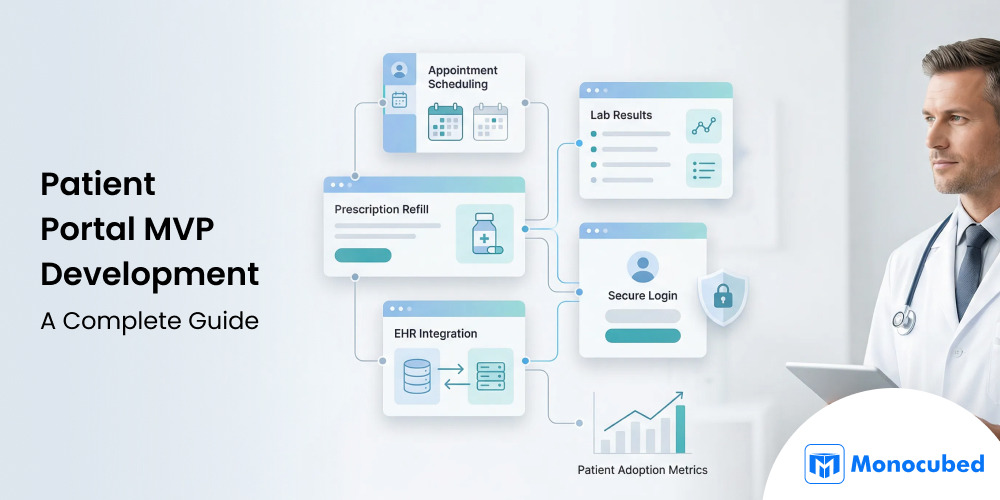
This guide covers every critical decision in patient portal MVP development, including:
- Defining the right feature scope to address the most-used patient tasks.
- Choosing a technology stack that supports scalability, security, and integrations.
- Managing HIPAA compliance and regulatory requirements from day one.
- Estimating costs and planning budgets to prevent overruns.
- Planning post-launch expansion using real-world patient adoption metrics.
Whether you are a healthcare startup validating a new product or a clinic modernizing patient engagement, this guide provides the clarity and strategy to launch smarter, faster, and with confidence.
What Is a Patient Portal MVP and Why Does It Matter?
A patient portal MVP is a streamlined digital platform that delivers the most critical patient-facing features first, without waiting for a full-scale build. Instead of spending months developing every possible feature, you launch with the essentials, gather feedback, and iterate.
The concept is borrowed from lean product development, but it carries special significance in healthcare.
Unlike a typical SaaS MVP, a patient portal must meet strict regulatory requirements from day one. You cannot ship a “minimum” product that ignores HIPAA, data encryption, or access controls. The “minimum” in a healthcare MVP refers to feature scope, not compliance.
This distinction matters because many healthcare organizations delay digital transformation entirely, waiting until they can afford or plan a complete system. The result is years of missed engagement. An MVP approach breaks that cycle by letting you validate patient adoption, identify workflow bottlenecks, and prove ROI before committing to a larger investment.
According to a report by the Office of the National Coordinator for Health IT, over 90% of patients offered portal access use it to view test results and manage appointments. The demand already exists. The question is whether your organization will meet it with a purpose-built solution or continue relying on phone calls and paper forms.
Understanding what an MVP should include, and what it should deliberately exclude, is the first step toward a successful launch.
Why the MVP Approach Works for Patient Portal Development: 5 Reasons
Healthcare organizations often hesitate to invest in digital portals because of the perceived complexity and cost. The MVP development model addresses these concerns directly by reducing risk while accelerating time to market.
1. Validate patient adoption before scaling
The biggest risk in any patient portal project is building features patients do not use. An MVP lets you launch with core functionality, measure adoption rates, and identify which features patients actually engage with. This data-driven approach prevents overbuilding and ensures every subsequent investment is backed by real usage patterns.
2. Control costs without compromising quality
A full-featured patient portal can cost $150,000 to $500,000 or more. An MVP typically ranges from $40,000 to $100,000, depending on complexity and compliance requirements. By starting smaller, you allocate budget more strategically and avoid spending on features that may never gain traction. With the time, you can expand your budget as your requirements, costs and your patient needs.
You can also check the healthcare website development cost to centralize the data and improve user experience of the staff, patient, and officers, working in your organization.
3. Meet compliance requirements from day one
Unlike consumer applications where you can “move fast and break things,” healthcare software requires regulatory compliance from the first release.
The MVP approach does not mean cutting corners on security or privacy. It means building fewer features, but building them correctly, with HIPAA compliance, encrypted data handling, and audit logging baked into the architecture from the start.
4. Reduce time to market
A full portal build can stretch beyond 12 months. An MVP can be ready for a pilot launch in 3 to 4 months. This faster timeline means your patients start benefiting sooner, your staff begins seeing administrative relief earlier, and your organization starts collecting the feedback needed to build the right long-term product.
5. Align stakeholders with tangible progress
Healthcare decision-making often involves multiple stakeholders, from clinical leadership to IT, compliance, and finance teams. An MVP gives everyone a working product to evaluate rather than a theoretical roadmap. Tangible progress builds consensus faster than slide decks.
The MVP approach is not about delivering a lesser product. It is about delivering the right product, informed by real-world use, and expanding from a position of validated knowledge rather than assumption.
Let’s Discuss Your Patient Portal Project
Share your requirements with our healthcare development experts and get a free consultation on scope, compliance, and technology decisions for your patient portal MVP.
6 Essential Features for a Patient Portal MVP You Must Include
Defining the right feature set is the most consequential decision in MVP development. Include too little, and patients will not adopt the portal. Include too much, and you lose the speed, cost, and focus advantages that make the MVP approach valuable.
Below is the list of features of a web portal for patients that represent the core functionality that drives patient adoption and delivers measurable operational value. Each has been selected based on what healthcare organizations and their patients consistently prioritize.
1. Secure user authentication and role-based access
Every patient portal must start with a robust authentication system. This includes multi-factor authentication for patients, role-based access control separating patient, provider, and admin permissions, and session management with automatic timeout. Authentication is not just a feature. It is the compliance foundation your entire portal rests on.
2. Appointment scheduling and management
Appointment management is consistently the highest-use feature in patient portals. Patients should be able to view available time slots, book new appointments, reschedule or cancel existing ones, and receive automated reminders via email or SMS. This single feature can reduce front-desk call volume by 30% or more, delivering immediate operational ROI.
3. Medical records access
Patients expect digital access to their health information. The MVP should include read-only access to lab results, visit summaries, medication lists, and immunization records. Data should be pulled from your EHR system through standardized interfaces like HL7 FHIR, ensuring accuracy and real-time availability.
4. Secure messaging
A HIPAA-compliant messaging system lets patients communicate with their care team asynchronously. This replaces the phone tag with structured, documented communication that both parties can reference. The messaging system should support text-based messages with the option for file attachments such as images or documents.
5 . Patient profile management
Patients should be able to view and update their demographic information, insurance details, emergency contacts, and communication preferences. This reduces administrative burden on staff and ensures patient records stay current without requiring phone calls or in-person visits.
6. Notification system
Automated notifications for appointment reminders, new lab results, and message responses keep patients engaged with the portal. Email and SMS notifications should be configurable based on patient preferences, respecting both communication choices and regulatory requirements.
Ready to Discuss Your Project?
Our team has delivered 200+ ecommerce projects with 98% client satisfaction. Schedule a free consultation to discuss requirements and get accurate estimates.
What to exclude from the MVP Features like telehealth video visits, prescription refill workflows, bill pay and insurance claims processing, wearable device integrations, and advanced analytics dashboards are valuable additions, but they belong in subsequent releases. Each adds significant development complexity, third-party integrations, and testing requirements that would delay your initial launch without being essential for early adoption.
The goal is to ship a portal that solves the most pressing patient and provider pain points. Once patients are actively using the platform, their behavior and feedback will tell you exactly which features to build next.
Technology Stack for Patient Portal MVP Development
Choosing the right technology stack for a healthcare portal involves balancing development speed, security capabilities, scalability, and long-term maintainability. The stack must support HIPAA compliance requirements, handle sensitive health data responsibly, and integrate with existing clinical systems.
1. Frontend technologies
React.js and Angular are the most common frameworks for patient portal frontends. Both support component-based architecture that enables responsive, accessible interfaces across devices.
The web portal must meet WCAG 2.1 AA accessibility standards, as patients include elderly users, individuals with disabilities, and people with varying levels of technical literacy. A mobile-first responsive design is essential since more than half of patient portal access happens on smartphones.
2. Backend frameworks
Node.js with Express, Python with Django, and Java with Spring Boot are all proven choices for healthcare backends.
The critical requirement is mature security middleware, well-tested authentication libraries, and ORM support for parameterized queries that prevent SQL injection.
Django is particularly strong for rapid MVP development due to its built-in admin interface, authentication system, and ORM, while Node.js excels when real-time features like messaging are a priority.
3. Database management
PostgreSQL is the recommended default for patient portal data. It supports row-level security, encryption at rest, robust access control, and has a mature ecosystem of healthcare-specific extensions.
Relational databases are essential for patient data where referential integrity, audit trails, and ACID compliance matter. NoSQL options like MongoDB may supplement specific use cases such as activity logging but should not serve as the primary patient data store.
4. Cloud infrastructure
HIPAA-eligible cloud providers are mandatory. AWS, Microsoft Azure, and Google Cloud Platform all offer BAA-covered services. Containerization with Docker and orchestration with Kubernetes provide consistent deployment environments. Managed services for databases, message queues, and monitoring reduce operational overhead and ensure reliable uptime.
5. Integration protocols
HL7 FHIR is the modern standard for healthcare data interoperability and should be the foundation of your API layer. Design your data models around FHIR resources like Patient, Appointment, Observation, and MedicationRequest from the beginning. If your organization uses legacy EHR systems, you may also need HL7 v2 support through an integration engine or middleware layer.
The technology decisions you make at the MVP stage will shape your product for years. Investing in a compliant, scalable architecture from the start prevents costly rearchitecting as you expand beyond the initial feature set.
How to Develop a Patient Portal MVP: A Step-by-Step Process
Building a patient portal MVP requires a structured process that balances speed with the rigorous compliance and security standards healthcare demands. The following phases outline a proven development approach to create a web portal—from concept to pilot launch.
1. Discovery and requirements definition
Action: Map workflows, interview patients, providers, and admin staff, and define compliance requirements (HIPAA, PIPEDA, GDPR). Document EHR and third-party integrations.
Impact: Creates a clear, prioritized feature backlog, user personas, and a requirements blueprint that guides development and aligns with real-world needs.
Patient benefit: Ensures the portal solves actual problems, not assumed ones.
2. Architecture and compliance planning
Action: Design system architecture with encryption, audit logs, role-based access, and session management. Define cloud infrastructure, CI/CD pipelines, and dev environments.
Impact: Lays the groundwork for robust security, regulatory compliance, and future scalability.
Patient benefit: Protects sensitive health data and ensures uninterrupted access.
3. UI/UX design and prototyping
Action: Develop wireframes and clickable prototypes for appointment booking, lab results, messaging, and profile management. Test with diverse users, including elderly and accessibility-challenged patients.
Impact: Creates clear, mobile-responsive workflows that reduce errors and support calls.
Patient benefit: Makes completing tasks simple, fast, and frustration-free.
4. Core development and EHR integration
Action: Implement essential features in order of priority. Integrate with EHRs via HL7 FHIR APIs, using an abstraction layer for future flexibility.
Impact: Delivers immediate value while future-proofing the system for growth.
Patient Benefit: Patients can access critical services immediately, without disruptions.
5. Security testing and compliance validation
Action: Run penetration testing, vulnerability scans, and compliance audits across all workflows. Use automated tools and expert manual review.
Impact: Ensures regulatory readiness and trustworthiness before patient data is used.
Patient Benefit: Gives patients confidence their health information is secure.
6. Pilot launch and iteration
Action: Release the portal to a controlled group of patients and providers. Track adoption, errors, usage patterns, and support requests. Collect structured feedback through surveys and interviews.
Impact: Turns assumptions into evidence-based improvements, shaping a roadmap for full launch.
Patient Benefit: A polished, reliable experience that meets patient expectations from day one.
Build Your Patient Portal MVP With Confidence
Our healthcare development team has built compliant, scalable portals for clinics and healthcare startups. Let us help you define the right scope, technology, and timeline for your MVP.
Each phase builds on the previous one, and skipping steps, particularly around compliance and security planning, creates risks that compound as the product scales.
5 Key Benefits of Building a Patient Portal MVP
Investing in a patient portal MVP delivers measurable value across multiple dimensions, from patient satisfaction to operational efficiency and regulatory readiness.
1. Improved patient engagement and satisfaction
Patients who can view lab results, book appointments, and message their care team digitally report significantly higher satisfaction scores. Self-service access reduces the frustration of phone holds, callbacks, and manual paperwork. A well-designed portal transforms the patient experience from reactive to proactive.
2. Reduced administrative burden
Every appointment booked online, every record viewed digitally, and every message exchanged through the portal is a phone call your front desk does not have to handle. Healthcare organizations that implement patient portals consistently report 25% to 40% reductions in call volume for routine inquiries. This frees staff to focus on complex patient needs and in-person care coordination.
3. Faster path to regulatory compliance
Building a compliant MVP establishes the security architecture, audit trails, and data handling processes that your organization needs regardless of portal scope. The compliance infrastructure you build for the MVP extends directly into future feature releases, creating a foundation that grows with the product rather than requiring redesign.
4. Data-driven product decisions
An MVP generates real usage data that guides every subsequent investment. Instead of debating whether to build telehealth or prescription refills next, you can look at actual patient behavior, feature requests, and support patterns to make evidence-based decisions. This eliminates the most expensive mistake in healthcare software: building features patients do not use.
5. Competitive differentiation
Patients increasingly choose providers based on digital experience. A functional, easy-to-use portal differentiates your organization from competitors still relying on manual processes. Even a focused MVP signals to patients that your organization values their time and is investing in modern care delivery.
The benefits of an MVP extend beyond the portal itself. The web portal development process builds internal capability, establishes vendor relationships, and creates organizational alignment around digital patient experience, all of which accelerate future technology initiatives.
5 Common Challenges During Patient Portal MVP Development and ( How to Overcome Them)
Patient portal development involves challenges that do not exist in typical web application projects. Anticipating these challenges allows you to plan for them rather than react to them mid-project.
Challenge 1: Navigating HIPAA and regulatory complexity
The problem: HIPAA compliance is not a single checkbox. It spans technical safeguards (encryption, access controls, audit logging), administrative safeguards (policies, training, risk assessments), and physical safeguards (data center security). Many teams underestimate the scope, treating compliance as a backend feature rather than a core architectural requirement.
The solution: Involve compliance expertise from the discovery phase and embed security and privacy reviews into every sprint. Monocubed’s healthcare development team ensures HIPAA and jurisdictional compliance is integrated into design, development, and deployment, preventing regulatory surprises and keeping patient data secure from day one.
Challenge 2: EHR integration complexity
The problem: Connecting to existing EHR systems is often the most technically challenging aspect. Vendors vary in API maturity, documentation quality, and support. Some offer modern FHIR APIs, while others require legacy HL7 v2 interfaces or proprietary connectors.
The solution: Build an abstraction layer between the portal and EHR systems to isolate vendor-specific complexities. Monocubed leverages this approach to support multiple EHR integrations efficiently, enabling your portal to scale and adapt without extensive rewrites.
Challenge 3: Balancing usability with security
The problem: Portals must be both secure and user-friendly, which can conflict. Multi-factor authentication, session timeouts, and complex password rules improve security but can frustrate patients, especially elderly users or those accessing the portal under stress.
The solution: Use a user-centered design approach with iterative testing. Monocubed designs security workflows that minimize friction while meeting compliance requirements, balancing robust protection with an intuitive, stress-free patient experience.
Challenge 4: Ensuring accessibility across patient populations
The problem: Portals serve a diverse audience, including elderly patients, individuals with visual or motor impairments, non-English speakers, and users with low digital literacy. Meeting WCAG 2.1 AA standards is only the starting point.
The solution: Conduct user testing with representative populations and apply inclusive design practices from the outset. Monocubed ensures accessibility is baked into the portal’s design and continuously validated, creating an experience everyone can navigate confidently.
Challenge 5: Managing stakeholder expectations
The problem: Healthcare organizations have multiple stakeholders with competing priorities: clinicians prioritize workflow efficiency, IT focuses on security, finance on ROI, and compliance on regulatory assurance. MVP development forces prioritization, which can create tension.
The solution: Set clear expectations upfront. Define what the MVP will include and what it will defer to later iterations, and validate decisions with real usage data. Monocubed facilitates alignment across stakeholders through transparent communication and data-driven roadmaps, ensuring everyone shares a common vision of success.
Understanding these challenges upfront does not eliminate them, but it ensures your team and your development partner approach the project with realistic expectations and proven strategies for each obstacle.
How Much Does It Cost to Build a Patient Portal MVP?
Most patient portal MVPs cost $70,000–$120,000 depending on feature scope, EHR integrations, compliance requirements, and the engagement model with your development partner.
Patient portal MVP development cost depends on feature scope, compliance requirements, EHR integration complexity, and the engagement model you choose with one of the top web portal development partners. The ranges below reflect typical market pricing based on projects of similar complexity.
| Portal Complexity | Feature Scope | Estimated Cost Range |
|---|---|---|
| Basic MVP | Authentication, appointment scheduling, profile management | $40,000 – $70,000 |
| Standard MVP | Basic + medical records, secure messaging, notifications | $70,000 – $120,000 |
| Advanced MVP | Standard + EHR integration, analytics dashboard, multi-provider support | $120,000 – $200,000+ |
Key factors that influence cost
- EHR integration complexity: Connecting to modern FHIR-enabled EHRs is simpler and more cost-effective. Legacy systems often require custom middleware, which increases effort and cost significantly.
- Compliance requirements: Security architecture, penetration testing, audit infrastructure, and regulatory documentation all add cost.
- Feature depth: Number of user roles, level of medical record access, notification sophistication, and analytics dashboards affect development effort.
Hidden costs to plan for
Here are the list of hidden expenses that impact overall web portal development cost, which increase your budget:
- Ongoing hosting & infrastructure: $500–$2,000/month for HIPAA-compliant cloud hosting.
- Security & monitoring: SSL certificates, intrusion detection, and regular audits.
- Third-party APIs: SMS notifications, telehealth video integrations, and payment processing fees.
- Maintenance & support: Post-launch updates, bug fixes, and compliance monitoring.
Organizations that only budget for initial development often encounter surprises when operational costs emerge. Make sure to calculate these hidden costs and all the factors to determine the healthcare site development cost and save your money.
How to reduce MVP development costs strategically
- Focus on a core MVP that covers the most critical patient needs: appointment scheduling, secure messaging, and basic medical record access.
- Validate usage and gather feedback before adding extra features to ensure development resources target what patients actually use.
- Leverage proven frameworks and open-source libraries instead of building everything from scratch to save time and cost.
- Partner with a healthcare-focused development team like Monocubed, experienced in compliance, EHR integration, and patient workflows.
- Avoid common pitfalls: teams without domain expertise often spend 20–30% more on rework, delays, and remediation.
Get a Tailored Estimate for Your Patient Portal MVP
Our healthcare development experts will evaluate your requirements, recommend the right feature scope, and provide a transparent cost estimate with no hidden fees.
Modernize Patient Experience with a Compliant, Scalable MVP
Patient portal MVP development is a strategic investment that balances the urgency of digital patient engagement with the realities of compliance, budget, and organizational readiness. Waiting for a perfect, fully-featured system often delays benefits and increases costs.
The MVP approach allows you to launch a compliant, focused portal that delivers immediate value to patients and providers while generating real-world insights to guide future enhancements.
Success comes to organizations that set clear priorities, build on a secure and scalable foundation, and treat the MVP launch as the start of an iterative journey, not a one-time project.
With Monocubed, you gain a partner with proven healthcare experience, deep compliance expertise, and a systematic development approach. Our healthcare web developers ensure your patient portal is secure, scalable, and aligned with real patient needs from day one.
Take the first step toward a modern patient experience today. Schedule a free consultation with Monocubed’s healthcare development experts to define the right scope, technology stack, and roadmap for a portal that drives results immediately.
Launch Your Patient Portal MVP in Weeks, Not Months.
Stop waiting for the perfect system — let Monocubed help you deliver a secure, compliant, and patient-friendly portal that starts generating value from day one.
Frequently Asked Questions About Patient Portal MVP Development
-
How long does it take to build a patient portal MVP?
A focused patient portal MVP typically requires 3 to 5 months from discovery through pilot launch, depending on the complexity of EHR integrations and compliance requirements. Projects with straightforward integrations and well-defined scope can move faster, while those requiring custom middleware for legacy EHR systems may extend the timeline.
-
What compliance standards must a patient portal meet?
In the United States, patient portals must comply with HIPAA regulations, which cover technical safeguards such as encryption and access controls, administrative safeguards like policies and training, and physical safeguards. Depending on your location, PIPEDA in Canada, GDPR in the European Union, or state-specific regulations may also apply. Compliance must be built into the architecture from day one, not added after development.
-
Can a patient portal MVP integrate with our existing EHR system?
Yes. Most modern EHR systems support HL7 FHIR APIs that enable standardized data exchange. For older systems, integration may require HL7 v2 interfaces or custom middleware. We recommend building an abstraction layer between the portal and the EHR to simplify future integrations and reduce vendor lock-in.
-
What features should be included in the first version?
The most effective patient portal MVPs include secure authentication with multi-factor authentication, appointment scheduling and management, read-only access to medical records and lab results, secure messaging between patients and providers, and patient profile management. Features like telehealth, prescription refills, and bill pay are better suited for subsequent releases.
-
How much does a patient portal MVP cost?
Costs typically range from $40,000 for a basic MVP to $200,000 or more for an advanced version with complex EHR integrations and multi-provider support. The primary cost drivers are feature scope, compliance requirements, and the complexity of integration with existing clinical systems. We provide detailed estimates after a free discovery consultation.
-
How do you ensure data security and patient privacy?
Security is built into every layer of the application. This includes AES-256 encryption for data at rest, TLS 1.2 or higher for data in transit, role-based access controls, comprehensive audit logging, automatic session timeouts, and regular penetration testing. All infrastructure is deployed on HIPAA-eligible cloud services with signed Business Associate Agreements.
-
What happens after the MVP launches?
The MVP launch is the beginning, not the end. Post-launch, you monitor patient adoption, feature usage, and feedback to inform the next development phase. Common second-phase additions include telehealth integration, prescription management, billing and payments, and family or caregiver access. All projects include post-launch maintenance support.
-
Can the MVP be scaled into a full-featured portal later?
The architecture built for the MVP is designed to scale. It uses modular, component-based architecture, scalable cloud infrastructure, and standardized API patterns that support adding new features, integrating additional EHR systems, and handling growing user volumes without requiring a rebuild.

 All our projects are secured by NDA