
 By Yuvrajsinh Vaghela
Contents
Do you want to build a customer portal, vendor management portal, or patient portal based on your needs – but lack the specialized expertise or internal bandwidth to execute it successfully? In such cases, outsourcing to a professional web portal development company becomes the most practical and scalable solution.
- According to Deloitte’s Global Outsourcing Survey, 80% of companies maintain or increase their outsourcing investment, with 42% of executives citing access to specialized talent as the top driver.
- The global IT outsourcing market is projected to reach $752 billion by 2031 (Source: GlobeNewsWire).
These insights clearly indicate that outsourcing portal development is no longer optional—it has become a strategic business decision for companies aiming to accelerate digital transformation.
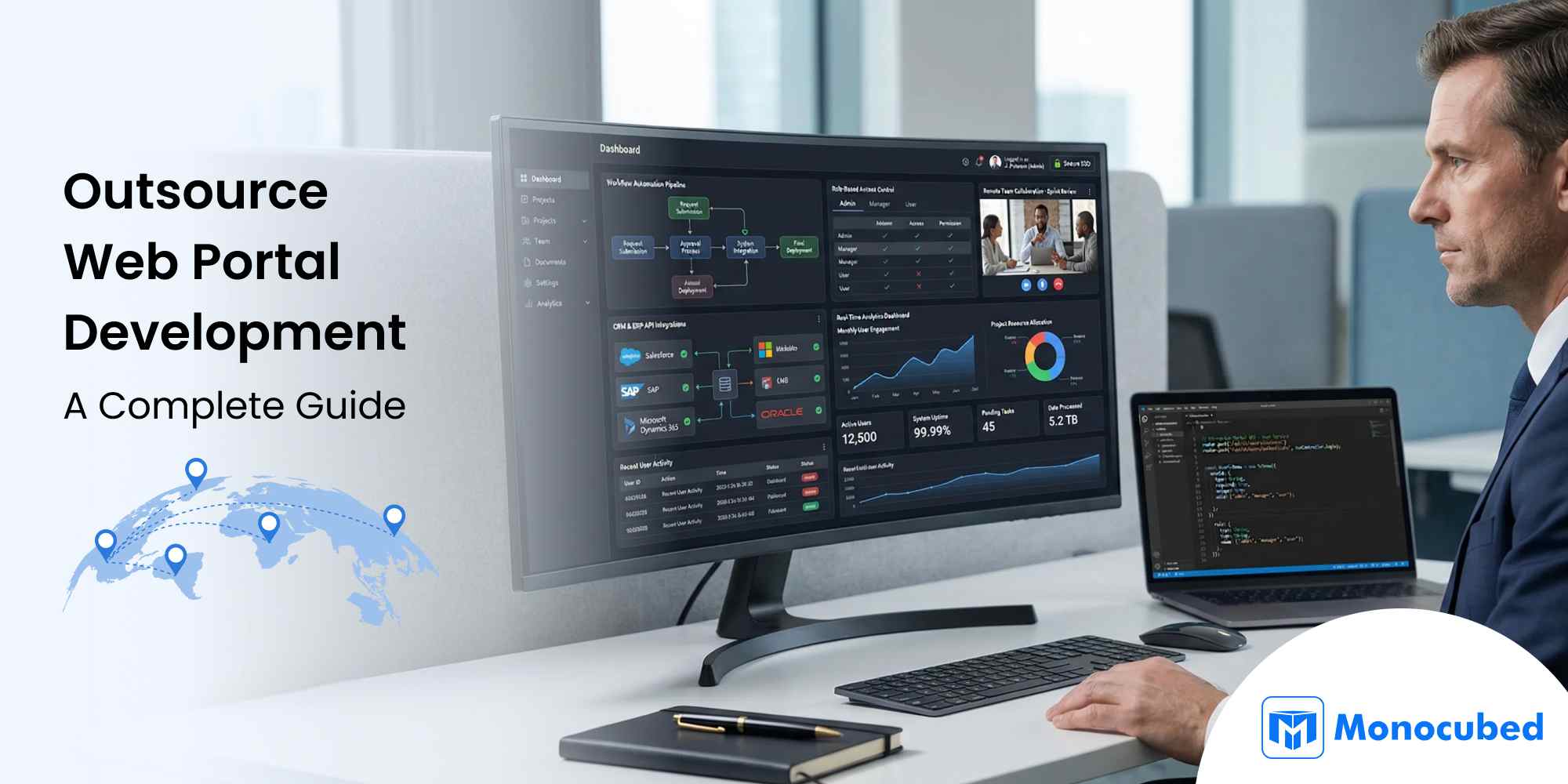
Unlike standard website development, portal development involves complex technical and functional requirements. It requires implementing role-based access controls, single sign-on (SSO) integration, workflow automation, real-time analytics dashboards, CRM and ERP API integrations, and enterprise-grade security compliance.
Delivering such solutions demands collaboration among frontend developers, backend engineers, UI/UX designers, QA specialists, and DevOps professionals. Building and onboarding this specialized team in-house can take three to six months and often involves significantly higher operational costs compared to partnering with an experienced web portal development service provider. This guide is for CTOs, product managers, and operations leaders at mid-to-large enterprises who are evaluating whether to outsource web portal development — and need a practical framework for choosing the right engagement model, partner, and budget.
Monocubed is a specialized web portal development company focused on custom enterprise portals, B2B platforms, and compliance-driven solutions — not a general freelance marketplace, template-based website builder, or offshore body shop.
Based on our extensive experience delivering from startup to enterprise portal solutions, this guide explains why outsourcing has become a preferred strategy for web portal development. It covers engagement models, partner selection frameworks, development workflows, cost considerations, and key challenges organizations should prepare for.
What is Outsourced Web Portal Development?
Outsourced web portal development is the practice of hiring an external web development company or team to design, build, and deploy a web portal on your behalf.
Instead of assembling an in-house team of developers, designers, and QA engineers, you partner with a company that already has this talent, along with the processes, tools, and experience needed to deliver portal projects efficiently.
The scope of outsourced portal work can range from building an entire portal from scratch to extending an existing platform with new features, integrating third-party systems, or providing ongoing maintenance and optimization after launch. The outsourcing partner handles the technical execution while you retain control over business requirements, design direction, and strategic decisions.
What separates portal outsourcing from general web development outsourcing is the technical complexity involved.
Web portals require multi-role authentication systems, data-level access controls, API integrations with enterprise tools like Salesforce and SAP, real-time data synchronization, and often compliance with regulations like HIPAA or GDPR.
These are not capabilities every web development company handles well, which makes partner selection particularly critical for portal projects.
Monocubed has delivered 200+ custom portal solutions since [founding year], specializing in role-based enterprise portals, HIPAA/GDPR-compliant platforms, and complex API integrations with Salesforce, SAP, and legacy systems. The team includes 50+ certified full-stack developers working across React.js, Angular, Node.js, Python Django, and PHP Laravel.
Understanding what outsourced portal development involves sets the context for a more practical question: when does outsourcing make more sense than building in-house?
Why Outsource Web Portal Development Instead of Building In-House?
The decision to outsource a web portal is not about taking shortcuts. It is about matching the technical complexity of the project with a team that has the right skills, processes, and experience to deliver it within a realistic timeline and budget.
Here are the key reasons why businesses outsourcing web portal development experts:
1. Access to specialized portal development expertise
Web portals are architecturally different from standard websites. They require role-based access control systems, SSO integration, multi-tenant data isolation, complex API orchestration, and compliance implementation. An outsourcing partner that has built dozens of portals brings proven solutions to these challenges. They have already solved the problems your team would encounter for the first time.
This specialized experience translates directly to fewer bugs, faster development cycles, and a more reliable final product. For a deeper look at the benefits of outsourcing web development, our dedicated guide covers the strategic and financial advantages in detail.
2. Faster time-to-market with proven processes
Outsourced web portal development companies do not start from scratch on every project. They have established development frameworks, reusable component libraries, pre-built authentication modules, and tested integration patterns.
A web site portal that might take an in-house team 8-12 months to build can often be delivered in 3-6 months by a team that has done similar work before.
For businesses where developing a customer portal or vendor platform directly impacts revenue, this time advantage translates to measurable business value—earlier user onboarding, faster process automation, and quicker return on investment.
3. Predictable portal development costs and reduced financial risk
Building an in-house development team requires significant upfront and ongoing investment, including salaries, employee benefits, infrastructure, software licenses, training, and management overhead,. regardless of whether the project progresses as planned. These fixed web portal development costs can quickly escalate, especially when project timelines extend or scope changes arise.
Outsourcing transforms these uncertain operational expenses into a clearly defined, project-based investment. With structured pricing models and milestone-driven payments, businesses gain better cost visibility, improved budget control, and reduced financial risk. This approach ensures transparency, allowing organizations to clearly understand deliverables, timelines, and expected outcomes at every stage of the web development lifecycle.
4. Scalable team capacity without long-term commitments
Portal development is not a constant workload. Discovery requires business analysts. Design requires UI/UX specialists. Development requires engineers across frontend, backend, and database. Testing requires QA specialists. An outsourcing partner assembles the right team composition for each phase and scales down when the work is complete. You never pay for idle capacity.
The strategic advantages of outsourcing are clear but the way you structure the engagement determines whether those advantages materialize. That brings us to choosing the right outsourcing model.
4 Outsourcing Models for Web Portal Development
Not all outsourcing arrangements work the same way. The model you choose affects your level of control, how costs are structured, and how flexible you can be when requirements evolve. And choosing the wrong model for your project type remains one of the most common mistakes businesses make when they outsource web development.
Here are the four primary models, along with clear guidance on when each one fits portal projects best.
1. Project-based (fixed-price) model
You define the full scope upfront—features, design requirements, integrations, timelines and the web portal development partner delivers the complete portal for a fixed price. Payments are tied to milestones: discovery completion, design approval, development sprints, and final delivery.
| Aspect | Details |
|---|---|
| Best for | Portals with well-defined scope and stable requirements |
| Pricing | Fixed total cost agreed before development starts |
| Control | Partner manages the team; you review at milestones |
| Flexibility | Limited—scope changes require formal change orders |
| Risk profile | Lower financial risk if scope remains stable |
This model works well for customer portals, vendor portals, and other projects where the feature set and integrations are clearly documented before development begins.
2. Dedicated team model
You hire a group of developers, designers, and QA engineers who work exclusively on your project. You manage priorities and sprint planning, while the outsourcing website portal development agency handles recruitment, HR, infrastructure, and administrative support.
| Aspect | Details |
|---|---|
| Best for | Complex portals with evolving requirements, long-term projects |
| Pricing | Monthly fee per team member |
| Control | You direct daily work and sprint priorities |
| Flexibility | High—adjust scope and direction as needed |
| Risk profile | Higher if requirements are unclear; lower for adaptive, long-running projects |
Dedicated web development teams are ideal for enterprise portals where requirements evolve through user feedback, where multiple integration phases are planned over quarters, or where continuous feature development extends well beyond the initial launch.
3. Time and materials (hourly) model
You define tasks and priorities, the team executes, and you pay for actual hours worked. This model provides maximum flexibility and is particularly useful when the full scope is difficult to define upfront.
This model suits portal maintenance phases, post-launch feature additions, and exploratory projects where you need to validate concepts before committing to a full build.
5. Hybrid model
Many portal projects benefit from combining models across different phases. For example, a fixed-price engagement for discovery and MVP development (where scope is defined), followed by a dedicated team model for ongoing feature development and optimization after launch.
The hybrid approach gives you budget certainty for the initial build while maintaining flexibility for post-launch iterations. It is the most practical model for portals that will evolve significantly based on user adoption data and stakeholder feedback.
Unsure Which Outsourcing Model Will Deliver the Best ROI?
Get personalized guidance from portal development specialists who have successfully delivered 200+ custom portal solutions across multiple engagement models.
Selecting the right outsourcing web portal development model structures the engagement. But the most consequential decision in outsourced portal development is the partner you choose. Let us break down how to evaluate that decision.
How to Choose the Right Web Portal Development Partner for Outsourcing
The web portal development firm or team you select determines the quality of your portal, the smoothness of the project, and the long-term viability of the platform. A wrong choice here costs time, missed business opportunities, and the trust of the users who depend on the portal daily.
Here are the evaluation criteria that matter most for outsourced portal projects, based on patterns we have observed across successful and unsuccessful engagements.
1. Verify portal-specific experience
General web development experience is not sufficient for portal projects.
Portals involve specific technical challenges like role-based access control architecture, SSO integration, multi-tenant data isolation, complex API orchestration with enterprise systems, and regulatory compliance implementation. Ask potential web development companies to demonstrate portal projects they have built, not just websites or basic web apps.
Review their portfolio for projects similar to yours in scope and industry.
If you want to build a B2B portal, look for B2B commerce case studies. If you need a patient portal with HIPAA compliance, verify they have built compliant solutions before. The closer their experience matches your project, the lower the risk of technical surprises during development.
2. Evaluate technical stack and team composition
A capable portal development partner should have full-stack expertise across modern technologies: frontend frameworks (React.js, Angular, Vue.js), backend technologies (Node.js, Python Django, Ruby on Rails, PHP Laravel), database systems (PostgreSQL, MongoDB, Redis), and cloud infrastructure (AWS, Google Cloud, Azure).
Equally important is team composition. A portal project typically requires a project manager, a UI/UX designer, two to four developers, a QA engineer, and a DevOps specialist. If the partner cannot provide this team structure, they may be subcontracting parts of the work to third parties which adds communication layers and increases quality risk.
3. Assess development process and communication practices
A structured web development process with defined phases, sprint reviews, and transparent reporting is non-negotiable. Ask potential development agencies or developers to walk you through their methodology from discovery to post-launch support.
Pay particular attention to communication. Ask these questions to ensure their workflow:
- How frequently do they provide updates?
- What tools do they use for project management?
- Do you get direct access to the developers building your portal or does every conversation filter through a project manager?
For portal projects that require iterative feedback on complex workflows, communication quality is often the strongest predictor of project quality.
4. Check references with measurable outcomes
Portfolios show what a company has built. References tell you what the experience was actually like. Ask for two to three client references from projects similar in scope to yours. Ask about timeline adherence, communication quality, how the partner handled scope changes, and whether they would engage them again.
Case studies that include specific outcomes like “reduced support ticket volume by 40%,” “cut procurement cycle time from five days to eight hours”, indicate an outsourced company that measures success by business impact, not just feature delivery.
5. Understand post-launch support and maintenance terms
A portal is not a build-and-forget product. It requires ongoing maintenance, security patches, performance optimization, and feature additions. Clarify what post-launch support the partner includes in the engagement and what ongoing maintenance costs.
Partners that include 90 days of post-launch support and offer flexible maintenance options (dedicated team, hourly retainer, or support-level agreements) demonstrate commitment beyond the initial project delivery.
6. Evaluate timezone and cultural alignment
For portal projects that require close collaboration—frequent design reviews, iterative feedback on workflows, and real-time issue resolution—timezone alignment significantly impacts productivity. A partner in a similar timezone enables real-time communication during your business hours, faster decision-making, and more productive sprint reviews.
Looking for a Reliable Web Portal Development Partner?
Get expert guidance from Monocubed on selecting the right team, technology stack, and development approach tailored to your business goals.
With the right web development partner identified, the next step is understanding what the actual web portal development process looks like from the first meeting to the portal launch.
The Outsourced Web Portal Development Process: 6 Step by Step
A well-structured process is what separates an outsourced portal project that delivers on time from one that spirals into delays and rework. When outsourcing portal development, the process should be transparent, collaborative, and driven by defined milestones at every stage.
Here is the typical end-to-end process, based on the methodology refined across 200+ portal projects at Monocubed. For a hands-on walkthrough of the build process itself, our step-by-step guide on how to create a web portal covers the technical fundamentals in detail.
Step 1: Discovery and requirements analysis
Every outsourced engagement should begin with a structured discovery phase. The development team conducts stakeholder interviews, documents user personas, maps existing workflows, identifies integration requirements with existing systems (CRM, ERP, databases), and defines compliance standards that apply to your industry.
Key deliverables include:
- Requirements specification document
- User flow diagrams
- Feature priority matrix (MVP vs. future phases)
- Technical architecture plan
- Project timeline with milestones and review points
Discovery typically takes two to four weeks. It is the single most important phase for preventing scope misalignment—a two-week investment in discovery can prevent months of costly rework by ensuring every stakeholder agrees on what will be built and in what order.
Step 2: UI/UX design and prototyping
With requirements documented, the design team creates wireframes and interactive prototypes that visualize how the portal will look and function for each user role.
Designs are organized around tasks—what each user needs to accomplish and how the interface supports those tasks with minimal friction.
Prototypes are reviewed with your team and tested with representative end users. This feedback loop catches usability issues before development begins, when changes cost a fraction of what they would during the build phase.
Design deliverables include wireframes for all major screens, a clickable interactive prototype, a visual design system (colors, typography, component library), and responsive layouts for desktop, tablet, and mobile devices.
Step 3: Agile development sprints
Development follows an agile methodology with two-week sprints. Each sprint has defined deliverables, and at the end of every sprint, you receive a working build to review and test. This iterative approach ensures you see progress continuously and can provide feedback that shapes the next sprint rather than discovering issues after the full build is complete.
The development phase covers frontend implementation, backend API architecture, database design, third-party integrations (Salesforce, SAP, payment gateways, communication tools), workflow automation configuration, and authentication setup including SSO and RBAC.
Step 4: Quality assurance and testing
Testing runs in parallel with development, not after it. QA engineers execute test cases for each feature as it is built. The testing scope typically includes:
- Functional Testing – Verifies that each feature operates according to defined requirements and specifications.
- Integration Testing – Ensures seamless communication and data exchange between the portal and connected systems such as CRM, ERP, or third-party APIs.
- Performance Testing – Evaluates how the portal performs under expected user load, traffic spikes, and concurrent usage scenarios.
- Security Testing – Identifies vulnerabilities, validates access controls, and ensures data protection measures are properly implemented.
- User Acceptance Testing (UAT) – Allows stakeholders and end users to validate workflows and confirm the portal meets real business and operational requirements.
For portals handling sensitive data in healthcare, finance, or insurance, penetration testing and compliance audits verify that security controls meet HIPAA, GDPR, PCI DSS, or SOC 2 standards.
Step 5: Deployment and launch
Deployment follows a staged approach. The portal is first released to a limited user group for controlled beta testing. Feedback from this rollout is used to fix issues and refine the experience before expanding access to the full user base.
The deployment process includes configuring production infrastructure (cloud hosting, CDN, SSL certificates), setting up monitoring and alerting systems, executing data migration from legacy systems when applicable, and establishing backup and disaster recovery protocols.
Step 6: Post-launch optimization and support
Launch is the starting point for optimization, not the end of the engagement. Analytics track user adoption, feature usage patterns, performance metrics, and error rates. Based on this data, the development team iterates on the portal—improving underperforming workflows, resolving friction points identified through real usage, and building features deferred from the initial release.
At Monocubed, all portal projects include 90 days of post-launch maintenance covering bug fixes, performance tuning, and minor feature adjustments. After the included support period, clients can engage our team on a dedicated or hourly basis for ongoing development.
With the development process understood, the next practical question decision-makers need answered is cost. Let us break down what outsourcing a web portal typically costs and what factors influence the numbers.
How Much Does It Cost to Outsource Web Portal Development?
Cost is one of the primary reasons businesses explore outsourcing, but it is also one of the most misunderstood aspects. The total investment in outsourcing nearshore or offshore portal development services depends on portal complexity, feature depth, the number of integrations, compliance requirements, design scope, and the development partner’s location and engagement model.
Here is a realistic breakdown based on common portal categories.
| Portal Type | Feature Scope | Outsourced Cost Range |
|---|---|---|
| Basic customer portal | User authentication, profile management, dashboard, support tickets | $10,000 – $25,000 |
| Mid-complexity portal | RBAC, workflow automation, 2-3 system integrations, responsive design | $25,000 – $55,000 |
| Advanced enterprise portal | SSO, real-time dashboards, 5+ integrations, compliance features, analytics | $55,000 – $100,000 |
| Large-scale platform | Multi-tenant architecture, AI features, complex integrations (SAP, Oracle), global deployment | $100,000 – $200,000+ |
Key factors that drive outsourcing costs
Portal complexity and feature depth: A customer self-service portal with basic account management costs a fraction of an enterprise platform with real-time dashboards, multi-level approval workflows, and AI-powered analytics. Each additional layer of functionality adds design, development, and testing effort.
Number and complexity of integrations: Each third-party integration like CRM, ERP, payment gateway, email service, analytics platform requires API development, data mapping, authentication configuration, and testing. Integrations with legacy systems that lack modern APIs are particularly expensive because they often require custom middleware or API wrappers.
Compliance and security requirements: Portals in regulated industries (healthcare, finance, insurance) require encryption protocols, audit logging, penetration testing, and compliance documentation. These requirements typically add 15-25% to the base development cost.
Engagement model and partner location: According to Accelerance’s 2025 Global Software Outsourcing Rates Guide, nearshore partners (USA, Canada, Latin America) typically charge $40-$80 per hour, offshore partners (India, Eastern Europe, Southeast Asia) range from $20-$50 per hour, and North American agencies charge $80-$150+ per hour.
However, hourly rates alone do not determine total portal development cost—a more experienced team at a higher rate often delivers faster with fewer rework cycles, resulting in a lower total investment.
Outsourcing vs. in-house cost comparison
The following table compares the total cost of building a web portal with an in-house US-based team versus outsourcing to a development partner, covering hiring, salaries, benefits, infrastructure, and management overhead.
| Cost Factor | In-House Team (USA) | Outsourced Partner |
|---|---|---|
| Hiring and onboarding | 3-6 months, $15,000-$30,000 per hire | Immediate availability, no hiring cost |
| Annual salaries (5-person team) | $400,000-$700,000+ | $60,000-$200,000 (project-based) |
| Benefits and overhead | 25-35% on top of salaries | Included in engagement fee |
| Infrastructure and tools | $10,000-$30,000/year | Included |
| Management overhead | Internal project management required | Partner manages execution |
| Scaling | Hire/fire cycle for capacity changes | Scale team per project phase |
For an instant ballpark estimate based on your specific requirements, use our Web Cost Calculator.
Web development cost clarity helps with budgeting, but understanding the common pitfalls that inflate costs is equally important. Let us walk through the mistakes that derail outsourced portal projects and how to avoid them.
7 Common Mistakes When Outsourcing Web Portal Development
Most failed outsourcing engagements share the same root causes—not technical failures, but process and communication breakdowns that are entirely preventable. Here are seven mistakes that consistently derail outsourced portal projects, along with practical strategies to avoid each one.
1. Skipping the discovery phase to save time
Some businesses push to start development immediately, treating discovery as an optional expense. This almost always backfires. Without thorough requirements analysis, the development team builds based on assumptions. The result is a portal that misses critical workflows, requires expensive rework, and launches months behind the original schedule.
How to avoid it: Experienced teams such as Monocubed typically conduct stakeholder interviews, workflow mapping, and technical feasibility assessments to ensure every business requirement is clearly documented before development begins. This early investment significantly reduces rework and scope creep.
2. Choosing a partner based solely on price
The lowest quote rarely delivers the best outcome. Partners that underquote often use junior developers, underestimate scope, or plan to charge significantly for change requests. When the inevitable scope adjustments arrive, the “affordable” partner becomes the expensive one.
How to avoid it: Evaluate partners based on their portal development experience, delivery methodology, and client success track record. A reliable portal site development partner will provide transparent cost breakdowns, realistic timelines, and technical recommendations instead of simply offering the lowest estimate.
3. Providing vague or incomplete requirements
Telling a development partner to “build a customer portal” without defining user roles, feature priorities, integration requirements, compliance needs, and design direction guarantees misalignment. Vague requirements give the partner room for interpretation—and their interpretation rarely matches your vision.
How to avoid it: Create a detailed requirements document before engaging a partner. Define user personas, feature lists organized by priority, specific integration needs, compliance standards, and acceptance criteria for each major workflow.
Mature portal development teams often help businesses transform high-level ideas into detailed technical documentation, prioritized feature roadmaps, and defined acceptance criteria.
4. Neglecting communication and feedback loops
Outsourcing does not mean delegating and disappearing for three months. Portal projects require regular feedback at every stage—design reviews, sprint demos, integration checkpoints, and user testing sessions. When clients disengage during development, the final product drifts from their expectations in ways that are expensive to correct.
How to avoid it: Attend weekly or bi-weekly check-ins consistently. Review every sprint deliverable. Designate a decision-maker on your side who can provide timely, authoritative feedback without delays.
5. Treating security as an afterthought
Retrofitting security and compliance into a portal after development is exponentially more expensive than building it in from the beginning. Businesses that defer security to a “final phase” often discover architecture-level vulnerabilities that require significant refactoring to resolve.
How to avoid it: Define compliance requirements (HIPAA, GDPR, PCI DSS, SOC 2) during the discovery phase. Verify that your development partner has built compliant solutions previously. Include security testing as a continuous part of the QA process.
Engage a development partner that integrates compliance and security planning from the discovery stage. Strong teams conduct risk assessments, implement secure coding standards, and include continuous security testing throughout development rather than treating it as a final checkpoint.
6. Not planning for post-launch maintenance
A portal is a living product that requires ongoing security patches, performance optimization, bug fixes, and feature additions. Businesses that outsource the initial build without planning for post-launch support end up with a platform that degrades in performance and security over time.
How to avoid it: Include post-launch maintenance in your outsourcing agreement from the start. Understand the partner’s support options included maintenance windows, dedicated team arrangements, hourly retainer models. Budget for ongoing maintenance cost at 15-20% of the initial development cost per year.
7. Failing to define measurable success criteria
Without clear metrics, you cannot objectively evaluate whether the project succeeded. “The portal is live” is not a meaningful success criterion. “User adoption reaches 80% within 60 days” or “support ticket volume decreases by 35% within 90 days of launch” are.
How to avoid it: Define measurable success criteria before development begins. Common portal metrics include user adoption rate, task completion time, support ticket reduction, workflow cycle time improvement, and system uptime. Track these post-launch to validate ROI and prioritize optimization efforts.
These mistakes are preventable with the right web portal development agency and a disciplined approach to the engagement. That brings us to why businesses trust Monocubed for outsourced portal development.
Why Choose Monocubed to Outsource Your Web Portal Development
Selecting an outsourcing partner for web portal development is a strategic decision that impacts your operations, your users, and your bottom line for years after the portal goes live. Monocubed is consistently recognized among the leading web portal development companies for technical depth, delivery reliability, and long-term client partnerships.
Here is what we bring to outsourced portal projects:
- Deep portal development expertise: We have built customer self-service portals, employee intranets, vendor management platforms, B2B commerce portals, and compliance-driven solutions for regulated industries.
- 50+ certified full-stack developers: Our team works across React.js, Angular, Node.js, Python Django, Ruby on Rails, Vue.js, and PHP Laravel. We handle frontend development, backend API architecture, database design, third-party integrations, cloud infrastructure, and DevOps—everything under one roof with no subcontracting.
- Structured 6-phase development process: From discovery and design through development, testing, deployment, and post-launch support, every phase has defined deliverables, review checkpoints, and transparent reporting. You see progress at every stage and provide feedback that shapes the outcome.
- Flexible engagement models: Project-based, dedicated team, hourly, or hybrid—we match the engagement structure to your project requirements and budget constraints. All models include 90 days of post-launch maintenance support at no additional cost.
- Enterprise-grade security and infrastructure: We deploy on AWS with 24/7 monitoring, end-to-end encryption, and a 99.9% uptime guarantee. Our portal solutions meet HIPAA, GDPR, PCI DSS, and SOC 2 compliance standards for regulated industries.
- 98% client satisfaction rate: This number reflects our focus on building portals that solve real business problems, not just portals that technically function. We measure success by the business outcomes our clients achieve after launch.
Ideal for: Enterprises outsourcing customer self-service portals. B2B companies building vendor or partner management platforms. Healthcare organizations requiring HIPAA-compliant patient portals. Financial institutions needing PCI DSS-ready compliance portals. SaaS companies building multi-tenant portal products. Organizations replacing legacy portals with modern, API-driven platforms.
Get the Right Development Experts for Your Project
Outsourcing web portal development gives you access to specialized expertise, proven processes, and flexible engagement models without the overhead of building an internal team from scratch. The success of your project depends on three decisions: choosing the right engagement model, selecting a partner with genuine portal experience, and staying actively involved throughout the process.
Whether you need a customer portal, a B2B commerce platform, or a compliance-driven enterprise solution, the right outsourcing partner turns your requirements into a portal that users adopt and that delivers measurable business results.
Explore our development services to see how Monocubed can help, or schedule a free consultation to discuss your project.
Get a Detailed Roadmap for Your Outsourced Portal Project
Share your requirements and receive a transparent project proposal with timeline, team composition, and cost breakdown within hours.
Frequently Asked Questions About Outsourcing Web Portal Development
-
What types of web portals can be outsourced?
Virtually any type of web portal can be outsourced effectively. Common types include customer self-service portals, employee intranets, vendor and supplier management portals, B2B commerce platforms, patient portals, partner channel portals, and compliance-driven portals for regulated industries like healthcare and finance. The critical factor is not the portal type but the outsourcing partner’s specific experience with similar projects. For a complete breakdown of portal categories, see our guide on types of web portals.
-
How long does outsourced web portal development take?
Timelines depend on complexity and scope. A basic customer portal with standard features typically takes 6-10 weeks. Mid-complexity portals with workflow automation and multiple integrations require 3-5 months. Large-scale enterprise portals with advanced analytics, compliance requirements, and extensive integrations can take 8-12 months. Starting with an MVP and iterating in phases is the most effective way to deliver value faster while managing timeline expectations.
-
How do I protect my intellectual property when outsourcing?
Reputable development partners sign non-disclosure agreements (NDAs) and work-for-hire contracts that assign full intellectual property ownership to you upon payment. Ensure your agreement explicitly states that all source code, design assets, documentation, and related deliverables are your property. Review IP clauses with legal counsel before signing any engagement contract.
-
What should I include in a requirements document before outsourcing?
A strong requirements document includes the portal’s business objectives, user personas with specific workflows for each role, a prioritized feature list (MVP vs. future phases), integration requirements (CRM, ERP, payment, communication tools), applicable compliance standards (HIPAA, GDPR, SOC 2), design preferences or brand guidelines, performance expectations (concurrent users, target response times), and a preferred project timeline.
-
Can I outsource portal development to a team in a different timezone?
Yes, but timezone difference directly affects communication speed and feedback cycles. For projects requiring close collaboration—iterative design reviews, frequent sprint feedback, rapid issue resolution—a partner in a similar timezone is more productive. For projects with well-defined scope and less frequent touchpoints, timezone gaps are manageable through asynchronous communication tools and scheduled overlap hours.
-
What happens after the outsourced portal launches?
Post-launch support typically includes bug fixes, performance monitoring, security patches, and minor feature adjustments. Most outsourcing partners offer a defined support window (60-90 days) included in the project cost. After that period, you can engage the partner for ongoing maintenance through dedicated team arrangements, hourly retainers, or support-level agreements. Planning for post-launch maintenance is essential—portals need continuous updates to remain secure, performant, and aligned with evolving business needs.
-
How much does it cost to outsource a basic web portal?
A basic customer portal with user authentication, profile management, a dashboard, and support ticket functionality typically costs $10,000-$25,000 when outsourced to a nearshore development partner. Mid-complexity portals with workflow automation and system integrations range from $25,000-$55,000. Enterprise portals with advanced features and compliance requirements can cost $55,000-$200,000+. Total cost depends on feature complexity, number of integrations, compliance needs, and the engagement model.
-
Should I outsource my web portal to a freelancer or a development company?
Freelancers can work for smaller, well-defined tasks like building a single feature or fixing specific issues. However, portal development requires coordinated work across frontend, backend, database, UI/UX, QA, and DevOps—skills that rarely exist in a single person. A development company provides a complete team with established workflows, code review processes, and accountability structures. Companies also offer continuity—if one developer is unavailable, the project continues. For portal projects with multiple integrations, compliance requirements, or long-term maintenance needs, a development company is the more reliable and scalable choice.
-
How do I ensure quality when outsourcing portal development?
Quality assurance starts with partner selection—verify their portal portfolio, check client references, and evaluate their testing methodology. During the engagement, review working software at the end of every two-week sprint. Require comprehensive testing that covers functional, integration, performance, and security validation. Define acceptance criteria for each feature so there is an objective quality standard. Post-launch, track adoption metrics and user feedback to identify areas for continuous improvement.
-
What post-launch support does Monocubed include with outsourced portal projects?
All Monocubed portal projects include 90 days of post-launch maintenance at no additional cost, covering bug fixes, performance tuning, and minor feature adjustments. After the included support period, clients can engage on a dedicated team basis, hourly retainer, or support-level agreement. We recommend budgeting 15–20% of initial development cost annually for ongoing maintenance, security patches, and feature enhancements.

 All our projects are secured by NDA