
 By Yuvrajsinh Vaghela
Contents
Your travel agency spent last week manually checking hotel availability across three different booking systems while a customer waited on the phone. By the time you confirmed the room, they’d already booked on Expedia.
This scenario plays out thousands of times daily across travel businesses still relying on manual processes.
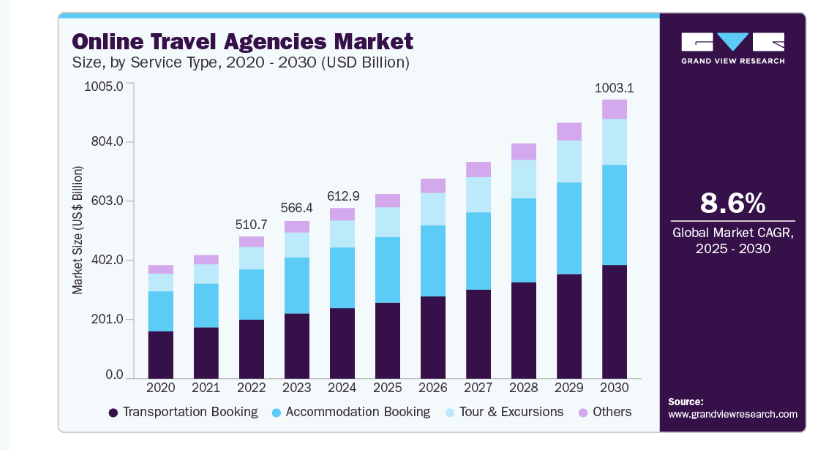
According to Grand View Research, The global online travel agencies market size was estimated at USD 612.95 billion in 2024 and is projected to reach USD 1,003.13 billion by 2030, growing at a CAGR of 8.6% from 2025 to 2030.
Custom travel portal development solves this by creating a centralized booking platform where customers search destinations, compare prices across suppliers, book flights, hotels, and activities, and manage itineraries through a single interface. The right travel booking portal transforms scattered operations into streamlined digital experiences that scale efficiently.
As a web portal development company, we’ve helped businesses build complex platforms that handle real-time data, secure transactions, and multi-system integrations. We’ve delivered multi-vendor projects like MoovStore and Sayyar that require complex inventory management and supplier integrations.
With our extensive experience, we’ve created this guide which covers:
- What is a travel portal and how it transforms booking operations
- 5 key benefits of building an online travel portal
- 5 types of travel portals and which model fits your business
- Must-have travel portal features ranked by impact
- Travel portal architecture and technology stack
- Step-by-step travel portal development process
- Realistic travel portal development cost breakdown
- Common mistakes and how to avoid them
Let us start with understanding what travel portal development actually involves.
What is a Travel Portal?
A travel portal is a secure, web-based platform that serves as the central hub for all travel booking activities. Rather than managing bookings through fragmented channels like phone calls, emails, and multiple supplier websites, everything happens through one interface.
Through a travel booking portal, customers can search destinations, compare flight and hotel options, book services, make secure payments, and manage their itineraries. For travel businesses, this centralized approach improves visibility, reduces manual work, and enables 24/7 booking capability.
How a travel portal transforms your business operations
A well-implemented online travel portal fundamentally changes how travel businesses operate and serve customers.
When a customer searches for a flight, the portal simultaneously queries multiple data sources—Global Distribution Systems (Amadeus, Sabre, Travelport), hotel aggregators (Hotelbeds, Expedia Partner Solutions), and direct supplier APIs. Results are normalized into a consistent format, displayed to the user, and bookings are processed automatically with instant confirmation.
The operational impact is significant. Manual booking processes that took 30-60 minutes per transaction reduced to under 5 minutes. Customers can book at 3 AM without staff involvement. Error rates drop because data flows directly between systems without manual re-entry.
Pro Tip: Before building a travel portal, document your current booking volume, average transaction value, and time spent per booking. These baseline metrics help you calculate ROI and prioritize features that deliver the most value.
Understanding what a travel portal does helps you evaluate whether the investment makes sense. But quantifying the benefits requires examining specific value drivers.
5 Benefits of Building an Online Travel Portal for Your Business
The business case for travel portal development extends beyond operational efficiency. Organizations invest in custom travel booking platforms because the benefits compound across multiple dimensions of the business.
Here are the 5 key benefits of developing a travel portal for your business.
1. Capture the growing online travel market
Travel businesses without robust online booking capabilities are excluded from market growth. According to Statista, online travel booking penetration grew from 35% in 2016 to over 65% in 2024, with projections reaching 75% by 2028.
Customers who prefer online booking simply choose competitors who offer it. Building a travel portal isn’t just about efficiency—it’s about accessing the majority of travel spending that now happens digitally.
| Market Metric | 2024 Value | 2030 Projection |
|---|---|---|
| Global Online Travel Market | $475 billion | $1+ trillion |
| Online Booking Penetration | 65% | 75%+ |
| Mobile Travel Bookings | 60% of online | 70%+ |
2. Dramatic reduction in operational costs
Manual travel booking is labor-intensive. Agents spend hours searching availability, calling suppliers, creating quotes, and processing payments. A single complex itinerary can require 4-6 hours of agent time.
Travel portals automate these processes. Customers self-serve through search and booking interfaces. Payment processing happens automatically. Confirmations generate instantly.
According to industry benchmarks, automated booking processes reduce operational costs by 40-60% compared to manual handling. For a travel agency processing 500 bookings monthly, this automation can eliminate 200-400 hours of manual work.
3. Provide 24/7 booking availability
Travel decisions don’t follow business hours. A customer researching their vacation at 11 PM wants to book immediately, not wait until morning. International customers in different time zones expect service availability when convenient for them.
Google research indicates that 65% of leisure travel searches occur outside traditional business hours. Without 24/7 booking capability, travel businesses miss the majority of potential customer touchpoints.
4. Access global supplier inventory
Traditional travel agencies access supplier inventory through personal relationships and manual processes. This limits selection and requires constant relationship maintenance.
Travel portals connect to global distribution systems and aggregator APIs that provide access to millions of hotels, thousands of airlines, and countless activity providers worldwide. A single GDS integration can provide access to 400+ airlines and 600,000+ hotels—inventory breadth impossible to achieve through direct relationships alone.
5. Generate valuable customer data
Every interaction on a travel portal generates data. Search patterns reveal destination interests and price sensitivity. Booking history shows travel preferences and frequency. Abandoned carts indicate conversion obstacles and pricing thresholds.
This data enables:
- Personalized marketing based on demonstrated travel interests
- Dynamic pricing optimized for conversion and margin
- Inventory decisions stocking what customers actually want
- Customer segmentation for targeted campaigns
- Trend identification for business planning and supplier negotiations
Travel businesses operating manually lack this visibility entirely. They can’t systematically track what customers search for, why bookings are abandoned, or how pricing affects conversion.
Modern travel portals are also evolving with advanced technologies. Built-in analytics dashboards highlight trends and booking patterns, while AI-powered features can predict demand, personalize recommendations, and optimize pricing in real-time. Top web portal development firms like Monocubed integrate these technologies to create a future-ready portal for the travel agency.
Want to Build a Custom Travel Portal?
Monocubed can help you build a customized travel booking platform that streamlines your operations and captures online bookings 24/7.
Once you understand the benefits, the next thing to explore the different types of web portals for travel organizations.
What Are the Different Types of Travel Portals?
Not all travel portals serve the same purpose. Understanding the different types helps identify which model aligns with your goals and target audience.
| Portal Type | Target Audience | Examples | Best For |
|---|---|---|---|
| Portal Type | Target Audience | Examples | Best For |
| B2C Travel Portal | Direct consumers | Expedia, Booking.com | Consumer travel agencies |
| B2B Travel Portal | Travel agents, agencies | Travelport, TBO Holidays | Wholesalers, consolidators |
| B2B2C Travel Portal | Agents serving consumers | Sabre Red, Amadeus | Travel agency chains |
| Corporate Travel Portal | Business travelers | SAP Concur, TripActions | Enterprise travel management |
| Niche Travel Portal | Specific segments | Hostelworld, Virtuoso | Specialized markets |
1. B2C travel portals
B2C portals serve individual travelers directly. Customers search, compare, and book travel services through the website or app without intermediary involvement.
The B2C model requires significant investment in user experience, marketing, customer support, brand building, and content. These portals monetize through supplier commissions (10-25% on hotels, smaller margins on flights) and advertising revenue.
2. B2B travel portals
B2B portals serve travel professionals rather than end consumers. These platforms provide inventory access, booking tools, and back-office functionality for travel agents and tour operators.
Key features include wholesale pricing with agent markup capability, white-label booking engines, credit management, agent dashboards, and API access for integration with agent systems.
3. Corporate travel portals
Corporate portals focus on business travel management. According to GBTA, global business travel spending reached $1.4 trillion in 2024.
These portals emphasize policy compliance, expense integration, approval workflows, duty of care tracking, and negotiated rate access. Requirements differ significantly from leisure travel—compliance and control matter more than price comparison.
4. Niche travel portals
Niche portals focus on specific traveler segments, destinations, or travel styles—budget travel, luxury travel, adventure travel, or destination specialists.
Specialization offers advantages: reduced competition, stronger brand positioning, community building, and premium pricing potential. A portal focused on luxury African safaris can charge higher margins and build deeper expertise than a general travel site.
Custom Travel Portal vs Off-the-Shelf Solutions: The Detailed Comparison
Before investing in custom travel portal development, it’s important to assess whether a packaged solution meets your needs or if a tailored approach is required.
1. Understanding your options
Commercial travel booking platforms like Travelport, Amadeus Selling Platform, and various white-label solutions offer pre-built functionality. They provide established integrations, existing supplier relationships, and subscription pricing typically ranging from $500 to $5,000+ monthly depending on booking volume.
Custom travel portal development takes the opposite approach. You build a system specifically designed for your workflows, brand, and target market. You create direct integrations with your chosen suppliers, maintain complete control over features and user experience, and pay a one-time development cost with lower ongoing expenses.
2. When custom development makes sense
| Decision Factor | Off-the-Shelf Solution | Custom Development |
|---|---|---|
| Process fit | Standard booking workflows | Unique customer journeys or niche markets |
| Supplier relationships | Standard GDS access | Direct supplier APIs, exclusive inventory |
| Branding | Limited customization | Fully branded experience |
| Pricing control | Platform-defined markups | Custom pricing rules and margins |
| Data ownership | Shared or limited access | Complete ownership and analytics |
| Long-term cost | Ongoing licensing fees | Higher upfront, lower recurring |
| Competitive advantage | Same as competitors | Unique differentiator |
If your target market, supplier relationships, or customer experience requirements are unique, custom travel portal development provides the flexibility that packaged software cannot.
9 Key Features Every Travel Portal Should Have
Selecting the right features determines whether a travel portal becomes a revenue-generating platform or an underutilized digital asset. Successful travel portals focus on capabilities that improve booking efficiency, enhance customer experience, and support long-term scalability.
Based on proven implementations across travel agencies, tour operators, and OTAs, the following features of web portals consistently deliver measurable business impact.
1. Advanced search and filtering
Search functionality is the heart of any travel portal. Users must find relevant options quickly across millions of potential combinations.
Essential capabilities include multi-city and flexible date search, price comparison across suppliers, filter options (stops, airlines, amenities), map-based hotel search, saved searches with price alerts, and search history for repeat searches.
2. Real-time booking engine
The booking engine converts search activity into confirmed reservations, making performance reliability essential for customer retention and revenue generation. Any delay or booking failure increases the risk of losing customers to competing platforms.
Core capabilities include real time availability verification, dynamic pricing updates, seat and room selection, ancillary services handling, multi item booking support, and self service booking modifications.
3. Secure payment gateway integration
Travel transactions typically involve high booking values, making secure and flexible payment processing a critical trust factor. A well integrated payment system supports global transactions while minimizing fraud risk.
Travel portals should support multiple payment methods such as credit cards, digital wallets, and Buy Now Pay Later options, along with multi currency support, PCI DSS compliance, fraud detection systems, split payment capabilities for group bookings, and automated refund processing.
4. Dynamic packaging capabilities
Dynamic packaging allows users to combine flights, hotels, transportation, and activities into a single booking experience. This functionality helps travel portals offer bundled pricing while improving customer convenience.
Bundled travel packages often provide savings ranging from 15 to 30 percent compared to individual bookings. This approach not only increases perceived customer value but also helps travel providers improve margins through supplier partnerships.
5. User profile and trip management
Personalization and convenience play a major role in travel platform adoption. User profile management enables faster booking experiences and improves customer loyalty.
Essential profile features include traveler information storage, booking history, upcoming trip dashboards, saved traveler profiles for group bookings, and loyalty program integration. Trip management functionality should offer unified itinerary views, real time travel alerts, self service booking changes, and access to travel documentation.
6. Reviews and ratings system
Travel decisions rely heavily on user-generated content and peer recommendations. Review functionality helps build credibility and reduces decision friction during the booking journey.
TripAdvisor research indicates that 81 percent of travelers consider reviews important when booking accommodations. Effective review systems include post-trip feedback prompts, multi-parameter rating criteria, photo uploads, moderation workflows, and aggregated reviews from external sources.
7. Content management system
Travel purchasing is strongly influenced by destination inspiration and educational content. A built-in content management system supports customer engagement while strengthening organic search visibility.
Key CMS capabilities include destination guides, blog publishing for SEO growth, multimedia galleries, promotional deal pages, and multilingual content delivery for global audiences.
8. Mobile optimization
Mobile devices now dominate travel booking behavior, making mobile performance a core requirement rather than an optional feature.
Phocuswright reports that online gross bookings are projected to reach $1.0 trillion in 2024 and grow to $1.2 trillion by 2026, with nearly 65 percent of global travel gross bookings expected to occur online. This rapid shift toward digital booking experiences highlights the need for travel portals to deliver seamless mobile and web performance.
9. Admin dashboard and analytics
Operators need visibility into platform performance. Include real-time booking dashboard, revenue analytics with margin analysis, supplier performance tracking (successful vs. failed bookings), customer analytics (acquisition, conversion, retention), and automated report generation.
Other features to consider while building a travel portal:
- Multi-language and multi-currency support – Serve international travelers with localized interfaces
- Loyalty and rewards program – Track points, tier status, and redemption
- Price alerts and notifications – Automated alerts for price drops on saved searches
- Travel insurance integration – Offer protection products during checkout
- Visa and documentation assistance – Information on entry requirements by destination
- Customer support integration – Live chat, chatbot, and ticketing systems
- Affiliate and partner management – Track referrals and commission payments
Need Help Prioritizing Travel Portal Features?
Our team has built 200+ web applications and knows which features deliver the best ROI for travel booking platforms.
All these features of a web portal are important to integrate during the development. In the next section, let’s learn about the development process and launch a scalable travel portal.
How to Build a Travel Portal: 6-Step Development Process
Developing a custom travel portal requires structured planning, user-centric design, and phased execution to ensure scalability, performance, and seamless supplier connectivity.
A well-defined web portal development process reduces implementation risks, improves time to market, and ensures the platform aligns with both business objectives and customer expectations.
Step 1: Discovery and requirements analysis
Objective: Establish a clear understanding of business needs, target market, and integration requirements.
Activities:
- Map current booking processes, documenting workflows and pain points
- Identify target customer segments and their booking preferences
- Define integration requirements with GDS, suppliers, and payment systems
- Capture regulatory and security requirements
- Determine success metrics and expected ROI
Importance: Comprehensive documentation prevents scope creep. Clear requirements allow for accurate budgeting and timeline estimation.
Expected Outcome: Detailed requirements specification serving as the blueprint for development.
Step 2: UX/UI design and planning
Objective: Translate requirements into an intuitive interface optimized for booking conversion.
Activities:
- Conduct user research to understand booking behavior
- Develop wireframes for search, results, and booking flows
- Create high-fidelity mockups for desktop and mobile
- Build interactive prototypes for usability testing
Importance: An intuitive design improves conversion rates. According to Baymard Institute, the average checkout abandonment rate is 70%—travel is even higher due to booking complexity.
Expected Outcome: Approved design package guiding development.
Step 3: Core development
Objective: Build the portal’s backend, frontend, and integrations using agile methodology.
Activities:
- Backend development for authentication, booking logic, and API services
- Frontend development for responsive search and booking interfaces
- Admin panel for booking management, reporting, and configuration
- Iterative sprints with regular demos for feedback
Importance: Iterative development ensures features meet requirements and reduces costly rework.
Expected Outcome: Functional portal with core modules operational.
Step 4: Integration implementation
Objective: Connect the portal with GDS, suppliers, and payment systems.
Activities:
- GDS certification and API implementation
- Hotel aggregator and activity platform connections
- Payment gateway integration with fraud detection
- Response normalization for consistent data display
- Error handling for supplier failures
Importance: Integration issues discovered late cause significant delays. Start integration work early.
Expected Outcome: Reliable supplier connections with real-time availability and booking capability.
Step 5: Testing and quality assurance
Objective: Verify the portal operates correctly, securely, and efficiently.
Activities:
- Functional testing across all booking workflows
- Integration testing with suppliers and payment systems
- Performance testing under simulated load
- Security testing including penetration testing
- User acceptance testing with pilot customers
Importance: Comprehensive testing prevents operational disruption and protects customer data.
Expected Outcome: Stable, secure, fully functional portal validated for launch.
Step 6: Deployment and optimization
Objective: Deploy safely and continuously improve based on usage data.
Activities:
- Staged deployment with monitoring capabilities
- Customer training and support documentation
- Track usage metrics and conversion rates
- Optimize features based on analytics and feedback
Importance: Continuous optimization ensures long-term value and competitive positioning.
Expected Outcome: Live portal with verified performance and ongoing improvement process.
Ready to Start Your Travel Portal Development Project?
Our team follows a proven development process that delivers on time and within budget.
After identifying the essential features that define a high performing travel portal, the next question most businesses ask is about investment requirements.
How Much Does It Cost to Develop a Travel Portal?
The average cost to develop a custom travel portal typically ranges from $30,000 to $350,000+, depending on features, integrations, and complexity. Here is the detailed breakdown of web portal development costs for travel companies.
Cost breakdown by portal complexity
| Complexity | Features Included | Average Cost (USD) | Timeline |
|---|---|---|---|
| Basic | Search, booking, payment, basic admin | $30,000–$60,000 | 3-4 months |
| Intermediate | Multiple suppliers, packages, user accounts, mobile-responsive | $70,000–$150,000 | 5-8 months |
| Advanced | Full GDS integration, dynamic packaging, mobile apps, analytics | $150,000–$350,000+ | 8-14 months |
Cost breakdown by development region
| Region | Average Hourly Rate |
|---|---|
| North America | $100–$200/hr |
| Europe | $70–$150/hr |
| India / APAC | $25–$75/hr |
Key factors affecting travel portal development cost
- Features and functionality: The number and complexity of modules directly impact development time and cost.
- Integrations: Each GDS and supplier integration adds significantly to cost, especially for real-time API integrations. GDS certification processes alone can add months to timelines.
- Security and compliance: PCI DSS compliance for payments, GDPR for European customers, and data protection requirements increase development effort.
- Design and user experience: Custom design improves conversion but requires additional UI/UX development hours.
- Maintenance and support: Ongoing costs for hosting, updates, and support typically run 15-20% of initial development cost annually.
While maintenance and support represent a predictable long-term investment, many travel businesses underestimate operational challenges that emerge after launch. Ignoring best practices during development can lead to performance issues, integration failures, and increased maintenance expenses over time.
Understanding common development mistakes helps organizations avoid costly rework, improve platform reliability, and maximize return on their investment.
5 Travel Portal Development Mistakes and How to Avoid Them
Avoiding common development pitfalls is significantly more cost-effective than fixing them after launch. Based on real-world travel portal implementations, Monocubed has helped travel businesses overcome recurring technical and strategic challenges that often impact performance, scalability, and user adoption.
1. Underestimating integration complexity
Many travel portal projects fail to accurately estimate the time and technical effort required for GDS and third-party supplier integrations. Travel APIs often involve certification processes, data formatting challenges, and supplier-specific requirements that can delay project timelines.
How Monocubed helps:
Monocubed follows an integration-first development approach, allocating dedicated timelines for GDS, aggregator, and supplier connectivity. Their travel-experienced development teams begin integration planning early in the project lifecycle to reduce delays and ensure reliable booking functionality.
2. Neglecting mobile experience
Many businesses design travel portals primarily for desktop users and later attempt to adapt them for mobile devices. This approach often results in inconsistent user experiences and reduced booking conversions, especially since mobile users now dominate travel searches and bookings.
How Monocubed helps:
Monocubed applies a mobile-first design strategy, ensuring booking workflows, search performance, and payment experiences are optimized across smartphones and tablets from the initial design stage. Continuous cross-device testing helps maintain usability and conversion efficiency.
3. Ignoring performance optimization
Travel portals simultaneously process data from multiple suppliers, which can slow down search results and booking confirmation if performance optimization is not addressed early. Slow response times directly impact customer retention and booking completion rates.
How Monocubed helps:
Monocubed implements advanced caching strategies, scalable architecture, and performance monitoring frameworks during development. The team also establishes performance benchmarks, such as delivering search results within three seconds, to maintain consistent user experience and platform speed.
4. Building features nobody uses
Travel portals sometimes include excessive functionality based on assumptions rather than real user demand. This often increases development costs, complicates platform management, and reduces system efficiency.
How Monocubed helps:
Monocubed focuses on MVP-driven development, prioritizing core booking workflows and essential user features. The platform is then enhanced based on real user analytics and business performance insights, allowing clients to scale features strategically.
5. Launching without marketing strategy
Many travel businesses focus heavily on development while overlooking marketing and user acquisition planning. Even well-built portals struggle to generate bookings without a strong digital visibility strategy.
How Monocubed helps:
Beyond development, Monocubed supports clients with SEO-focused portal architecture, performance optimization for search rankings, and conversion-driven content strategies. This ensures the platform is built not only for functionality but also for long-term traffic growth and customer acquisition.
Pro Tip: Before launching, create an adoption scorecard that tracks key metrics such as platform traffic, booking conversion rate, and average transaction value. Monitoring these indicators during the first 90 days helps businesses identify improvement opportunities and optimize user engagement quickly.
While performance tracking helps refine your platform after launch, building a travel portal that consistently drives bookings requires aligning features, integrations, and user experience with your unique business goals and customer expectations.
Creating a Travel Portal That Works for Your Business
Developing a travel portal is a strategic investment that can capture online bookings, reduce operational costs, and provide valuable customer data. By focusing on the right features, planning integrations carefully, avoiding common mistakes, and prioritizing user experience, businesses can maximize ROI and market position.
Partnering with an experienced web portal development team like Monocubed ensures your portal is built efficiently, integrates seamlessly with suppliers, and evolves as your business grows.
Why businesses partner with Monocubed:
- Proven development expertise: With 6+ years of experience and 200+ successful projects, our team brings deep knowledge across React.js, Node.js, Laravel, and complex API integrations.
- B2B platform experience: We understand the challenges of real-time inventory systems and multi-supplier integrations, having delivered solutions for marketplaces and enterprise platforms.
- Flexible engagement models: Whether you need project-based development, dedicated developers, or hourly support, our teams adapt to your needs.
With Monocubed as your partner, your travel portal becomes a strategic platform that captures online bookings, increases operational efficiency, and drives long-term business growth.
Build a Travel Portal That Customers Actually Use
Monocubed combines travel industry understanding with technical excellence to deliver booking platforms that drive conversion and measurable ROI.
Frequently Asked Questions About Travel Portal Development
-
How long does travel portal development take?
Travel portal development timelines range from 3-14 months depending on scope. Basic portals with core functionality launch in 3-4 months. Mid-range portals with multiple supplier integrations require 5-8 months. Enterprise implementations with full GDS integration may take 8-14 months. GDS certification processes often add 3-6 months independent of development time.
-
What features should a travel portal have?
Essential travel portal features include advanced search with flexible dates and filters, real-time booking engine with availability checking, secure payment processing with multiple methods, user profiles with booking history, dynamic packaging for flights and hotels, reviews and ratings, mobile-responsive design, and admin dashboard with analytics. Advanced features include loyalty programs, multi-language support, and AI-powered recommendations.
-
Can a travel portal integrate with Amadeus, Sabre, or Travelport?
Yes, custom travel portals can integrate with all major GDS providers including Amadeus, Sabre, and Travelport. Integration typically uses their APIs for real-time availability and booking. Certification processes vary by provider and can take 3-6 months. We also integrate with hotel aggregators like Hotelbeds and Expedia Partner Solutions, activity platforms such as Viator and GetYourGuide, and direct supplier APIs.
-
How much does it cost to build a travel portal?
Travel portal development typically costs between $30,000 and $350,000+ depending on features and complexity. Basic portals with search, booking, and payment start around $30,000-$60,000. Mid-range portals with multiple integrations range from $70,000-$150,000. Enterprise platforms with full GDS integration and mobile apps can exceed $150,000.
-
What security measures should a travel portal include?
Travel portal security requirements include PCI DSS compliance for payment processing, SSL or TLS encryption for data transmission, encryption at rest for stored data, multi-factor authentication options, role-based access control, comprehensive audit logging, and regular penetration testing. GDPR compliance is required for European customers. Fraud detection systems protect against payment fraud and chargebacks.
-
How do I compete with large OTAs like Expedia and Booking.com?
Competing directly with major OTAs on inventory breadth and marketing spend is difficult. Successful strategies focus on differentiation through niche specialization in specific destinations or travel styles, superior service with personalized assistance, unique inventory through direct supplier relationships, B2B focus serving travel agents or corporate travel managers, and price transparency with honest all-in pricing. Many successful travel businesses thrive by targeting underserved segments rather than competing broadly.
-
What ongoing maintenance does a travel portal require?
Ongoing maintenance includes hosting and infrastructure management, security updates and patches, bug fixes, performance monitoring, backup management, and technical support. Budget approximately 15-20% of initial development cost annually for maintenance. Additionally, plan for periodic enhancements based on user feedback, supplier API updates, and evolving business requirements since GDS and supplier systems change regularly.

 All our projects are secured by NDA