
 By Yuvrajsinh Vaghela

Contents
Healthcare web app development cost typically ranges from $25,000 to $500,000+, depending on application type, feature complexity, HIPAA compliance requirements, and EHR or clinical system integrations.
Basic healthcare web apps cost less due to limited functionality, while enterprise-grade platforms with telehealth, AI, and interoperability demand significantly higher investment.
The cost varies widely between a simple scheduling app and a feature-rich healthcare platform with AI, telehealth, and multiple system integrations, making it hard to estimate a clear budget.
Without a clear understanding of the cost drivers, healthcare organizations risk underestimating development investments, delaying project timelines, or compromising compliance and patient experience.
As a trusted healthcare web development company, we understand the complexities involved in building secure, compliant, and scalable healthcare applications. Backed by experience delivering 200+ custom web applications across healthcare, fintech, and enterprise industries, this guide covers:
- Actual healthcare web app development cost breakdown
- Key factors that influence the healthcare app development pricing
- Realistic budget ranges for different app types
- Strategic insights to plan and optimize development investments
By the end, you will be equipped to make informed budgeting decisions and plan your healthcare web app development project with greater clarity and confidence.
What is healthcare web app development cost?
Healthcare web app development cost refers to the total investment required to design, build, secure, and maintain a HIPAA-compliant web application for healthcare use. This includes development, UI/UX design, security implementation, system integrations, testing, and ongoing compliance-related expenses.
What is the Average Cost of Healthcare Web App Development?
The average healthcare web app development cost ranges from $25,000 to $500,000, with most mid-range projects falling between $75,000 and $250,000. These figures reflect custom development with HIPAA-compliant architecture, secure cloud infrastructure, and at least one major clinical system integration.
The final cost depends entirely on your project scope, and no two healthcare web apps carry the same price tag.
According to Grand View Research, the global healthcare IT market is projected to reach $2864.39 billion by 2033, growing at a CAGR of 16.2%. This growth reflects the accelerating demand for digital health platforms, patient engagement tools, and interoperable clinical systems.
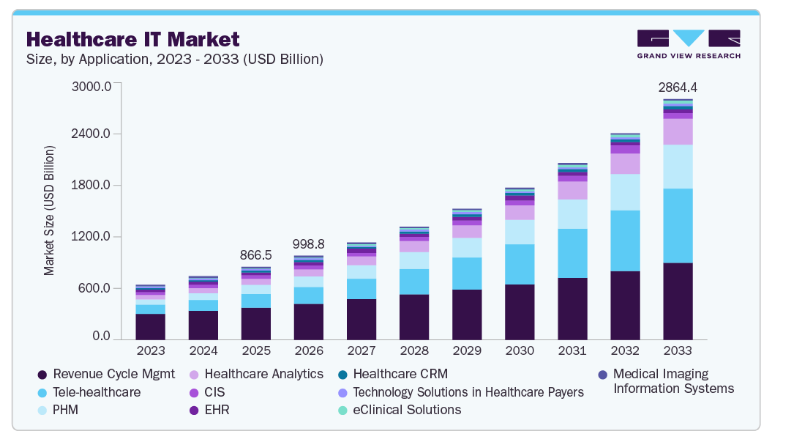
Organizations investing in healthcare web app development today are positioning themselves within a market where digital infrastructure is becoming the standard, not the exception.
Healthcare web app cost ranges by type
Healthcare web app development costs vary significantly based on the application’s purpose, compliance level, and system integrations. The table below outlines typical cost ranges, timelines, and features for common healthcare web app types.
| App Type | Cost Range | Timeline | Key Features |
|---|---|---|---|
| Basic Healthcare Web App | $25,000 – $75,000 | 2 – 4 months | Patient scheduling, secure messaging, user profiles, basic record access, HIPAA-compliant forms |
| Clinical Web Application | $75,000 – $200,000 | 4 – 7 months | EHR/EMR integration, lab results viewer, prescription management, billing, multi-provider workflows |
| Telehealth Platform | $120,000 – $300,000 | 5 – 9 months | Video consultations, virtual waiting rooms, e-prescribing, remote patient monitoring, session recording |
| Enterprise Health System App | $200,000 – $500,000+ | 6 – 14 months | Multi-location support, full HL7 FHIR interoperability, AI-powered features, analytics dashboards, multi-tenant architecture |
| Specialty Clinical App | $80,000 – $250,000 | 4 – 8 months | Custom clinical workflows, specialty-specific modules, imaging integration, treatment tracking |
These ranges cover web app development costs. Hosting, maintenance, compliance updates, and third-party licensing add to the total cost of ownership, which we address in detail later in this guide.
Get a Tailored Healthcare Web App Cost Estimate
Every healthcare project has unique compliance needs, integration requirements, and clinical workflows. Share your project scope with our team and receive a transparent, detailed cost breakdown.
8 Key Factors That Influence Healthcare Web App Development Cost
Healthcare web app development pricing is influenced by technical complexity, regulatory requirements, design scope, team expertise, and third-party dependencies. The following factors explain where most healthcare development budgets are allocated.
1. Application scope and clinical complexity as primary cost drivers
The primary cost driver is the overall scope and complexity of your healthcare web app. A simple patient scheduling app requires a fundamentally different architecture than a multi-location enterprise platform with EHR interoperability, AI-powered triage, and analytics dashboards.
Simple apps with limited features and a single user role cost between $25,000 and $75,000. Medium-complexity apps with clinical integrations and multi-role access fall in the $75,000 to $200,000 range. Complex enterprise platforms with advanced functionality exceed $200,000 and often require phased rollouts spanning 6 to 14 months.
2. Healthcare features, EHR integrations, and their impact on development pricing
Every feature added to a healthcare web app carries its own design, development, testing, and compliance validation cost. Here are typical cost ranges for common healthcare features:
| Feature | Cost Range |
|---|---|
| Appointment scheduling with provider calendars | $3,000 – $12,000 |
| HIPAA-compliant secure messaging | $4,000 – $15,000 |
| EHR/EMR integration (Epic, Cerner, Allscripts) | $15,000 – $60,000 |
| Lab results and medical records viewer | $5,000 – $20,000 |
| Telehealth video consultation module | $10,000 – $40,000 |
| Online billing and payment processing | $4,000 – $15,000 |
| Prescription management and e-prescribing | $6,000 – $25,000 |
| Patient intake forms with digital signatures | $3,000 – $10,000 |
| Multi-factor authentication and role-based access | $3,000 – $8,000 |
| Analytics and reporting dashboard | $8,000 – $30,000 |
| AI-powered symptom triage or clinical decision support | $15,000 – $50,000 |
| Remote patient monitoring module | $12,000 – $45,000 |
EHR/EMR integration is consistently the most significant healthcare cost multiplier. Connecting with systems like Epic, Cerner, or athenahealth requires working with HL7 FHIR standards and SMART on FHIR APIs, which demands specialized healthcare interoperability expertise.
For example, integrating a basic appointment scheduling feature may add only a few thousand dollars, while full EHR interoperability with systems like Epic or Cerner can increase development cost by $30,000 to $60,000 due to compliance validation, data mapping, and security testing.
3. UI/UX design requirements for patients, providers, and administrators
Healthcare web apps must serve diverse user populations, including patients of varying ages and technical literacy, clinical staff working under time pressure, and administrators managing complex workflows. The healthcare design approach you choose affects both cost and user adoption.
- Template-based design ($2,000 – $8,000): Pre-built healthcare templates customized with your branding. Limited customization and may not meet WCAG accessibility standards.
- Semi-custom design ($8,000 – $25,000): Modified templates with custom workflows and branding. Good balance of cost and usability for mid-range projects.
- Fully custom design ($25,000 – $80,000+): Built from scratch with patient research, wireframing, prototyping, and accessibility testing. Delivers the highest adoption rates.
Based on our experience building custom web applications, investing in user research and accessibility during the design phase reduces post-launch redesign costs and directly improves patient engagement metrics.
4. Technology stack selection and its effect on development and maintenance costs
The choice between React.js, Angular, Vue.js for frontend and Node.js, Python Django, PHP Laravel, or .NET for backend affects development speed, scalability, and long-term maintenance costs. Healthcare apps benefit from technologies with strong FHIR ecosystem support and mature security libraries.
Choosing a technology stack that natively supports healthcare standards prevents expensive re-architecture later. For example, selecting frameworks with built-in support for FHIR APIs and deploying on HIPAA-eligible cloud platforms (AWS, Azure, GCP) from day one avoids migration costs that can run $20,000 to $50,000 or more.
6. Development team expertise and geographic location impact on pricing
The development team you choose affects both cost and quality. Healthcare projects require domain expertise that general-purpose developers often lack, particularly around HIPAA compliance, HL7 FHIR standards, and clinical workflow design.
| Region | Hourly Rate |
|---|---|
| North America (USA/Canada) | $100 – $250 |
| Western Europe | $70 – $150 |
| Eastern Europe | $40 – $80 |
| South Asia | $20 – $50 |
A lower hourly rate does not always mean lower total cost. Teams without healthcare experience may take longer, produce compliance gaps, and require expensive remediation, making experienced teams more cost-effective despite higher rates.
7. HIPAA, SOC 2, and regulatory compliance requirements and associated costs
HIPAA compliance adds 15% to 30% to development costs compared to non-healthcare web apps. This covers AES-256 encryption, multi-factor authentication, role-based access controls, comprehensive audit logging, penetration testing, and compliance documentation.
Organizations that also require SOC 2 certification, GDPR compliance, or HITRUST certification should budget an additional $10,000 to $50,000 per certification.
8. Third-party healthcare APIs, tools, and ongoing licensing costs
Healthcare web apps rely on external services that carry ongoing costs:
- Payment processing (Stripe, PayPal): Transaction fees + $0 – $500/month
- SMS/WhatsApp notifications (Twilio): $200 – $2,000/month
- Video conferencing for telehealth: $500 – $3,000/month
- Identity verification services: $100 – $500/month
- Email services (SendGrid): $50 – $500/month
These healthcare site development costs compound over time and must be factored into your total budget from the planning stage.
Need Help Estimating Your Healthcare Web App Development Cost?
Get a tailored cost estimate based on your app requirements, features, compliance needs, and integration complexity. Our healthcare technology experts will help you plan a realistic and scalable development roadmap.
To better understand the total investment required, it’s important to examine the hidden and often overlooked expenses that significantly impact long-term healthcare web app development costs.
5 Hidden and Often Overlooked Costs in Healthcare Web App Development
The initial development quote rarely reflects the true total cost of ownership for a healthcare web app. Hidden and ongoing expenses such as hosting, compliance audits, and maintenance can increase the overall budget by 30% to 50% if not planned upfront. These commonly overlooked expenses can add 30% to 50% to your original budget if not planned for.
1. HIPAA-compliant hosting, cloud infrastructure, and disaster recovery expenses
Healthcare web apps require HIPAA-eligible cloud services with Business Associate Agreements, encrypted storage, and audit-ready logging. Standard web hosting does not meet these requirements.
- HIPAA-eligible VPS: $500 – $1,500/month
- Dedicated HIPAA cloud (AWS/Azure/GCP): $1,500 – $5,000+/month
- Disaster recovery and backup: $200 – $1,000/month
2. Ongoing maintenance, security updates, and feature enhancement costs
Neglecting maintenance leads to security vulnerabilities, compliance failures, and degraded user experience. Annual maintenance costs typically run 15% to 25% of the original development investment.
- Basic maintenance: $1,000 – $3,000/month (bug fixes, minor updates, monitoring)
- Comprehensive maintenance: $3,000 – $10,000/month (EHR compatibility, compliance patches, performance optimization, feature adjustments)
3. Compliance audits, regulatory changes, and update-related expenses
Healthcare regulations evolve continuously. The 21st Century Cures Act, TEFCA interoperability mandates, and updated HIPAA guidelines require periodic app updates and compliance reviews.
- Annual HIPAA compliance audit: $5,000 – $15,000
- SOC 2 certification: $10,000 – $50,000
- Regulatory update implementation: $5,000 – $20,000/year
4. Security monitoring, penetration testing, and data protection investments
Continuous security monitoring and proactive testing help prevent data breaches and ensure compliance with healthcare security standards.
- Security monitoring and SIEM tools: $200 – $1,000/month
- Annual penetration testing: $5,000 – $25,000
- DDoS protection services: $100 – $500/month
5. Recurring licensing and subscription costs for healthcare integrations
Healthcare web applications often rely on third-party integrations such as EHR/EMR systems, clinical data exchange networks, telehealth platforms, payment gateways, and specialized healthcare APIs. These licensing and subscription fees are frequently underestimated during initial budgeting and can significantly impact long-term operational expenses.
Estimated Costs:
- EHR/EMR integration licensing: $1,000 – $10,000+/year (varies by vendor and integration depth)
- Telehealth API or platform subscriptions: $500 – $5,000/month
- Clinical data exchange or interoperability services (HL7/FHIR providers): $1,000 – $8,000/month
- Payment gateway and healthcare billing APIs: 2% – 4% per transaction or $200 – $1,000/month
- Identity verification and patient authentication services: $100 – $1,000/month
These cost estimates are industry averages based on typical healthcare development projects. Actual expenses may vary significantly depending on vendor pricing models, integration complexity, data exchange volume, compliance requirements, and customization needs.
Organizations should conduct vendor-specific cost assessments during project planning to establish accurate budgeting expectations. You can get the estimated cost before collaborating with top web app development companies for healthcare applications projects.
Although healthcare app development can be expensive, the right technology decisions, development methodologies, and feature prioritization strategies can significantly optimize costs.
To better estimate your specific needs and see how different features impact your budget, try our Web App Cost Calculator.
6 Strategies to Reduce Healthcare Web App Development Costs Without Compromising Quality
Cost optimization in healthcare web app development focuses on reducing unnecessary build effort while preserving security, compliance, and clinical usability.
Reducing healthcare web app costs does not mean cutting corners on HIPAA compliance or patient experience. It means making strategic decisions that focus your investment where it delivers the most value.
1. Minimum viable product approach for reducing initial development costs
Launch a MVP with essential features like scheduling, secure messaging, and basic record access. Gather real patient and provider feedback before investing in advanced capabilities like telehealth, AI features, or analytics dashboards. Developing a minimum viable product avoids building features that go unused and focuses your budget on what patients and staff actually need first.
2. Thorough discovery and planning to prevent scope creep and rework
Adding features mid-project increases costs through scope changes, rework, and extended timelines.
A $10,000 to $15,000 discovery investment can save multiples of that amount during web application development by documenting every clinical workflow, integration requirement, and compliance obligation upfront.
3. Use of HIPAA-compliant third-party services to lower development effort
Use established services for video conferencing (Twilio, Zoom Healthcare), payment processing (Stripe), and communication (SendGrid, Twilio SMS) instead of building custom. Each integration still requires HIPAA-compliant implementation, but third-party services save significant development time compared to building from scratch.
4. Cost-efficient and scalable technology stack selection for healthcare apps
Select technology frameworks with strong healthcare ecosystem support. React.js or Angular for frontend, Node.js or Python Django for backend, and PostgreSQL for databases work well for healthcare web applications.
Choosing technologies that natively support FHIR APIs and deploy easily on HIPAA-eligible cloud platforms prevents costly re-architecture later. Monocubed can help you choose the right and modern technologies to build web applications for your healthcare enterprise or organization.
5. Phased healthcare web app development for better budget control
Instead of developing every feature simultaneously, adopt a phased development roadmap that distributes investment over time while delivering measurable value at each stage:
- Phase 1 – Core Patient Features: Patient registration, appointment scheduling, patient dashboards, and secure messaging
- Phase 2 – System Integrations: EHR/EMR integration, workflow automation, billing systems, and data interoperability
- Phase 3 – Advanced Capabilities: Analytics dashboards, predictive insights, AI-driven features, and enhanced patient engagement tools
6. Open-source healthcare frameworks and standards for cost optimization
Open-source web technologies like HAPI FHIR, OpenMRS, and established frontend libraries and frameworks provide robust foundations without licensing fees. Combined with AI-powered development tools, these popular web frameworks reduce development time and cost while maintaining compliance standards.
While implementing cost-optimization strategies can help control development expenses, pricing can still vary significantly depending on the development partner you choose.
Why Healthcare Web App Development Costs Vary Between Vendors
When evaluating healthcare development proposals, understanding why pricing differs helps organizations avoid low-cost vendors that introduce compliance risk or long-term rework.
Understanding why one vendor quotes $80,000 and another quotes $250,000 for what appears to be the same project helps you evaluate proposals on total value rather than just the headline number.
1. Healthcare domain expertise as a key differentiator in cost and quality
Teams with healthcare development experience understand HIPAA compliance, HL7 FHIR interoperability, and clinical workflow design from the start. They build compliance into the architecture rather than treating it as an add-on, which prevents expensive remediation later. General-purpose developers may deliver a functional app that fails its first compliance audit.
2. Development process maturity and its influence on pricing accuracy
Web app development agencies like Monocubed with structured discovery, agile sprint cycles, dedicated QA, and documented compliance processes deliver more predictable outcomes. Less mature teams may quote lower prices but introduce risk through scope creep, missed requirements, and inadequate testing.
Ask about the web development process, the hired web app development company follows to build a secure and scalable project.
3. Industry specialization and its role in long-term project value
Healthcare-focused teams bring pre-built components, established integration patterns for major EHR systems, and familiarity with regulatory requirements. This specialization reduces both development time and compliance risk compared to teams learning healthcare requirements on your project.
4. Vendor location, communication, and operational cost differences
North American agencies charge $100 to $250 per hour compared to $20 to $80 for offshore teams. However, the total cost difference is often smaller than hourly rates suggest because experienced nearshore teams require fewer hours, produce fewer compliance gaps, and communicate more effectively during stakeholder reviews.
Is Healthcare Web App Development Worth the Investment?
The value of a healthcare web app extends far beyond the features it delivers. The real question is whether the investment generates returns that justify the cost.
1. Return on investment through improved revenue, efficiency, and patient engagement
Healthcare organizations that implement well-designed web apps report measurable improvements across multiple areas:
- Patient acquisition: Practices with online scheduling and digital intake report 25% to 40% increases in new patient bookings
- Operational efficiency: Digital workflows reduce administrative staff time by 15 to 30 hours per week
- Revenue cycle improvement: Online billing and payment processing accelerate collections and reduce billing-related administrative costs by up to 30%
- Patient retention: Portals with secure messaging and record access improve patient satisfaction scores and reduce no-show rates by 20% to 35%
2. Scalability advantages of custom-built healthcare web applications
A properly architected healthcare web app scales with your organization. Adding new locations, providers, specialties, and patient volume does not require rebuilding the platform. This long-term scalability makes the initial investment more cost-effective than it appears when evaluated over a 3 to 5 year period.
3. Risk reduction through compliance-driven and secure development practices
Custom healthcare web apps built with HIPAA-compliant architecture reduce the risk of data breaches, regulatory fines, and compliance failures. According to IBM’s Cost of a Data Breach Report, the average healthcare data breach costs $10.93 million, the highest of any industry. Investing in security from day one is significantly less expensive than remediation after a breach.
4. Long-term value of custom healthcare web apps compared to off-the-shelf solutions
Off-the-shelf healthcare software carries recurring subscription fees that compound over time. A custom web app costs more upfront but eliminates ongoing licensing fees, provides complete ownership of your platform, and allows unlimited customization as your clinical workflows evolve.
After exploring the factors that influence vendor pricing, it’s important to understand how a specialized healthcare development partner like Monocubed ensures accurate, transparent, and value-driven cost estimation.
How Monocubed Helps Healthcare Organizations Plan and Optimize Development Budgets
Healthcare web app development costs vary widely based on application type, feature complexity, compliance requirements, and system integrations. Understanding these web app development cost drivers, hidden expenses, vendor pricing variations, and cost-optimization strategies is essential for building a secure, scalable, and future-ready healthcare solution.
Organizations that invest in proper planning, phased development, and compliance-focused architecture are more likely to achieve successful outcomes while maintaining budget control.
Partnering with an experienced healthcare technology provider further simplifies this process.
At Monocubed, healthcare web app cost estimation starts with understanding your clinical workflows, compliance requirements, integration needs, and long-term growth goals.
We follow a discovery-first approach to identify high-impact features, map system integrations, and prevent costly development mistakes. Our transparent and strategic estimation process helps healthcare organizations plan, build, and scale digital solutions with confidence.
Want to Know Your Healthcare Web App Development Cost?
Get a personalized cost estimate tailored to your feature requirements, compliance needs, and integration scope. Our healthcare technology experts will help you define a clear, scalable, and budget-friendly development roadmap
Frequently Asked Questions About Healthcare Web App Development Cost
-
How long does healthcare web app development take?
Basic healthcare web apps typically take 2 to 4 months to develop. Mid-range clinical apps with EHR integration require 4 to 7 months, while enterprise platforms may take 6 to 14 months, depending on complexity and compliance needs. Timeline depends on feature complexity, number of integrations, compliance requirements, and team size. Compressed deadlines increase costs because parallel work streams and additional developers are needed.
-
Can I reduce healthcare web app development costs without sacrificing compliance?
Yes, through strategic planning. Start with an MVP that includes core features, integrate third-party services for telehealth and payments instead of building custom, choose tech stacks with strong healthcare support, and invest in thorough discovery to prevent scope creep. These strategies optimize investment while maintaining full HIPAA compliance.
-
Why do costs vary so much between development agencies?
Agencies factor in healthcare domain expertise, HIPAA compliance capabilities, EHR integration experience, team size, QA standards, and post-launch support. An agency quoting $75,000 may exclude compliance testing, while one quoting $175,000 includes penetration testing, security audits, staff training, and 90-day maintenance. Always compare proposals on total scope, not headline price.
-
Do I need a custom healthcare web app, or is off-the-shelf software enough?
Off-the-shelf solutions work for organizations with standard scheduling, messaging, and basic record access needs. Custom development is necessary when your clinical workflows do not fit generic templates, you need deep EHR integration with specific systems, you serve specialties with unique requirements, or you need multi-location support with custom administrative controls. Custom apps cost more upfront but deliver better long-term ROI.
-
How does HIPAA compliance affect healthcare web app development cost?
HIPAA compliance adds 15% to 30% to development costs compared to non-healthcare applications. This covers end-to-end encryption, multi-factor authentication, role-based access controls, audit logging, penetration testing, and compliance documentation. Non-compliance exposes organizations to fines of up to $1.5 million per violation category and severe reputational damage.
-
What ongoing costs should I budget for after launch?
Budget for HIPAA-compliant hosting ($500 to $5,000+ per month), maintenance and updates ($1,000 to $10,000 per month), annual compliance audits ($5,000 to $15,000), security monitoring ($200 to $1,000 per month), and third-party service fees (variable). Annual maintenance typically runs 15% to 25% of the original development cost.
-
Can AI reduce healthcare web app development costs?
AI-powered development tools can accelerate code generation, testing, and quality assurance, reducing timelines by up to 50% for standard features. However, complex EHR integrations, HIPAA compliance architecture, and clinical workflow customization still require experienced healthcare developers. AI works best as a supplement that optimizes costs without compromising compliance quality.
-
What happens after my healthcare web app launches?
All Monocubed projects include 90 days of post-launch maintenance at no additional cost, covering bug fixes, performance tuning, and minor feature adjustments. After the support period, you can engage us on an hourly or dedicated team basis for ongoing development, compliance updates, and feature additions.

 All our projects are secured by NDA