
Our client is an electronics eCommerce retailer based in Central America, offering smartphones, laptops, tablets, smartwatches, and accessories across multiple international brands. Their extensive product catalog required heavy filtering by brand, color, storage, and price, which quietly generated over 48,000 URLs and strained their server infrastructure. Here is how our eCommerce website performance optimization fixed both problems.
The website contains a large product catalog with thousands of device variations, including different brands, colors, storage capacities, and price ranges. To help customers navigate the catalog, the website had implemented extensive filtering capabilities.
However, the filter system generated thousands of parameter-based URLs, which created serious technical challenges related to crawl efficiency, server performance, and site architecture scalability. Essentially, the site was asking search engines to crawl pages that were just different filtered views of the same product listings. That is when Monocubed stepped in to fix both the URL bloat and server issues.
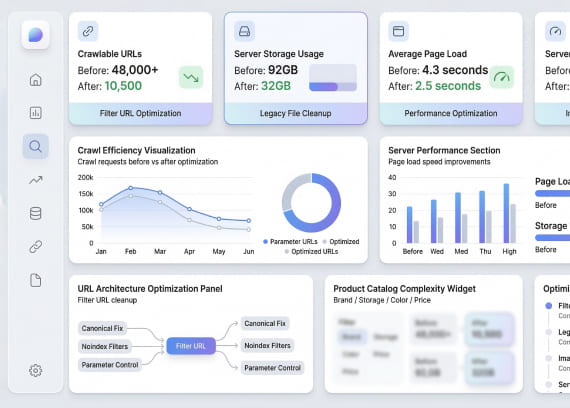
Here is a quick overview of the results we achieved through filter architecture optimization and server infrastructure cleanup.
- 78% reduction in unnecessary URLs
- 42% faster page loading speed
- 65% server storage freed up
The Challenge
When the client approached our web development consulting services team, the platform had two major technical problems that were hurting both search engine performance and website speed.
1. Excessive Filter-Based URLs
The filtering system created a new URL every time users selected filters such as:
- Brand
- Color
- Storage capacity
- Price range
- Sorting options
- Pagination
This resulted in over 48,000 parameter-based URLs, many of which contained duplicate or low-value content. Search engines were wasting crawl budget on these low-value filter pages instead of focusing on the actual product and category pages that matter for rankings.
2. Server Storage Issues
During the infrastructure review, we discovered that many products that had been removed from the frontend were still stored on the server. Their associated files were never cleaned up when products were discontinued.
Unused files included:
- Old product images
- Orphaned product assets
- Unused media files
- Legacy product database entries
These unnecessary files consumed nearly 65% of the allocated server storage, increasing server load and slowing response times across the platform.
Want to Improve Your eCommerce Website Performance?
Our experienced development team will audit your website infrastructure and optimize it for better crawl efficiency and faster load times.
Our Approach
Our eCommerce website development services team tackled both problems with a three-part strategy focused on cleaning up the URL architecture and freeing up server resources.
1. JavaScript-Based Dynamic Filtering
We replaced parameterized filter links with JavaScript-driven filtering logic. Instead of generating a new URL for each filter combination, product listings now update dynamically within the page without creating new URLs.
This eliminated the need to create thousands of filter URLs that were cluttering the site’s architecture.
2. Clean URL Architecture
We restructured the site to focus on high-value indexable pages:
- Category pages
- Product pages
- Key landing pages
All filters, sorting, and pagination now operate client-side. This way, search engines only crawl and index pages that carry unique, valuable content.
3. Server Cleanup and Optimization
A full server audit was conducted to identify unused assets.
We removed over:
- 18,000 unused product images
- 9GB of obsolete media files
- Thousands of legacy product records
This brought server storage down from 92GB to 32GB, significantly reducing server load and improving infrastructure performance. Our web maintenance services ensured the cleanup was thorough and sustainable.
Technical Impact
Here is a before-and-after comparison of the key metrics:
| Metric | Before Optimization | After Optimization |
|---|---|---|
| Crawlable URLs | 48,000+ | 10,500 |
| Server Storage Usage | 92GB | 32GB |
| Average Page Load | 4.3 seconds | 2.5 seconds |
| Server Response Time | 850ms | 420ms |
The average page speed improved by 42%, going from 4.3 seconds down to 2.5 seconds. Server response time was also cut in half, from 850ms to 420ms.
Key Outcomes
Improved Crawl Efficiency
Removing thousands of parameter URLs allowed search engines to focus on high-value product and category pages. New products and updates now get indexed faster with a cleaner site structure.
Faster Website Performance
Optimized server resources and a cleaner architecture reduced page load times by over 40%. Customers can now browse and filter products without waiting for new pages to load.
Reduced Server Load
Cleaning up unused files freed 65% of server storage and improved overall system stability.
Scalable Site Architecture
The optimized filtering structure ensures the platform can scale its product catalog without generating unnecessary URLs going forward.
Is Your Ecommerce Website Struggling with Crawl Efficiency or Slow Page Speeds?
At Monocubed, we audit and optimize website infrastructure to ensure your platform performs at its best.
What This Optimization Delivered
By optimizing the filtering architecture and cleaning up unused server resources, the platform achieved major improvements in both technical performance and crawl efficiency.
- 78% reduction in unnecessary URLs (48,000+ down to 10,500)
- 42% faster page loading speed (4.3s down to 2.5s)
- 65% server storage optimization (92GB down to 32GB)
- 50% faster server response time (850ms down to 420ms)
The new architecture provides a stronger foundation for future product expansion and improved search engine visibility.

 All our projects are secured by NDA