
Power Buying Dealers (PBD) West is a business based in California, USA. They help local and small convenience store owners, especially those running shops at gas stations, grow their businesses. In the USA, big chain stores like 7-Eleven have the buying power to negotiate bulk deals with major vendors. But small, independent store owners do not get those deals easily. PBD West bridges that gap.
PBD West has partnerships with major vendors in the market. Through these partnerships, they help store owners get better pricing, promotions, and deals on products across categories like snacks, beverages, and tobacco. They also provide category management guidance, helping store owners decide what products to stock and how to price them to grow revenue.
Running this kind of operation requires a platform that can handle vendor partnerships, promotion management, on-site compliance auditing, billing, and store onboarding, all in one place. Through our custom CRM development and modernization approach, PBD West transformed its outdated system into a modern platform with a scalable tech stack, improved UI, and advanced features to support its day-to-day operations.
Challenges PBD West Was Facing With Its Legacy Platform
If you run an operation like PBD West, where you are the bridge between major vendors and hundreds of local store owners, you know how quickly things get complicated.
On any given day, your team is managing vendor partnerships with major brands. They are creating and tracking promotions that flow from those vendor deals down to individual store locations. They are onboarding new stores, managing compliance audits, handling billing and invoicing, and making pricing calculations that involve third-party data sources.
Now imagine doing all of this on a legacy platform built on Laravel 7 or 8, with an outdated UI and modules that do not fully support your current operations. That was the situation PBD West was facing when they came to our web app development services team.
Here is what was not working for them:
- Outdated tech stack — The existing platform was built on an older version of Laravel with APIs that were not functionally complete. Some modules were partially built, and others needed significant updates.
- Incomplete feature coverage — The old CRM did not cover all of their day-to-day operations. Key modules were missing or not fully usable, forcing the team to rely on manual processes and workarounds.
- Aging UI — The user interface had not been updated in years. It was not intuitive for the team members who needed to use it daily, which slowed down onboarding and reduced adoption.
- Limited role management — Different team members, from admins to SMC executives to data admins, needed different levels of access. The old system did not handle this well.
- Manual pricing calculations — Pricing tools like cigarette cost calculations and other product-specific formulas were being done manually or through disconnected tools.
The client had already invested in new Figma designs for the platform. They knew exactly what they wanted the platform to look like and how it should function. What they needed was a development team that could take on a full legacy application modernization; upgrade the system with the latest technologies while preserving their existing data and business logic.
Want to Upgrade Your Legacy CRM Platform?
We can help you modernize your business platform with the latest technologies. Get a free consultation and a personalized quote today.
How We Rebuilt the PBD West Platform
PBD West was not starting from zero. They had an existing platform with backend APIs, business data, and operational workflows already in place. Our job was to upgrade everything: the tech stack, the APIs, the UI, and the feature set, while keeping the core business logic intact.
Before diving into the features, here is the technology stack we used and why.
- React 19 with TypeScript for a modern, type-safe frontend: PBD West needed a fast, responsive dashboard that their team could use every day. React 19 gave us the component-based architecture to build reusable UI elements across eight or nine different modules. TypeScript caught errors during development, which meant fewer bugs reaching the staging environment. Paired with Vite for fast build times and Tailwind CSS for consistent styling, the frontend was built for speed and maintainability.
- Laravel 11 for a reliable, scalable backend: The client was already on Laravel, so upgrading to Laravel 11 was the natural path forward. It gave us improved API routing, better performance, and modern PHP 8+ support. We upgraded all existing APIs and built new ones for the modules that were missing or incomplete.
- MySQL for structured business data: With complex relationships between vendors, locations, stores, promotions, orders, and billing records, a relational database was the right choice. MySQL handled the data integrity and querying needs of the platform effectively.
- Laravel Sanctum for secure API authentication: Since this is a single-page application with role-based access, Sanctum provided lightweight, token-based authentication without the overhead of a full OAuth setup. The platform also supports Google Sign-in for quick access.
- AWS S3 for file storage: Business files and documents are stored on AWS S3, providing scalable and secure cloud storage for the platform.
- Third-party integrations: QuickBooks for invoice syncing and accounting automation, Google Address API for location handling, Altria API for CPC (Cost Per Carton) pricing calculations, Klaviyo for email marketing syncing, and Swagger for API documentation.
Our full-stack web development team consisted of three members on average: a backend developer, a frontend developer, and a QA engineer (half-time). For a two-month stretch, we added a third developer to the team to accelerate delivery on complex modules.
The client provided detailed Figma prototypes, which gave us a clear visual direction from day one. We followed an Agile workflow with regular client demos and feedback cycles to make sure the platform matched their operational needs at every stage.
The platform mirrors PBD West’s business structure exactly. There are three main entities: PBD (the admin team with roles like Admin, Users, SMC, Executive, and Data Admin), Vendors (the major brands they partner with), and Stores/Locations (the local convenience store owners they serve).
About 90% of the platform’s features are built for the PBD admin team, with limited functionality for specific external users.
Let’s walk through the key modules we built.
-
Dashboard With Live Business Metrics
-
Store Location Management With 12-Tab Detail Pages
-
Promotions With Tiered Pricing and Bundles
-
Vendor Programs With Contracts and Eligibility Criteria
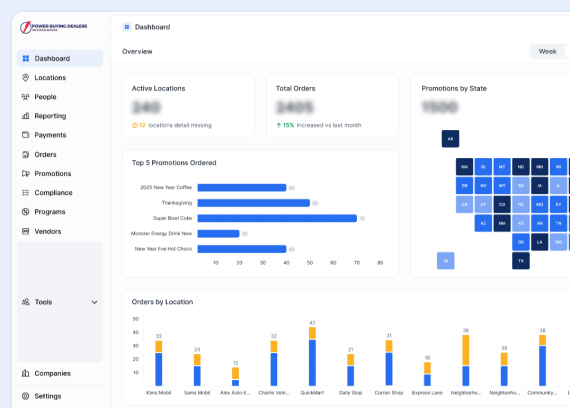
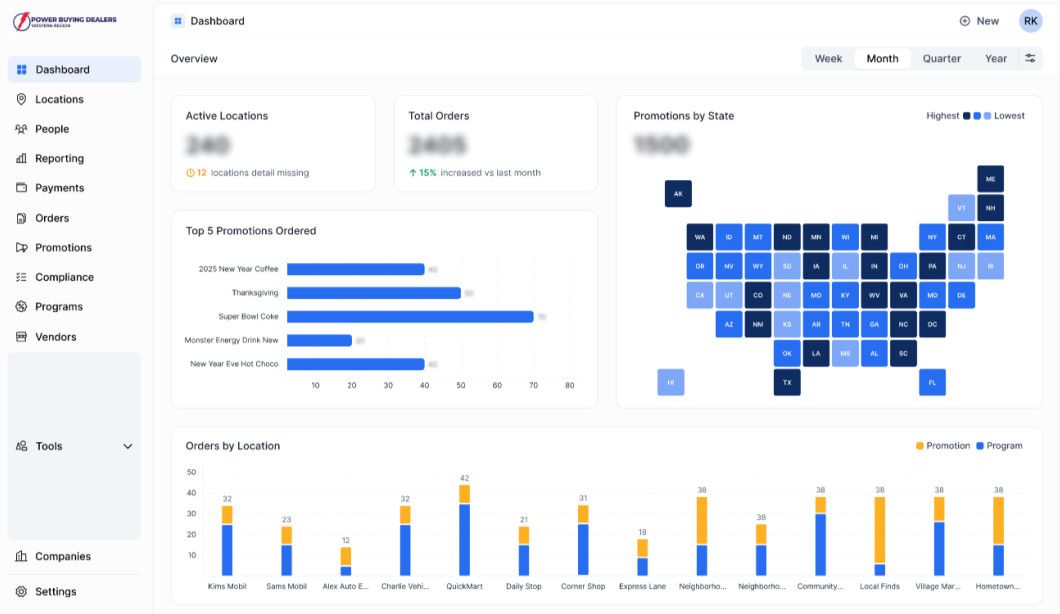
The dashboard shows active locations, total orders with percentage change, and promotions by state on an interactive US map. Bar charts display top promotions ordered and orders by location, with filters for Week, Month, Quarter, and Year views.
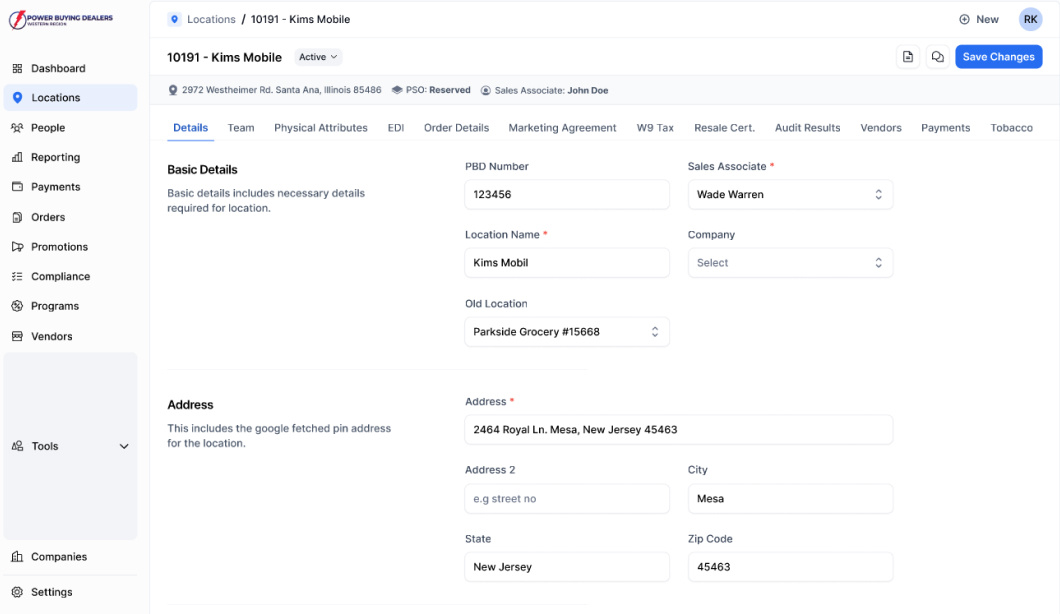
Each location has 12 tabs: Details, Team, Physical Attributes, EDI, Order Details, Marketing Agreement, W9 Tax, Resale Cert., Audit Results, Vendors, Payments, and Tobacco. The Google Address API fetches pin addresses. Team members can leave comments on location records for collaboration.
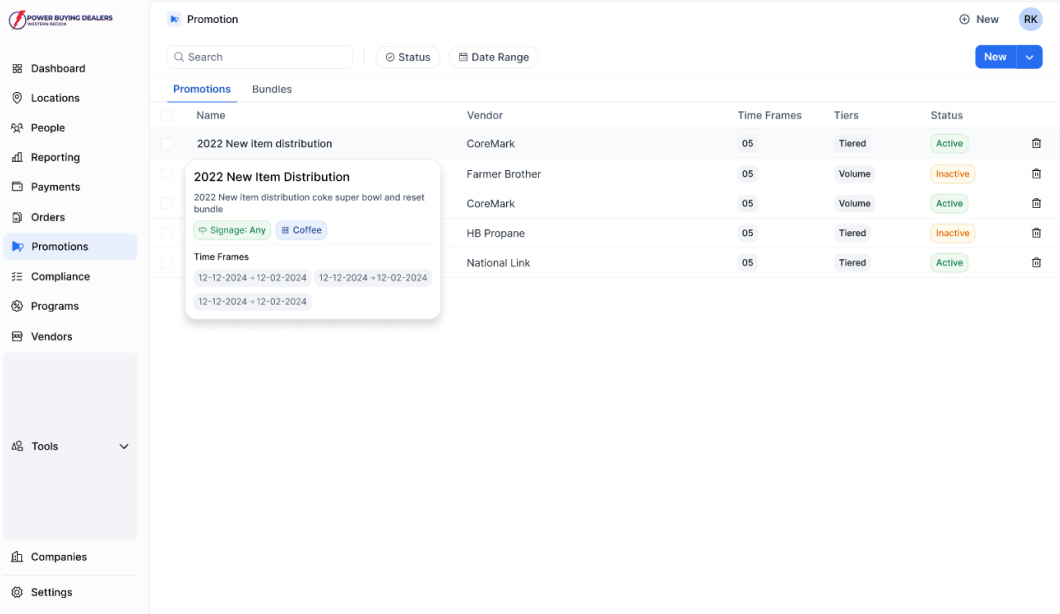
The promotions module tracks vendor deals with Tiered and Volume pricing, Buy Down Rates, and Bonuses. Requirements toggles for Compliance, Signage, and Bonus Driven control what each promotion demands. A separate Bundles tab manages bundled deals across multiple vendors.
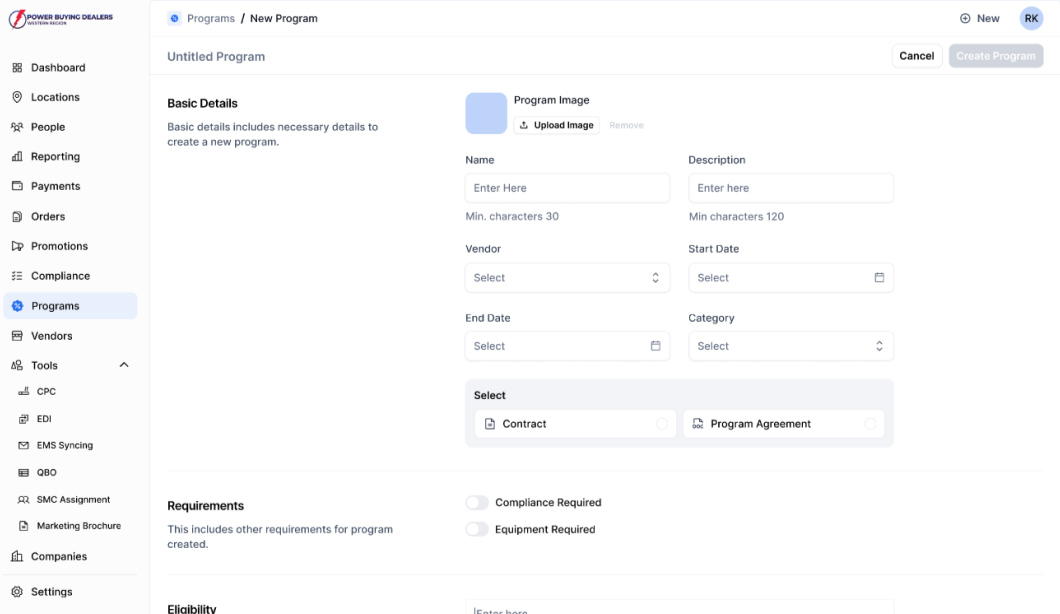
Programs are managed separately from promotions. Each program includes Contract and Program Agreement documents, Compliance and Equipment requirements, eligibility criteria, and start/end dates tied to specific vendors.
Need a Custom Platform to Manage Your Promotions and Vendor Deals?
We build custom business platforms that centralize your operations and automate complex workflows. Talk to us and get a free quote today.
-
Monthly Compliance Audits With Photo Verification
-
Payment Registers With QuickBooks Auto-Sync
-
EDI Invoice Files and CPC Pricing Calculator
-
Vendor Profiles and Contact Directory
-
Custom Reports With Saved Templates
-
Seven Permission Groups With Module-Level Access Control
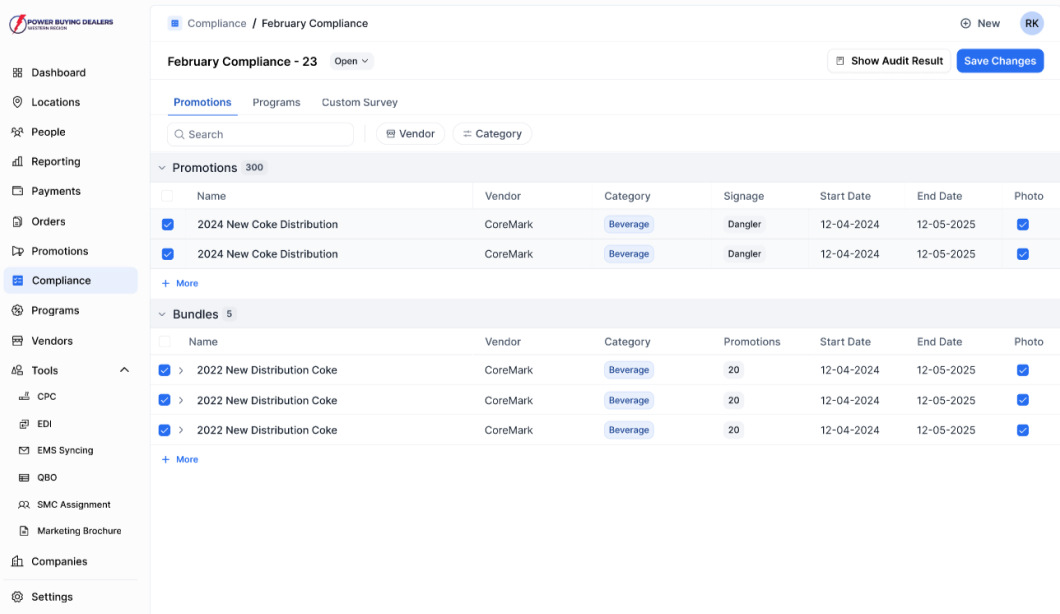
The compliance module tracks monthly audits with tabs for Promotions, Programs, and Custom Surveys. Each entry shows the compliant store count, the number of audits, and the Open/Closed status. Photo verification checkboxes and audit results are built in.
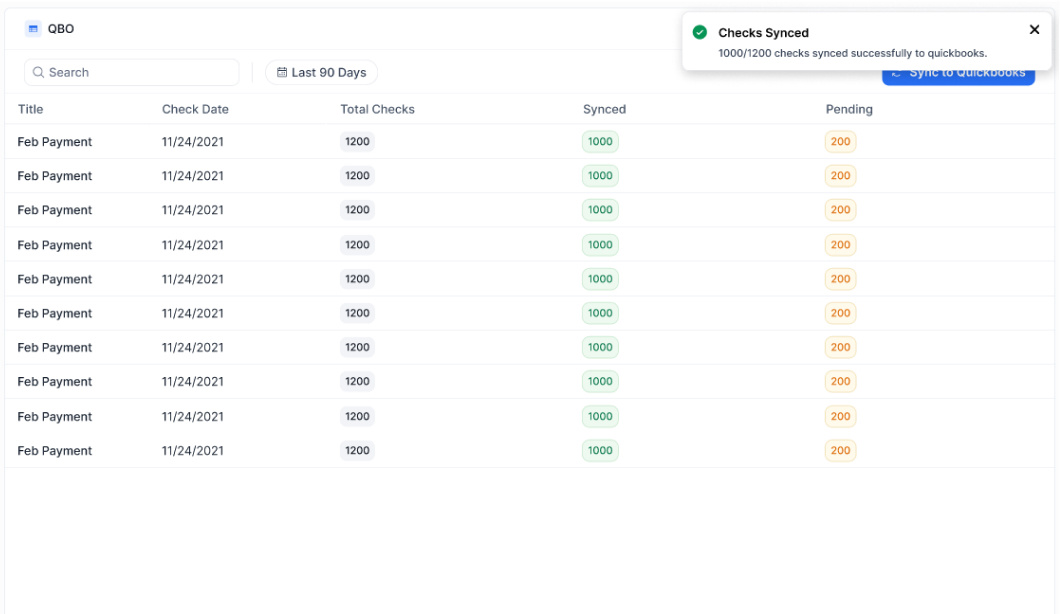
Payments are managed through Registers, Checks, and On-hold Checks with a multi-step upload process. The QBO tool shows total checks, synced count, and pending count. A “Sync to QuickBooks” button triggers automatic invoice syncing, eliminating manual data entry.
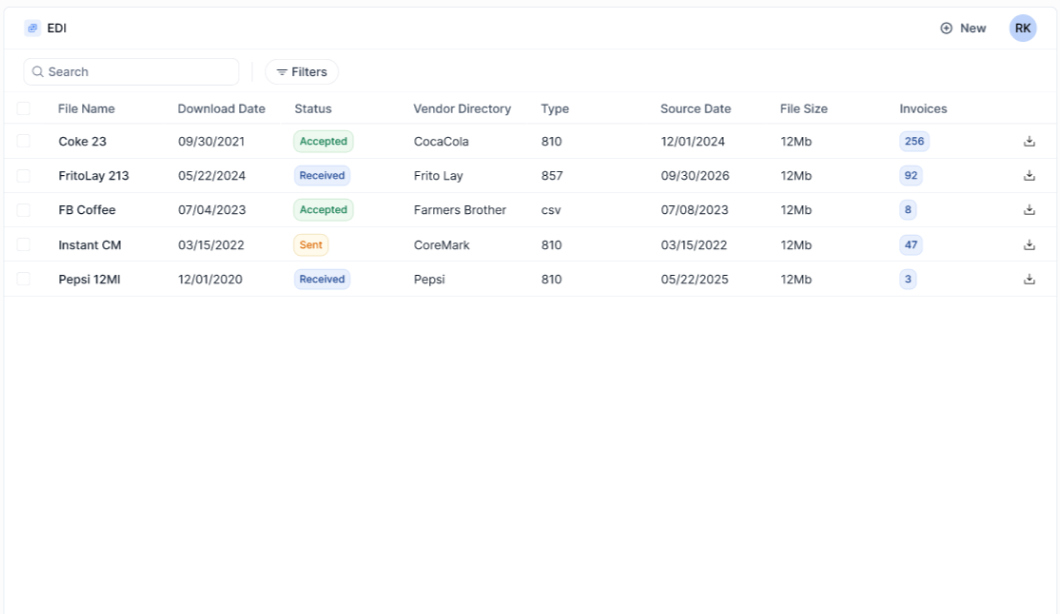
The EDI tool manages electronic invoice files from vendors with transaction tracking and email status. The CPC calculator uses the Altria API for automated cigarette pricing. An SMC Assignment tool maps sales associates to store locations on an interactive US map.
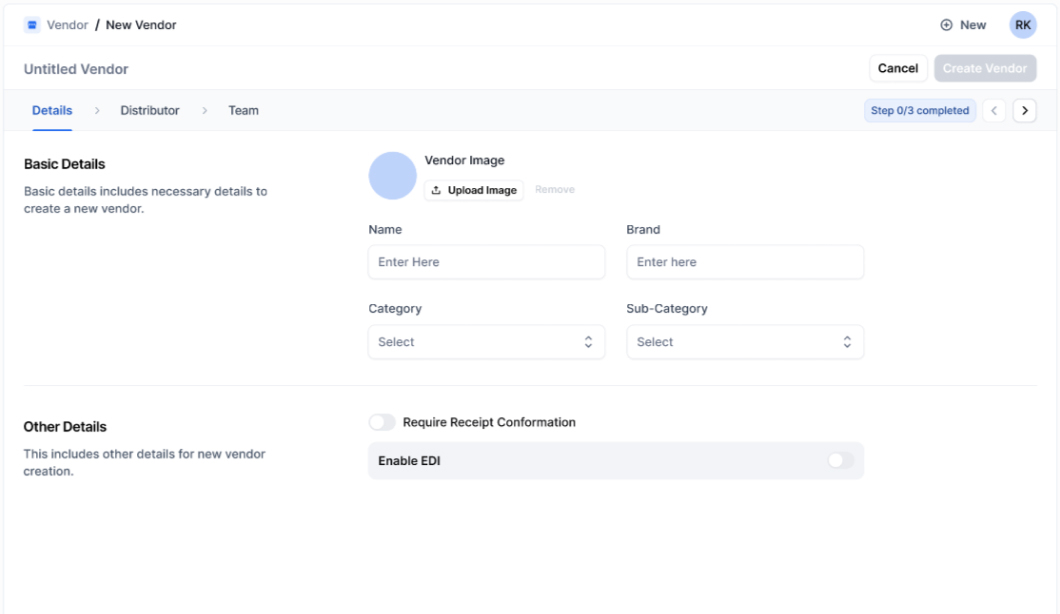
Vendors are created through a 3-step process (Details, Distributor, Team) with EDI and receipt confirmation toggles. The People module tracks contacts with roles (Owner, Employee, Executive, Contact), titles, permissions, and marketing message preferences across the entire store network.
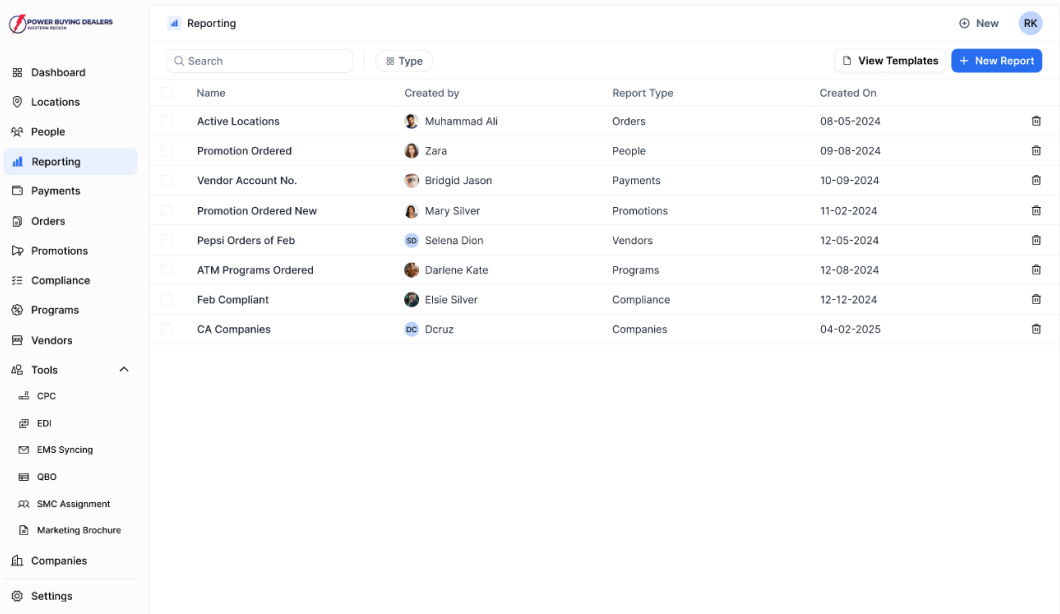
Reports can be generated for Orders, People, Payments, Promotions, Vendors, Programs, Compliance, and Companies. Saved templates let the team run recurring reports with a single click instead of building them from scratch each time.
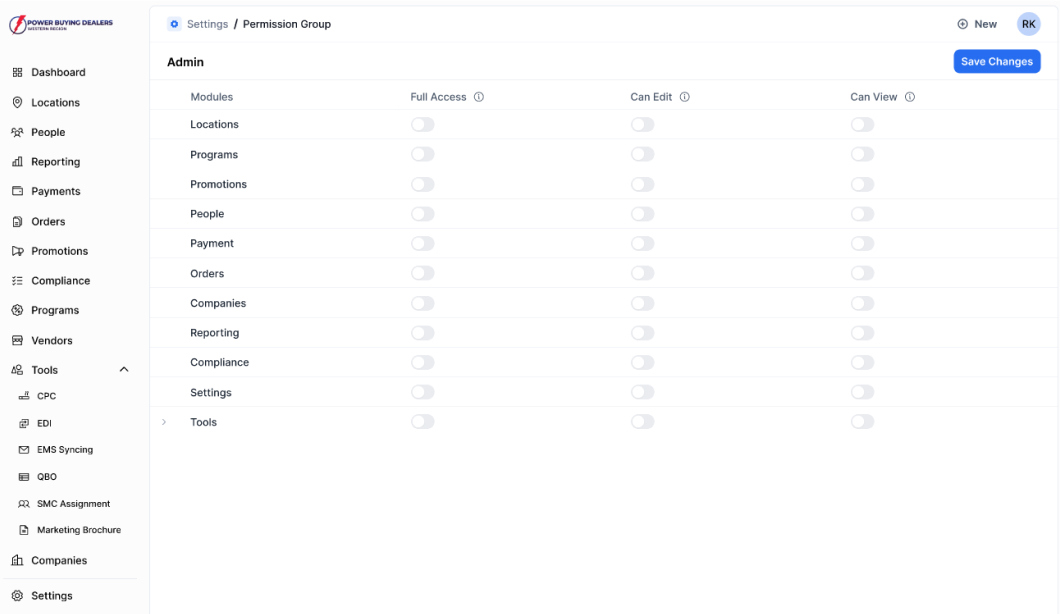
Seven permission groups (Admin, Users, SMC, Executive, Data Admin, Delete Promotions, Delete Vendors) control access across 11 modules. Each group has a module-level matrix with Full Access, Can Edit, and Can View toggles, giving PBD West fine-grained control over the entire platform.
What the Platform Upgrade Delivered for PBD West
This platform was designed and developed specifically for PBD West’s business model. It is optimized for their operational workflow, from vendor negotiations to store-level compliance tracking. Here is what the custom business intelligence platform development delivered over their legacy system.
-
Unified Operations Across All Business Functions
-
Automated Accounting with QuickBooks Integration
-
Accurate, API-Driven Pricing
-
Scalable Architecture for Future Growth
With a custom CRM and business intelligence platform, PBD West consolidated vendor management, promotions, programs, orders, billing, compliance, people management, and reporting into a single application. No more switching between tools or relying on manual processes to bridge the gaps between systems.
By integrating directly with QuickBooks, the platform eliminated manual invoice entry and data reconciliation. The QBO tool shows exactly how many checks are synced versus pending, giving the team full visibility into the sync status at all times.
With Altria API integration for CPC calculations and the EDI tool for managing electronic vendor invoices, the platform removed guesswork from pricing and invoice management.
The React 19 and Laravel 11 tech stack, combined with an API-first architecture documented with Swagger, means the platform is ready for future expansion. When PBD West decides to give vendors or store owners direct dashboard access, the foundation is already in place.
Who Else Can Use a Platform Like This?
The platform we built for PBD West can be adapted for any business that acts as an intermediary between suppliers and retailers or manages complex vendor relationships. Our web portal development services team builds these kinds of multi-role platforms across industries.
-
Wholesale Distributors
-
Franchise Management Companies
-
Trade Promotion Management Firms
Wholesale businesses that manage relationships with multiple manufacturers and supply to retail stores face similar challenges. A custom CRM can automate order processing, track promotions, manage vendor pricing, and handle invoicing in one place.
If you distribute products across multiple categories like food and beverage, health and beauty, or cleaning supplies, a platform like this would centralize your operations and give you visibility into every vendor relationship.
Companies that manage franchise networks need to track compliance, distribute promotions, and manage billing across dozens or hundreds of locations. A custom business intelligence platform can handle franchise onboarding, performance tracking, and centralized reporting.
Businesses that specialize in managing trade promotions between CPG (consumer packaged goods) brands and retailers can use a similar platform to track promotion lifecycles, calculate pricing, and generate billing automatically.
Want to Manage Your Vendor Relationships and Store Network Better?
Build a custom business intelligence platform that centralizes your operations, automates billing, and gives you real-time visibility into your business. Let’s talk.
Build a Platform Like PBD West’s for Your Business
Why manage vendor partnerships, store networks, and promotions through disconnected tools when a single platform can do it all for you? PBD West ran their business on a legacy CRM for years before upgrading to a modern platform that brought all their operations under one roof.
Develop a custom CRM and business intelligence platform that automates and streamlines your business operations. Benefits?
- Centralized vendor, store, and promotion management
- Automated billing and accounting with QuickBooks integration
- Real-time business intelligence and reporting
- Your team will be able to focus on growing partnerships instead of manual data entry
Contact us and get a free consultation and a personalized quote without any fees or commitments. Our web development consulting services team will help you design a custom solution to solve your business challenges.

 All our projects are secured by NDA