
 By Yuvrajsinh Vaghela
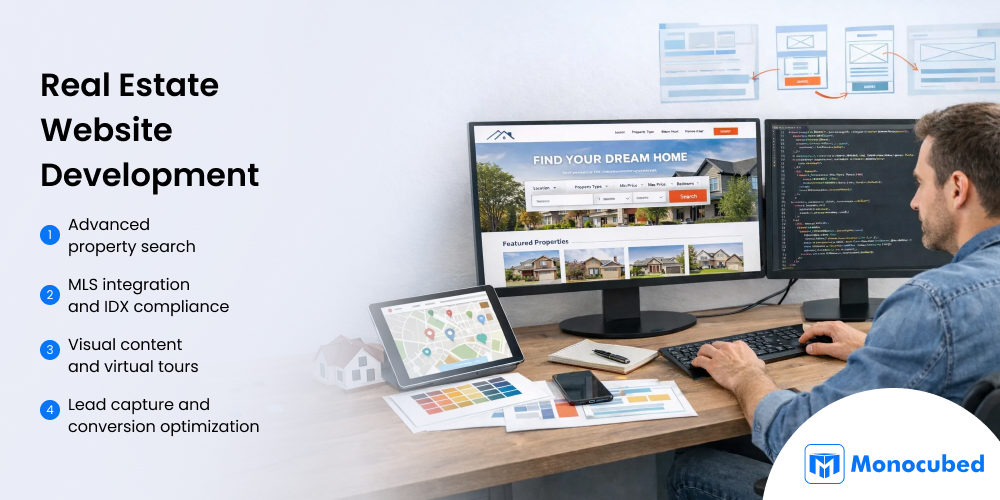
Contents
While you’re reading this sentence, somewhere a potential buyer just clicked away from a competitor’s outdated property listing. That lead could have been yours.
According to the National Association of Realtors, 52% of home buyers found their dream home online and 70% used mobile and tablets to make a purchase. That’s millions of qualified leads browsing real estate websites right now.
If you’ve no digital presence or site with no modern features like virtual tours and smart search, your real estate business is losing a lot of potential.
Professional real estate website development can completely transform your lead generation. At Monocubed, we’ve helped businesses build sophisticated web portals and real estate marketplaces that capture leads and drive conversions.
As a leading real estate website development company delivered 200+ web solutions, we hear these questions from real estate professionals all the time:
- How do I build a real estate website that generates leads?
- What features does a property listing platform need?
- How much does real estate website development cost?
- Should I use a template or build custom?
- How do I integrate MLS/IDX into my website?
- What technology stack works best for real estate platforms?
With our experience of delivering web development services to 100+ global clients, we know what it takes to build property platforms that convert.
This guide covers everything you need to know about building a real estate website that actually works for your business.
Let’s dive in.
What is Real Estate Website Development?
Real estate website development is the process of building specialized web platforms for property-related businesses. But here’s what most people get wrong: a real estate website isn’t just a regular business website with property photos.
During building a real estate site, a web developer faces challenges that general web developers rarely encounter. Property websites must integrate with Multiple Listing Services (MLS), display thousands of high-resolution images without sacrificing performance, implement geospatial search functionality, and capture leads at multiple touchpoints throughout the user journey.
Think about platforms like Zillow or Realtor.com. They’re not simple websites. They’re complex, data-driven applications handling millions of listings, real-time updates, and sophisticated search algorithms.
A real estate platform typically includes:
- Property listing management with detailed descriptions, photos, and specifications
- Advanced search and filtering systems
- MLS/IDX integration for comprehensive inventory
- User accounts for buyers, sellers, and agents
- Lead capture and CRM connectivity
- Interactive maps and location-based features
- Mobile-responsive design for on-the-go browsing
So, what separates successful property website development from mediocre implementations?
The understanding that these real estate websites or platforms serve as transaction-enabling systems, not digital brochures. Every design decision, feature implementation, and technical choice should ultimately serve one goal: converting anonymous visitors into qualified leads.
The complexity of building a real estate site increases when you consider the diverse user base.
- Buyers want intuitive search.
- Sellers want maximum exposure.
- Agents need tools to manage listings and track leads.
- Administrators require dashboards for analytics.
A well-architected real estate development website addresses all these needs without compromising the experience for any user group.
Now that you understand what real estate web development involves, let’s explore the different approaches you can take to build your platform.
3 Development Approaches for Creating Real Estate Websites
Choosing the right website development approach is one of the most important decisions in your project. Here are the three different approaches for you to choose before you hire one of the top website development companies or a freelancer for your project.
1. AI and template-based website builders
AI-powered website builders have made it possible to launch a basic real estate website within days. Platforms like Wix, Squarespace, and specialized real estate templates offer drag-and-drop interfaces requiring no technical expertise.
- Cost: $200-$2,000
- Timeline: Days to weeks
- Best for: Individual agents testing online presence, very limited budgets
Limitations: However, the limitations become apparent quickly. Template-based solutions restrict customization beyond what the platform allows. Your website will look similar to hundreds of competitors using the same templates, making brand differentiation nearly impossible.
More critically, these real estate and property selling platforms struggle with MLS integration, often relying on basic IDX plugins with limited search functionality and poor data synchronization. Performance issues compound as your listing database grows.
2. CMS-based real estate website development
Content Management Systems like WordPress, combined with real estate-specific themes and plugins, represent a middle ground. A skilled real estate web developer can extend WordPress with IDX plugins, custom themes, and specialized functionality.
- Cost: $5,000-$25,000
- Timeline: 4-8 weeks
- Best for: Small to medium agencies with straightforward requirements
The CMS website development approach offers greater customization than templates at lower cost than fully custom development. You gain access to a vast ecosystem of plugins and community support.
Yet CMS-based solutions carry inherent limitations. Plugin dependencies create security vulnerabilities and compatibility issues with each platform update. Performance degrades as you add more plugins and listings. You remain dependent on third-party developers for critical functionality like MLS integration.
3. Custom real estate web development
Custom web development is the approach successful brokerages, property portals, and real estate marketplaces choose when serious about digital leadership. Every aspect of your platform is built specifically for your business requirements.
- Cost: $50,000-$200,000+
- Timeline: 3-6+ months
- Best for: Brokerages, property portals, real estate marketplaces, enterprises
The advantages extend beyond flexibility. Your platform’s architecture can be optimized specifically for real estate workloads, ensuring fast performance even with large listing databases. Integration with MLS feeds, CRM systems, and third-party services can be implemented exactly as your business requires.
Here’s a quick comparison:
| Approach | Cost Range | Customization | Best For |
|---|---|---|---|
| AI / Templates | $200–$2,000 | Very limited | Individual agents |
| CMS-Based | $5,000–$25,000 | Moderate | Small agencies |
| Custom Development | $50,000–$200,000+ | Unlimited | Brokerages, large portals |
Custom site development creates an owned asset that appreciates over time through continuous improvement, rather than ongoing subscription fees that build no equity.
With your website development approach selected, let’s explore which type of real estate platform best serves your business model.
4 Types of Real Estate Websites: Which One Fits Your Business?
Before starting your website development for a real estate project, you need to define which platform type aligns with your business goals.
1. Real estate agency websites
Agency websites serve as digital headquarters for brokerages and real estate companies. They showcase listings, agent profiles, local market expertise, and brand story. The primary goal is to establish credibility and capture leads from buyers and sellers in specific geographic markets.
Unlike aggregator platforms, where your listings appear alongside competitors, your agency website is exclusively yours. You control the visitor journey, present your value proposition without distraction, and capture leads directly.
Key features: Agent profiles, branded property listings, neighborhood guides, testimonials, blog content for SEO
2. Property listing portals and real estate marketplaces
Property portals aggregate listings from multiple sources, serving as comprehensive search destinations. These platforms prioritize breadth of inventory and search functionality over individual brand experiences.
Building a property portal requires significantly greater technical sophistication. The database must handle potentially millions of listings with efficient indexing. Search functionality needs to support dozens of filter combinations while returning results in milliseconds.
Key features: Advanced search, multiple MLS feeds, user accounts, saved searches, agent directories, advertising systems
3. Commercial real estate platforms
Commercial real estate web design addresses specialized needs of office, retail, industrial, and investment property markets. These platforms differ substantially from residential-focused websites in both data requirements and user expectations.
Commercial property listings require different data fields: square footage calculations, zoning classifications, cap rates, lease terms, tenant information, building specifications. Financial analysis tools help investors evaluate opportunities.
Key features: Commercial-specific search filters, financial calculators, due diligence document management, CoStar/LoopNet integration
4. Property management platforms
Property management platforms serve landlords and property managers with tools for tenant management, maintenance coordination, and financial tracking. The emphasis shifts from lead generation to operational efficiency.
Key features: Tenant portals, maintenance request systems, lease management, rent collection, financial reporting
Understanding which platform type you’re building helps define clear requirements. Now let’s examine the features that make real estate websites actually convert.
Have a Real Estate Platform Idea? Let’s Talk.
Whether you’re building an agency website, property portal, or commercial platform, our team can help you define requirements and plan your project.
Must-Have Features for a High-Converting Real Estate Website
The features you implement determine whether your platform becomes a lead generation engine or an expensive digital brochure. Here’s what you need to prioritize.
1. Advanced property search
Property search is the core functionality visitors expect. But the gap between basic search and conversion-optimized search is enormous.
Must-have search features:
- Location filters (city, neighborhood, zip code, radius)
- Price range with min/max values
- Property type (single-family, condo, townhouse, multi-family)
- Bedrooms and bathrooms
- Square footage and lot size
- Specific amenities (pool, garage, basement)
- Keyword search for unique features
Map-based search has become expected functionality. Interactive maps allow users to explore neighborhoods visually, draw custom search boundaries, and understand property locations in geographic context.
Saved search functionality transforms one-time visitors into returning users. When buyers save their criteria and receive email notifications about new matching listings, they have reason to provide contact information and return repeatedly. This feature alone can dramatically increase lead capture rates.
2. MLS integration and IDX compliance
For real estate websites serving the US market, Multiple Listing Service integration is essential for displaying comprehensive property inventory. IDX (Internet Data Exchange) policies govern how MLS data can be displayed.
What MLS integration requires:
- Connection to your MLS provider’s data feed
- Regular synchronization (every 15 minutes to 2 hours)
- Data validation for accuracy despite source inconsistencies
- Compliance with MLS display rules and attribution requirements
- Handling of listing status changes and expirations
Real estate web developers with MLS experience understand common pitfalls and can architect solutions that handle edge cases gracefully. Inexperienced full stack developers often underestimate this complexity, leading to synchronization issues and compliance problems.
3. Visual content and virtual tours
Real estate decisions are inherently visual. High-resolution photo galleries, virtual tours, video content, and floor plans help buyers evaluate properties remotely.
Photo gallery best practices:
- Lazy loading for performance
- Responsive images for different devices
- Lightbox viewing for full-screen exploration
- WebP format for smaller file sizes
Virtual tours have transitioned from premium features to expected functionality. Integration with Matterport enables 3D walkthroughs. 360-degree photo tours provide immersive experiences with lower production costs.
4. Lead capture and conversion optimization
Every feature should ultimately support lead capture. Strategic placement of contact forms, calculator tools, and engagement mechanisms transforms passive browsing into active lead generation.
Essential lead capture elements:
- Property inquiry forms on listing pages
- Mortgage calculator tools
- Home valuation widgets
- Pop-up and exit-intent forms
- Live chat integration
- CRM integration for lead routing
Pro tip: Mortgage calculators serve dual purposes and provide genuine value while creating natural opportunities for lead capture. Visitors using these tools demonstrate serious purchase intent.
Now that you know what features to include, let’s discuss the technology that powers these capabilities.
Technology Stack for Real Estate Web Development
Technology decisions have lasting implications for performance, scalability, and maintenance costs. Here’s what works best for real estate platforms.
1. Frontend technologies
- React.js is an excellent choice for real estate platforms due to its component-based architecture and ideal for reusable listing cards and property galleries. The virtual DOM enables fast rendering of large property lists. Server-side rendering through Next.js addresses SEO requirements.
- Vue.js offers a gentler learning curve and excellent performance for medium-complexity applications. Hiring vue.js expert for your project helps you design,create, and launch a real estate platform faster.
- Angular provides enterprise-grade tooling preferred for large-scale applications.
2. Backend technologies
- Node.js handles concurrent connections efficiently—crucial for search queries. The JavaScript ecosystem provides excellent packages for MLS integration and API development. Event-driven architecture enables real-time features like instant notifications.
- Laravel (PHP) enables rapid web development with elegant syntax. The strong ORM simplifies complex database queries typical in real estate applications. Outsourcing Laravel development can help you speed the launch to market.
- Ruby on Rails offers convention-over-configuration productivity that accelerates development timelines. Great for MVPs and rapid iteration.
3. Database selection
PostgreSQL frequently emerges as the preferred choice for real estate applications due to advanced geospatial capabilities through PostGIS extension. Location-based queries essential for property search perform efficiently with proper PostgreSQL configuration.
4. Third-party integrations
Real estate platforms rely on key integrations to function as complete business systems. Each integration plays a specific role in delivering listings, capturing leads, and driving revenue.
- MLS / IDX integrations provide live property data for search and listings. Solutions like Spark API, RETS, SimplyRETS, and ListHub connect your platform directly to MLS systems and keep inventory accurate and up to date.
- Mapping services enable location-based search and visual exploration. Google Maps offers familiarity and rich data, while Mapbox allows deeper customization and better scalability for high-traffic platforms.
- CRM integration ensures inquiries flow directly into your sales pipeline. Tools such as Follow Up Boss and kvCORE support agent workflows, while Salesforce and HubSpot handle complex sales operations.
- Payment processing supports monetization through premium listings, featured placements, or subscriptions. Stripe handles flexible billing models, and PayPal adds a trusted checkout option.
- Analytics tools track user behavior, conversions, and performance. Platforms like Google Analytics and Mixpanel help optimize marketing and UX decisions.
- Email marketing integrations automate lead nurturing. Mailchimp, SendGrid, and ActiveCampaign keep prospects engaged with timely, personalized communication.
All these integrations are important to make scalable, robust, and high-performing real estate websites.
Expert tip: Integration complexity varies significantly. MLS connections often require 2-4 weeks of dedicated development time due to data mapping and compliance requirements. Plan your timeline accordingly, and work with a real estate web developer who has direct experience with your specific MLS providers.
Since you now understand the web technologies to use for building a real estate site, let’s examine the development process and what to expect at each stage.
How We Build Real Estate Websites: 4 Step-by-Step Process
Understanding the website development process helps you plan effectively and engage productively with your site development partner. Let’s check each step of building a real estate website for your business in detail.
Step 1: Discovery and planning
Every successful project begins with deep discovery. At Monocubed, this phase is where we translate business goals into documented, build-ready requirements. Rushing this stage almost always leads to scope changes and rework later.
How Monocubed gathers requirements:
- Stakeholder workshops to understand business goals, revenue models, and growth plans
- Target audience analysis and buyer/agent persona definition
- Competitor and market analysis to identify feature gaps and best practices
- MLS, IDX, and data source evaluation based on your target geography
- Feature prioritization using MoSCoW or MVP-based frameworks
- Technical feasibility and risk assessment
Step 2: Design and prototyping
Design transforms requirements into visual interfaces. Effective website design for real estate platforms requires understanding both aesthetic preferences and conversion optimization principles.
Design progression:
- Information architecture defining site structure
- Wireframes establishing layout and functionality placement
- High-fidelity mockups applying visual design
- Interactive prototypes for user testing
During website design, our team of designers provides interactive prototypes that simulate actual user experience. You can click through screens, test navigation, and provide feedback before development begins. This saves time and prevents costly changes during development.
Step 3: Development and integration
Development transforms designs into functional software through iterative implementation.
Development phases:
- Frontend: User interface, search functionality, listing pages, map integration
- Backend: APIs, business logic, admin panel, user authentication
- Database: Data structures, query optimization
- Integration: MLS feeds, mapping services, CRM systems
Our full-fledged web development company uses agile methodology with 2-week sprints, providing regular updates and opportunities to review progress.
Step 4: Testing and launch
Quality assurance ensures your real estate and property platform performs reliably across all scenarios. Here is the list of different types of testing approaches that validates functionality, performance, security, and user experience to ensure the platform not only meets your business goals but also delivers a strong competitive advantage in the market.
Testing types:
- Functional testing of all features
- Cross-browser compatibility
- Mobile responsiveness
- Performance and load testing
- Security vulnerability assessment
- User acceptance testing
Launch activities: Production environment setup, DNS configuration, SSL certificate installation, monitoring implementation
At Monocubed, we follow this structured, step-by-step approach to build real estate websites that are scalable, search-friendly, and ready for long-term growth. With proven experience in real estate and data-driven platforms, we ensure every stage—from discovery to launch—is executed with clarity, transparency, and measurable outcomes.
Not Sure Where to Start and How to Build a Website?
Let our experts help you build a scalable and reliable platform for buyers and sellers and drive more business growth and revenue.
With process understanding established, let’s examine how the website development costs.
How Much Does a Real Estate Website Development Cost?
Real estate website development costs typically range from $15,000 to $250,000+, depending on the platform’s scope, integrations, and scalability requirements. Below is a practical breakdown to help you estimate investment levels based on project complexity.
Typical cost breakdown by website type
| Website Type | Estimated Timeline | Cost Range |
|---|---|---|
| Agency website with IDX | 8–12 weeks | $20,000–$50,000 |
| Advanced real estate platform | 12–20 weeks | $50,000–$100,000 |
| Property listing portal | 20–30 weeks | $80,000–$150,000+ |
| Multi-vendor real estate marketplace | 24–36 weeks | $120,000–$250,000+ |
Key factors influencing cost
- Feature complexity: The more features you want such as advanced search filters, user dashboards, or paid listings and the more time and effort it takes to build.
- MLS / IDX requirements: Costs increase if you connect to multiple MLS systems, handle large volumes of property data, or meet strict compliance rules set by MLS providers.
- Custom UX and branding: A fully custom design that guides users smoothly from search to inquiry takes more work than using standard layouts, but it improves conversions and brand trust. Also, website redesign can significantly increase the overall budget—especially when design changes are requested after the discovery phase.
- Data scale and performance: Websites with thousands of listings or heavy traffic need extra optimization to stay fast and reliable, which adds to development effort.
Ongoing costs to plan for
Beyond development, most real estate platforms require $1,000–$3,000 per month for:
- Hosting and infrastructure to keep the site fast and available
- MLS and data licensing fees to access property listings
- Security, monitoring, and maintenance to protect data and ensure smooth operation
These ongoing costs help keep your platform stable, secure, and competitive after launch.
Get a Custom Quote for Your Real Estate Website
Every project is different. Use our free Web Cost Calculator to get an instant estimate, or speak with our team for a detailed proposal.
Now let’s discuss how to choose the right website development partner to build your platform.
How to Choose the Right Real Estate Web Development Company
Selecting the right web site development partner may be the most important decision in your entire project. Here’s what to evaluate.
Key evaluation criteria
- Industry experience: Real estate web site development involves specialized requirements that generalist agencies often underestimate. Partners who have built real estate platforms before understand MLS integration challenges and know which features drive conversions.
- Technical expertise: Verify expertise in the exact technologies your project requires. This includes hands-on experience with MLS/IDX integrations, scalable search architecture, mapping services, CRM connections, and performance optimization. Ask for real examples of platforms they’ve built, not generic case studies.
- Process maturity: Strong partners follow a defined delivery process—from discovery and SRS documentation to testing and launch. Clear milestones, documentation, sprint planning, and quality assurance indicate predictable execution and fewer surprises.
- Communication quality: How a partner communicates during the evaluation phase often reflects how the project will be run. Look for clarity, responsiveness, and the ability to explain technical decisions in business terms.
- Post-launch commitment: Real estate platforms evolve continuously. Ongoing support, optimization, and enhancement capabilities are essential for long-term success.
Questions to ask potential developers
- Have you built real estate websites with MLS/IDX integration before?
- What’s your typical development timeline for projects like this?
- How do you handle changes to requirements during development?
- What’s included in post-launch support?
- Can you provide references from previous real estate clients?
- What project management tools do you use?
- How do you ensure code quality and security?
Red flags to avoid
- Extremely low pricing compared to market rates
- Vague proposals without detailed specifications
- Unwillingness to provide references or portfolio examples
- No MLS integration experience for projects requiring it
- Poor communication responsiveness
- No post-launch support options
The outsourced website development partner becomes a long-term asset, contributing not just initial development but ongoing strategic guidance as your platform evolves.
Transform Your Real Estate Business With Monocubed
The real estate technology market continues to evolve rapidly. Virtual tours, AI-powered search, and mobile-first experiences are no longer premium features—they’re baseline expectations. Buyers who can’t find what they want on your platform will simply move to a competitor who delivers a better digital experience.
The difference between a real estate website that generates leads and one that collects dust comes down to execution, choosing a real estate website development partner who understands MLS integration challenges, knows which features actually drive conversions, and can build platforms that scale with your business.
At Monocubed, we’ve spent 6+ years building complex, data-driven web applications.
Our team developed FieldCamp with GPS tracking and mapping integrations—similar requirements to property search platforms. We built MoovStore, a multi-vendor marketplace handling thousands of listings with advanced search—the same architecture real estate portals demand.
With 200+ successful projects, 98% client satisfaction, and a team of 50+ developers across USA and Canada, we deliver:
- End-to-end real estate website development from planning to launch
- Seamless MLS/IDX integration with your local providers
- Scalable architecture that grows with your listing database
- Ongoing support and optimization post-launch
Every month without a modern real estate website means losing potential clients to competitors with better digital presence. Now is the time to invest in a platform that works as hard as you do.
Ready to Build Your Real Estate Platform?
Get started with a free consultation. Our team will review your requirements, recommend the right approach, and provide a detailed project estimate.
Frequently Asked Questions
-
How much does real estate website development cost?
Real estate website development costs range from $15,000 for basic agency websites to $250,000+ for sophisticated property portals and real estate marketplaces. Basic agency websites with MLS integration typically cost $15,000-$50,000. Advanced platforms with custom search, user accounts, and CRM integration range from $50,000-$100,000. Large-scale portals require investments of $100,000-$250,000+. Factors affecting cost include feature complexity, design requirements, MLS integration needs, and development team location.
-
How long does it take to build a real estate website?
Development timelines range from 8 weeks for basic agency websites to 6+ months for complex property portals. Standard agency websites with MLS integration typically require 8-12 weeks. Advanced platforms need 12-20 weeks. Sophisticated real estate marketplaces may require 24-36 weeks. The timeline includes discovery, design, development, integration, testing, and launch phases.
-
What is MLS/IDX integration and do I need it?
MLS (Multiple Listing Service) is a database of property listings shared among real estate professionals. IDX (Internet Data Exchange) refers to policies and technology allowing MLS listings on websites. If you want to show properties beyond your own exclusive listings, you need IDX integration. Most real estate agency websites serving buyers benefit significantly from comprehensive MLS inventory that buyers expect.
-
What features are essential for a real estate website?
Essential features include property listings, search functionality with filters, mobile-responsive design, contact forms, and SEO optimization. Recommended features include MLS/IDX integration, saved searches, user accounts, virtual tours, mortgage calculators, and CRM integration. Advanced features include AI-powered recommendations, map-based search with custom boundaries, and progressive web app capabilities.
-
How do I integrate my real estate website with my CRM?
CRM integration involves API connections between your website and platforms like Follow Up Boss, kvCORE, Salesforce, or HubSpot. When visitors submit inquiries, the integration automatically creates contact records, assigns leads based on routing rules, and triggers follow-up sequences. Your real estate web developer should have experience with common CRM integrations.
-
What makes real estate websites different from regular websites?
Real estate websites function as transaction-enabling platforms rather than simple information sites. They must handle dynamic content with thousands of listings, support complex search queries, integrate with external data sources such as MLS and mapping services, manage user accounts, and capture leads at multiple touchpoints. Performance requirements are more demanding due to high-resolution images and large databases. These factors require specialized expertise that general web developers often lack.

 All our projects are secured by NDA