
 By Yuvrajsinh Vaghela
Contents
A patient portal is a secure online platform that gives patients 24/7 access to their personal health information, appointment scheduling, and direct communication with healthcare providers. Businesses in the healthcare sector prefer outsourcing patient portal development to maximize efficiency, cost savings, and quality outcomes.
As per a recent Grand View Research report, The global patient portal market size was valued at USD 2.9 billion in 2022 and is expected to expand at a compound annual growth rate (CAGR) of 19.44% from 2023 to 2030.
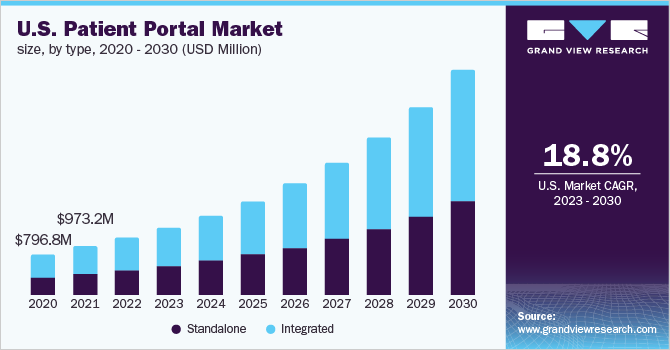
This rapid growth indicates the increasing demand for digital healthcare solutions across hospitals, clinics, and private practices.
Now, the question stands – should you build your patient portal in-house or outsource it to a specialized healthcare web development company?
In our experience of working with healthcare organizations, we’ve seen that outsourcing patient portal development delivers faster results, better compliance, and significant cost savings. In this guide, we’ll walk you through everything you need to know about outsourcing your patient portal project.
Why Is Patient Portal Development Popular?
The healthcare industry is rapidly shifting towards digital solutions, and patient portals are at the center of this transformation. Understanding the current market trends will help you make informed decisions about your portal development strategy.
Patient portals have become an essential part of modern healthcare delivery. Here’s why healthcare organizations are investing heavily in portal development:
- Over 90% of healthcare organizations now offer patient portal access to their patients [Source – TechTarget]
- Systematic reviews published in the Journal of Medical Internet Research show that patient portal adoption is consistently associated with improved patient–provider communication, better health status awareness, and higher medication adherence—especially among patients managing chronic conditions. [Source – NIH]
- Multiple peer-reviewed studies also indicate that patient portals improve appointment adherence, reduce missed visits, and enhance preventive health behaviors, although the overall impact on healthcare utilization and operational efficiency varies by clinical context and implementation quality. [Source – NIH]
With such strong market demand, it’s clear that investing in a patient portal is no longer optional, it’s a necessity for healthcare organizations looking to stay competitive.
What is Patient Portal Development Outsourcing?
Patient portal development outsourcing means hiring an external software development company to design, develop, and maintain your patient portal solution. Instead of building an in-house team, you partner with specialists who already have experience in healthcare software development.
This approach gives you access to:
- Skilled developers with healthcare domain knowledge
- Pre-built compliance frameworks for HIPAA and HITECH
- Faster development timelines
- Cost-effective solutions without compromising quality
In simple terms, outsourcing allows you to leverage external expertise while focusing on what you do best, providing quality patient care. Now, let’s explore the key benefits of choosing this approach.
6 Benefits of Outsourcing Patient Portal Development
Outsourcing your patient portal development comes with numerous advantages that can significantly impact your organization’s efficiency and bottom line. Here are the six most important benefits you should consider.
1. Reduces development cost
Building a patient portal in-house requires significant investment. You’ll need to hire specialized healthcare web developers, invest in infrastructure, and bear ongoing operational costs.
In-house web portal development costs include:
- Recruiting costs: $15,000-$30,000 per developer
- Annual salaries: $80,000-$150,000+ for healthcare IT specialists
- Benefits, training, and infrastructure expenses
- Ongoing costs even during non-development periods
When you outsource patient portal development services, you pay only for the development work. There’s no need to maintain a permanent team. In our experience, healthcare organizations save 40-60% on patient portal development costs by choosing the right outsourcing patient portal development partner.
The cost savings alone make outsourcing an attractive option, but there’s more to consider.
2. Access to healthcare IT expertise
Patient portal development isn’t like building a regular web application. It requires specialized knowledge that’s hard to find and expensive to maintain in-house.
Specialized knowledge areas include:
- Healthcare workflows and clinical processes
- Interoperability standards (HL7, FHIR)
- EHR/EMR integrations (Epic, Cerner, Allscripts)
- Medical data standards and terminologies
- Regulatory compliance requirements
Finding developers with this skillset in-house is challenging and expensive. When you outsource to a healthcare software development company, you get immediate access to teams that have already built similar solutions.
This expertise translates into better quality software and fewer costly mistakes during development.
3. Faster time-to-market
Time is critical in healthcare. The longer you take to launch your patient portal, the more you fall behind competitors and miss opportunities to improve patient engagement.
Experienced outsourcing partners offer:
- Pre-built components for common portal features
- Established development processes optimized for healthcare projects
- Scalable teams that can ramp up quickly
- Parallel development capabilities across multiple features
What might take an in-house team 12-18 months to build can often be delivered in 6-9 months by a specialized outsourcing partner.
Speed to market can be a significant competitive advantage in today’s fast-moving healthcare landscape.
4. Guaranteed regulatory compliance
Healthcare software must comply with strict regulations. Non-compliance can result in heavy fines, legal issues, and damage to your organization’s reputation.
| Regulation | What It Covers |
|---|---|
| HIPAA | Protected Health Information (PHI) security |
| HITECH | Electronic health record standards |
| GDPR | Data protection for EU patients |
| FDA | Medical device software guidelines |
| SOC 2 | Security and availability controls |
Reputable outsourcing vendors maintain these certifications and build compliance into their development processes from day one. This reduces your regulatory risk significantly.
With compliance handled by experts, you can focus on your core healthcare operations without worrying about regulatory pitfalls.
5. Scalability and flexibility
Healthcare needs change over time. Your patient portal should be able to grow with your organization without requiring a complete rebuild.
Outsourcing provides flexibility to:
- Scale development resources based on project phases
- Add specialized skills (security experts, UX designers) as needed
- Adjust project scope without long-term hiring commitments
- Get flexible post-launch support and maintenance
This flexibility is especially valuable for healthcare organizations that experience seasonal fluctuations or rapid growth.
6. Focus on Core Healthcare Operations
Your primary focus should be patient care, not IT management. Developing software in-house diverts leadership attention from clinical excellence to technical complexities.
When you outsource, you can:
- Concentrate on improving patient outcomes
- Expand your healthcare services
- Train your medical staff
- Leave technical challenges to the experts
By letting specialists handle your portal development, your team can focus entirely on delivering exceptional patient care.
These six benefits make a compelling case for outsourcing. But before you start, you need to decide who to outsource to – freelancers or a development company.
Looking to Build a HIPAA-Compliant Patient Portal?
Partner with experienced healthcare software developers who understand compliance, security, and EHR integrations.
Freelance Developers vs. Patient Portal Development Company: A Detailed Comparison
When outsourcing, you have two main options – hire freelance developers or partner with a development company. Each has its pros and cons, and choosing the right one depends on your specific needs.
Let’s compare both options across key criteria:
| Criteria | Freelance Developers | Development Company |
|---|---|---|
| Hourly Rate | $25-$75/hour | $50-$150/hour |
| Healthcare Expertise | Limited | Specialized teams available |
| HIPAA Compliance | Rarely certified | Pre-built compliance frameworks |
| Team Size | Single resource | Full team (developers, designers, QA, PM) |
| Reliability | Single point of failure | Backup resources available |
| Long-term Support | Uncertain | Dedicated maintenance agreements |
| Security Practices | Varies | Enterprise-grade security |
| EHR Integration Experience | Rare | Common |
Our recommendation: For patient portal development, we strongly recommend partnering with a development company that has healthcare experience. The compliance requirements, integration complexity, and sensitive nature of patient data make it risky to work with freelancers.
Now that you know who to work with, let’s look at the step-by-step web portal development process before outsourcing your patient portal project.
5-Step Process to Outsource Patient Portal Development
Successfully outsourcing your patient portal requires careful planning and execution. Following a structured process will help you avoid common pitfalls and ensure a smooth development journey.
Here’s a step-by-step process to help you outsource your patient portal project successfully:
Step 1: Define your project requirements
Before you start looking for vendors, document your requirements clearly. A well-defined requirements document saves time and prevents misunderstandings later.
Key things to define:
- Core features needed (scheduling, messaging, records access, payments)
- Integration requirements (existing EHR/EMR systems, labs, pharmacies)
- User types (patients, providers, administrators)
- Compliance requirements specific to your organization
- Budget range and timeline expectations
- Post-launch support needs
Taking time to define requirements upfront will make the entire process smoother and more efficient.
Step 2: Research and shortlist vendors
Once you have clear requirements, start researching potential outsourcing partners. Look for companies that specialize in healthcare software development.
What to look for:
- Portfolio of patient portal projects
- HIPAA compliance certification
- Experience with your EHR system (Epic, Cerner, etc.)
- Positive client testimonials from healthcare organizations
- Transparent communication practices
- Appropriate team size for your project
Create a shortlist of 3-5 vendors that meet your criteria for detailed evaluation.
Step 3: Evaluate technical capabilities
Once you have a shortlist, assess each vendor’s technical capabilities in depth. This step is crucial for ensuring they can deliver what you need.
Evaluate them on:
- Technology stack alignment with your infrastructure
- Interoperability expertise (FHIR, HL7, API development)
- Security practices (encryption, access controls, audit logging)
- Mobile development capabilities
- UI/UX design focused on patient accessibility
- Testing and QA processes
Request technical demonstrations or proof-of-concept projects if needed.
Step 4: Conduct due diligence
Before signing any contract, do your homework. Due diligence protects you from potential risks and ensures you’re making the right choice.
Due diligence checklist:
- Request and contact client references
- Review case studies of similar projects
- Verify security certifications and compliance audits
- Understand their data handling procedures
- Clarify IP ownership and code ownership terms
- Discuss disaster recovery and business continuity
Don’t skip this step – thorough due diligence can save you from costly mistakes.
Step 5: Structure the engagement
Set clear expectations from the start. A well-structured engagement agreement protects both parties and ensures smooth collaboration.
Define terms for:
- Project milestones and deliverables
- Communication frequency and channels
- Change request procedures
- Quality assurance checkpoints
- Acceptance criteria for each phase
- Post-launch support and maintenance
With a solid engagement structure in place, you’re ready to begin development with confidence.
Following these five steps will significantly increase your chances of a successful outsourcing engagement. Next, let’s look at some of the top companies you can consider.
5 Top Patient Portal Development Companies
Choosing the right web development partner is critical to your project’s success. Here are some reputable companies that specialize in healthcare software development.
| Company | Team Size | Hourly Rate | Key Services | Location |
|---|---|---|---|---|
| Monocubed | 50+ | $25-$49 | Custom patient portals, EHR integration, HIPAA compliance | India |
| Intellectsoft | 300+ | $50-$99 | Healthcare apps, patient engagement platforms | USA |
| Belitsoft | 250+ | $25-$49 | Medical software, telemedicine solutions | Eastern Europe |
| Savvycom | 300+ | $25-$49 | Healthcare mobile apps, patient portals | Vietnam |
| Glorium Technologies | 100+ | $50-$99 | EHR systems, patient management software | USA/Ukraine |
Note: Rates and team sizes are approximate and may vary based on project requirements.
Research each company thoroughly and choose one that aligns with your specific needs, budget, and project goals. Now, let’s discuss what features your patient portal should include.
Key Features to Include in Your Patient Portal: Divided Into 3 Categories
A successful patient portal delivers value for patients, healthcare providers, and administrators alike. When planning your portal with an outsourcing partner, ensure to include these essential features of a web portal tailored to your organization’s goals.
1. Patient-facing features
These are the features your patients will interact with daily:
- Secure Login – Multi-factor authentication for patient accounts
- Health Records Access – View medical history, diagnoses, and treatment plans
- Lab Results – Access test results with historical trends
- Appointment Scheduling – Book, reschedule, or cancel appointments online
- Secure Messaging – Communicate directly with the care team
- Prescription Refills – Request medication refills digitally
- Bill Pay – View and pay medical bills online
- Telehealth Integration – Join virtual consultations
- Health Education – Access educational resources and care instructions
- Mobile Access – Native iOS and Android apps
2. Provider-Facing Features
These features help your healthcare staff work more efficiently:
- Patient communication dashboard
- Appointment management tools
- Clinical documentation capabilities
- Order entry and tracking
- Care team collaboration features
3. Administrative Features
These features help your admin team manage the portal effectively:
- User management and access controls
- Analytics and reporting dashboards
- Content management system
- Integration monitoring tools
- Comprehensive audit logging
Prioritize features based on your organization’s needs and budget. You can always add more features in future phases.
Elevate Your Patient Care with a Custom Portal
Discover how a secure, intuitive portal can streamline operations and boost engagement.
Before you start patient portal development, it’s crucial to ensure your outsourcing partner fully understands your needs, technical requirements, and compliance expectations. Asking the right questions early can save time, prevent costly mistakes, and help you select a partner who aligns with your project goals.
Questions to Ask Your Outsourcing Patient Portal Development Partner
Asking the right questions helps you evaluate potential vendors and ensures you choose the best partner for your project. Here are the key questions to ask during your vendor evaluation process.
Technical questions
These questions assess the vendor’s technical capabilities:
- What experience do you have with healthcare interoperability standards like HL7 FHIR?
- How do you handle EHR/EMR integrations?
- What is your approach to ensuring HIPAA compliance throughout development?
- How do you secure patient data at rest and in transit?
- What testing methodologies do you use for healthcare applications?
Process questions
These questions help you understand how the vendor works:
- How do you structure your development sprints and client communication?
- What is your approach to change management during development?
- How do you handle knowledge transfer at project completion?
- What does your post-launch support model look like?
- Can you provide references from current healthcare clients?
Business Questions
These questions cover the commercial aspects of the engagement:
- What are your standard contract terms for healthcare projects?
- How do you handle data breaches or security incidents?
- What insurance coverage do you carry?
- How do you ensure business continuity if key team members leave?
- What is your pricing model – fixed price, time & materials, or dedicated team?
Whether you want to build a patient portal mvp or a complex patient portal with dashboards, the answers to these questions will give you a clear picture of whether the vendor is the right fit for your project.
How Much Does it Cost to Develop a Patient Portal?
Outsourcing a patient portal development project can cost anywhere from $50,000 for a basic solution to $400,000 or more for an enterprise-level portal with advanced features and integrations. The final patient portal development cost depends on portal complexity, features, vendor location, and ongoing maintenance.
Cost by complexity level
| Portal Type | Features Included | Estimated Cost | Timeline |
|---|---|---|---|
| Basic | Secure login, records view, messaging, appointment scheduling | $50,000 – $100,000 | 3–5 months |
| Standard | Basic + bill pay, prescription refills, telehealth | $100,000 – $200,000 | 5–8 months |
| Advanced | Standard + AI features, analytics, multiple system integrations | $200,000 – $400,000 | 8–12 months |
| Enterprise | Fully custom solution with extensive integrations | $400,000+ | 12+ months |
Cost by vendor location
| Region | Hourly Rate |
|---|---|
| United States | $100 – $200/hr |
| Western Europe | $80 – $150/hr |
| Eastern Europe | $40 – $80/hr |
| India | $25 – $50/hr |
| Latin America | $35 – $70/hr |
Additional patient portal development costs to consider
Beyond core development, these items may affect your budget:
- Advanced features: Features such as analytics dashboards, reporting tools, or custom workflows can increase development effort.
- Third-party integrations: Integration with existing web services or internal systems (e.g., payment gateways or appointment scheduling tools) may incur additional costs.
- Ongoing support and updates: Maintaining your portal, fixing bugs, and implementing minor enhancements ensures it remains functional and secure.
- Hosting and infrastructure: Cloud hosting, SSL certificates, and server maintenance costs are necessary to keep the portal online and performant.
Focusing on these relevant costs helps you plan an accurate budget for web-based patient portal development and avoid unnecessary assumptions.
Red Flags to Consider While Outsourcing Patient Portal Development Service Providers
Outsourcing a patient portal project can streamline development and reduce costs, but selecting the wrong vendor can lead to delays, security issues, or a product that fails to meet requirements. Here are the key red flags to watch for — and how Monocubed addresses each to ensure a successful project.
Red flag 1: Lack of EHR integration experience
Warning: The vendor has no proven experience with major EHR systems or cannot provide case studies for integrations.
Solution: Monocubed has successfully integrated patient portals with leading EHR platforms, including Epic, Cerner, Allscripts, and Meditech. Their documented projects demonstrate seamless, real-time data exchange with minimal disruption.
Red flag 2: Weak data security practices
Warning: The vendor does not follow HIPAA compliance, SOC 2 standards, or refuses to sign a Business Associate Agreement (BAA).
Solution: Security is central to Monocubed’s development process. They implement strict access controls, encryption, and HIPAA-compliant workflows, and all projects are backed by signed BAAs to protect patient data.
Red flag 3: Poor communication and project management
Warning: The vendor lacks a dedicated project manager, has unclear communication protocols, or misses regular updates.
Solution: Monocubed assigns dedicated project managers, maintains structured communication channels, and uses tools like Jira and Asana to ensure transparency. Regular video calls keep clients aligned at every stage.
Red flag 4: Undefined scope or change management
Warning: The vendor does not clearly document requirements, manage changes, or provide a structured workflow for scope updates.
Solution: Monocubed follows agile methodologies with clearly defined sprints, documented requirements, and transparent change request procedures that include cost implications, reducing surprises during development.
Red flag 5: Lack of quality assurance and testing
Warning: The vendor has no QA process, automated testing, or user acceptance testing (UAT), increasing the risk of bugs, security gaps, or poor user experience.
Solution: Monocubed implements automated testing, independent security audits, and UAT phases to ensure the portal meets healthcare standards, functional requirements, and user expectations.
By identifying these red flags early and choosing a partner like Monocubed, healthcare organizations can avoid common pitfalls, ensure compliance, and build a secure, user-friendly patient portal that meets both provider and patient needs.
Choose the Right Partner for Your Patient Portal Development
Outsourcing patient portal development can help healthcare organizations save time, reduce costs, and access specialized expertise. However, success depends on choosing the right partner and being aware of potential challenges or red flags.
By clearly defining your requirements, prioritizing essential features, and evaluating vendors for experience, security, communication, and quality assurance, you can ensure your portal delivers a secure, user-friendly, and fully compliant experience for both patients and providers.
Partnering with an experienced web portal development agency like Monocubed allows you to leverage proven development practices, seamless EHR integrations, and patient-centric design, minimizing risks while accelerating project delivery.
Take the first step toward a modern, efficient, and engaging patient portal today.
Transform Patient Care Through Our Portal Development Technology
Modernize your patient experience with a portal built for accessibility, security, and growth. Partner with Monocubed and turn your digital health vision into reality.
Frequently Asked Questions
-
Is it safe to outsource patient portal development given HIPAA requirements?
Yes, when done correctly. Reputable outsourcing vendors maintain HIPAA compliance, sign Business Associate Agreements (BAAs), and implement enterprise-grade security measures. Make sure your vendor has documented compliance programs and conducts regular security audits.
-
How long does it take to develop a patient portal?
It depends on the complexity. A basic portal with core features takes 3-5 months. A comprehensive solution with multiple integrations and advanced features may require 8-12 months. Outsourcing typically accelerates timelines compared to in-house development.
-
Should we build a custom portal or use a white-label solution?
White-label solutions offer faster deployment and lower initial costs but limited customization. Custom development provides tailored functionality and competitive differentiation but requires more investment. Consider your unique requirements, budget, and long-term strategy when deciding.
-
What integrations are essential for a patient portal?
Critical integrations include your EHR/EMR system (Epic, Cerner, Allscripts), laboratory information systems, pharmacy systems, payment processors, and telehealth platforms. Your outsourcing partner should have experience with healthcare standards like HL7 FHIR.
-
How do we ensure the outsourcing vendor maintains confidentiality?
Sign comprehensive NDAs, require BAAs for HIPAA compliance, limit access to production patient data, conduct vendor security assessments, and include confidentiality clauses with penalties in contracts.
-
What happens after the portal is launched?
Post-launch support is essential. Discuss maintenance agreements covering bug fixes, security updates, performance monitoring, and feature enhancements. Ensure proper knowledge transfer so your team can handle basic operations.
-
Can we outsource only parts of the development?
Yes, partial outsourcing is common. You might outsource specific components like mobile apps or integrations while handling core development in-house. This hybrid approach lets you leverage external expertise while maintaining internal control.

 All our projects are secured by NDA